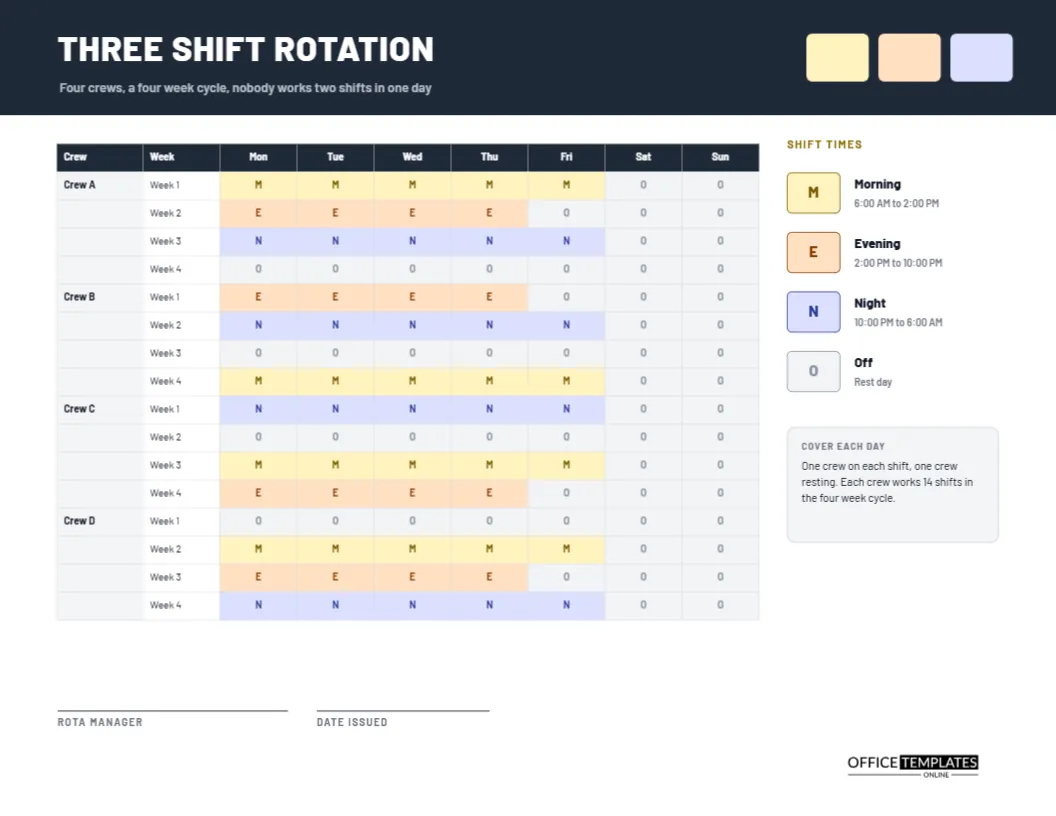
Factories, plants, warehouses and emergency services run around the clock, and the roster behind them is a puzzle: three shifts, seven days, and a team that needs rest. The classic solution is a rotation, where crews move through morning, evening, night, and rest in a fixed order. Once the pattern is set, it repeats without rewriting. This landscape roster shows four crews through a four-week cycle, so you can see the whole pattern at once.
Charcoal Header With Three Pale Shift Tiles
A charcoal band holds the title THREE SHIFT ROTATION in heavy spaced Barlow capitals, with a line beneath it saying four crews, a four-week cycle, nobody works two shifts in one day. To the right sit three small tiles in yellow, orange and blue, the colours of morning, evening and night. They preview the key and give the page a clear visual identity.
Four Crews, Four Weeks, Seven Days
The grid has sixteen rows, four for each crew, one per week of the cycle. Seven-day columns run from Monday to Sunday. Every cell holds a letter: M, E, N, or O. The crew name appears only in the first row of each block, with the others left blank in a tint, so each crew reads as a group.
How the Pattern Moves
| Crew | Week 1 | Week 2 | Week 3 | Week 4 |
|---|---|---|---|---|
| Crew A | Morning five days | Evening four days | Night five days | Rest week |
| Crew B | Evening four days | Night five days | Rest week | Morning five days |
| Crew C | Night five days | Rest week | Morning five days | Evening four days |
| Crew D | Rest week | Morning five days | Evening four days | Night five days |
Each crew works fourteen shifts in the cycle, then repeats from the start.
Always One Crew on Every Shift
In any week of the cycle, one crew is on mornings, one on evenings, one on nights, and one resting. This is the point of the design. Coverage never changes from week to week, only who provides it. The note in the box on the right says exactly that, and it is what you can promise your customer or manager.
The Shift Times Key
A key on the right lists the shift times: morning 6:00 AM to 2:00 PM, evening 2:00 PM to 10:00 PM, and night 10:00 PM to 6:00 AM, plus the rest day. Each is a coloured tile with a large letter and a short label. Replace the times with your own, such as twelve-hour shifts, and the grid still works.
Why Rotations Are Popular
Rotations are predictable. Staff know their pattern months ahead, can plan family life and holidays around the rest weeks, and do not have to wait for a weekly roster. Managers save time because there is nothing to rewrite. The trade-off is flexibility, so you need a separate method for absence and cover, such as an overtime list or a swap form.
Handling Absence in a Fixed Rotation
When someone is off sick, the cover usually comes from the resting crew or from voluntary overtime. Record the cover on the roster in the notes or in a separate log. Keeping the rotation unchanged and writing exceptions beside it keeps the pattern clean and the paperwork honest.
Starting Dates and Crew Sizes
The page shows a repeating pattern, not specific dates. Write the cycle start date beside the rota manager signature, and show each crew’s current week. For a larger site, you can have several copies of the roster, one for each department, each with its own crew names and sizes.
Fatigue and Safety Considerations
Night work is hard on the body. Good rotations move forward, from morning to evening to night, rather than backward, and give a rest day or more between changes. Always follow the rules and advice that apply to your industry. This page shows a pattern; it does not decide whether the pattern is safe for your site.
Explaining the Pattern to New Staff
New starters often find a four-week cycle confusing. Hand them the page with their crew highlighted and a calendar showing the current week. Walk through one cycle aloud. A pattern that takes five minutes to explain is easier to follow than one hidden in a dense spreadsheet.
Editing Crews, Codes and Patterns
Every cell is editable. To change a pattern, retype the letters in a crew’s row. To rename the crews, edit the first cell of each block. For a two-shift site, delete the night code and adjust the letters. The table is a real Table object, so fonts, fills and widths can be changed.
Printing and Posting the Rotation Pattern
US Letter landscape. Print one copy for the notice board and one for each shift supervisor. The colours are strong, but each cell has a letter, so black and white copies remain readable.
Planning Handover Between Crews
When one crew finishes and the next begins, important information must pass between them. Build ten or fifteen minutes of overlap into your shift times or agree on a written handover note. A rotation only works smoothly if every crew leaves the plant, the ward, or the depot in a state that the next crew can pick up.
Reviewing the Rotation After a Full Cycle
After one complete four-week cycle, ask the crews what worked. Look at absences, overtime, and complaints by week. If the move from evening to night is causing trouble, adjust the pattern at the next cycle. A rotation should be tested, not simply inherited.
Choosing Between a Rotation and a Weekly Roster
A fixed rotation suits steady operations where demand is the same every week. If demand swings, a weekly schedule with flexible shifts may serve you better, and you can still borrow the rotation as a starting template.
Rotation Roster Questions
Can I use five crews?
Yes. Add rows and decide how the extra crew fits into the cycle.
Does the roster include public holidays?
No. Record holiday cover in the notes or a separate list.
Is the pattern legal for every workplace?
That depends on local rules. Check them before adopting a rotation.