A Page for Students Who Write to Universities and Teachers
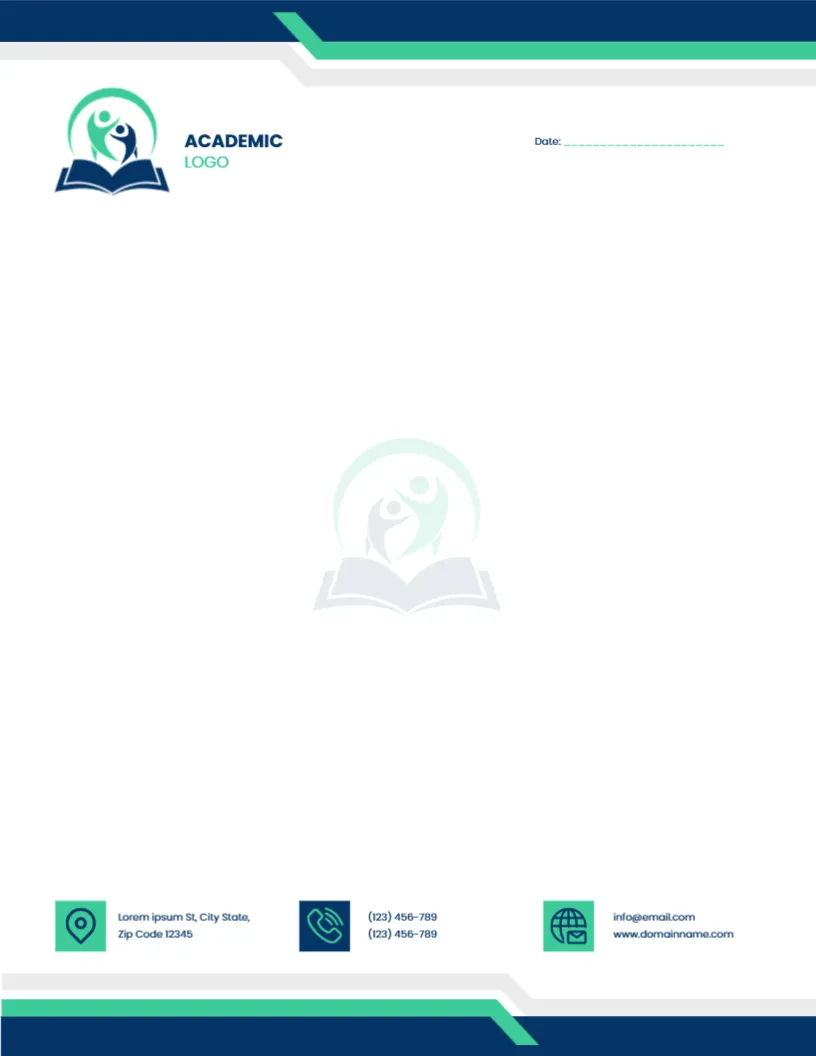
Students write more formal letters than most people realise: applications, scholarship requests, extension requests, internship enquiries and appeals. A neat page signals that the writer is serious. This letterhead uses navy and green shapes, a small book logo and the placeholder ACADEMIC LOGO. It suits high school students, university applicants, graduate students and researchers.
Navy and Green Shapes
The page is 8.5 x 11 inches, portrait, one page. Navy and green shapes sit along the top and foot, in a style familiar from university prospectuses. Navy is a formal colour, and green feels like growth. The shapes are graphics and cannot be recoloured with the text tools.
The Book Logo and Its Placeholder
An open book icon sits in the header, next to the words ACADEMIC and LOGO. These are placeholders. Replace the text with your name, or with a short line such as Applicant for Fall Admission. You can swap the book with a school crest or your own monogram by choosing Replace Image, but only use a real crest if you have permission.
Contact Lines for Admissions Offices
The foot lists an address, two phone numbers, an email and a website in placeholder text. A student may use a home address, a mobile number and a school or personal email. Choose an email address that looks serious, ideally some combination of your first and last name.
The Date and a Subject Line
A Date line sits near the top. Below it, add a subject line in bold, for example Request for an extension on Assignment 2. A clear subject helps a busy teacher or administrator understand your request before opening the body.
Academic Letters Worth Sending on This Page
- Scholarship and financial aid requests.
- Requests for a deadline extension with a reason.
- Internship and research assistant enquiries.
- Letters asking a teacher for a reference.
- Appeals about a grade or a decision, written politely.
Tone and Structure
Address the reader by title and surname, such as Dear Professor Lee. Put your request in the first paragraph, give your reasons in the second and close with thanks. Keep the letter on one page. A calm, respectful tone is more persuasive than a long explanation.
Editing the Template
All text lines can be changed. The shapes and the book are fixed graphics. If your letter must follow a school format, such as a particular address block, type it in the open area and keep the header as it is.
Printing for a School Office
Print on white 90 gsm paper and sign above your typed name. If the letter goes by email, export a PDF with your name in the file name, for example Maria Lopez Extension Request.
Attachments and Follow Up
Academic letters often come with attachments such as a transcript, a certificate or an assignment. Name each attachment in a short list at the end of the letter, and use clear file names. If you do not hear back in a week, send a short polite follow up and mention the original date.
For a household page, see the household correspondence letterhead. For community work, try the volunteer letterhead. For a general page, see the generic design letterhead. More are in letterheads.