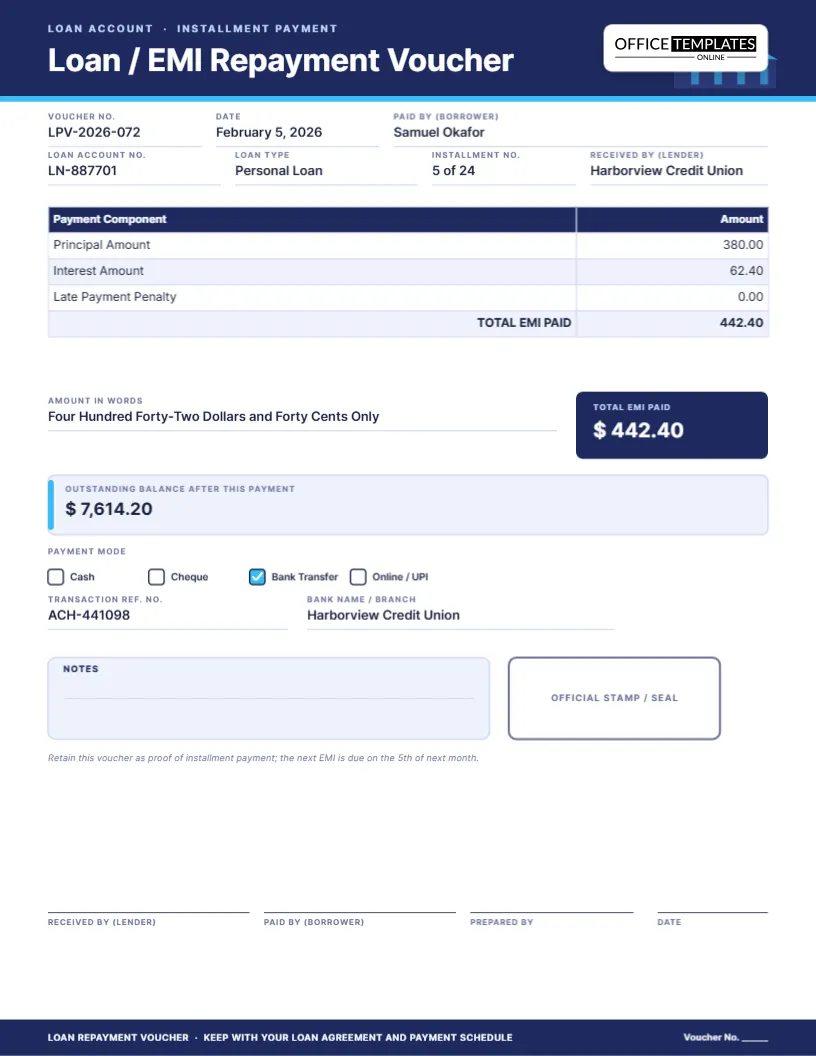
A loan repayment is more than a single number leaving an account – it is a principal amount, an interest amount, sometimes a penalty, and a running balance that should get smaller with every installment. A bank statement line rarely shows that breakdown. This loan and EMI repayment voucher does, giving a lender and a borrower a shared, readable record of exactly what each installment covered and what remains outstanding afterward.
It works for a formal loan between a bank or credit union and a borrower, but just as well for a private or family loan where no automated statement exists at all – often the situation where a clear paper trail matters most.
What each voucher shows
- Voucher number, date and the borrower making the payment
- Loan account number, loan type, installment number (such as “5 of 24”) and the lender receiving payment
- A payment-component table splitting principal, interest and any late penalty
- The total EMI paid this cycle, and a separate tile for the outstanding balance after this payment
- Payment method, transaction reference, notes, an official stamp area and signature lines
A closer look at the design
One page, US Letter portrait, 8.5 x 11 inches, in an indigo and sky-blue palette with a small bank-facade motif in the header. Inter keeps every figure and label sharp and easy to scan, which matters on a document people will check every month for the life of a loan. The outstanding-balance tile sits apart from the payment-component table so it cannot be mistaken for part of this month’s payment.
Why separate the principal and interest
Two installments of the same total amount can represent very different progress on a loan, depending on how much of each is interest. Early in most loans, interest makes up the larger share; later, principal dominates. Recording the split on every voucher lets a borrower actually watch that shift happen, and gives both sides a document that matches an amortization schedule line for line if one is ever needed for a dispute or an early-payoff calculation.
Where this template fits
- Credit unions and community lenders issuing manual installment receipts
- Private lenders and family members formalizing a personal loan
- Small businesses repaying a vendor financing or equipment loan
- Borrowers who want their own record independent of the lender’s statement
- Peer-to-peer or informal lending arrangements without dedicated software
- Landlords or brokers documenting a tenant or client’s structured repayment plan
- Anyone managing a loan through a spreadsheet who wants a proper receipt for each payment
Notes worth recording
- Whether this installment was paid on time, early or late, and any penalty applied
- A note if an extra payment was made toward principal outside the regular schedule
- Confirmation of the next due date and the expected next installment number
- Any agreed change to the repayment schedule going forward
Setting up the voucher
- Update the voucher number, date and borrower name.
- Fill in the loan account number, loan type, installment number and lender name.
- Edit the payment-component table with this installment’s principal, interest and any penalty.
- Update the total EMI paid and the outstanding balance tile after this payment.
- Check the payment method used, and fill in the transaction and bank reference fields.
- Add any relevant notes about the schedule or an early payment.
- Download as a PDF to keep alongside the loan agreement, or PNG/JPG for a quick share.
Tips for tracking loan repayments
- Keep every voucher in one folder per loan so a full repayment history is available in one place
- Cross-check the outstanding balance tile against the lender’s own statement periodically
- Record penalties honestly, even when small, so the loan’s true cost stays visible over time
- Note any extra principal payments clearly, since they change the remaining schedule
- Keep vouchers until the loan is fully repaid and for your usual financial record-keeping period afterward
- For a private loan, agree with the other side up front on how missed or late installments will be recorded, so there is no confusion when it eventually happens
Printing an installment receipt
The page is US Letter, 8.5 x 11 inches, and prints at full size. A PDF export works well for emailing a receipt to a borrower, or for a lender’s own filing system; a private or family loan arrangement in particular benefits from a printed copy signed by both sides.
Sharing between lender and borrower
For an informal loan, it helps for both parties to keep a copy of every voucher, so there is never a disagreement later about how many installments were paid or what the current balance is. Signing both the “received by” and “paid by” lines at the time of payment, even for a family loan, avoids that entirely.
Loan voucher questions, answered
Do I need to know the exact interest calculation to fill this in?
You need the split for this installment, usually available from the lender’s amortization schedule; the voucher records it rather than calculating it.
Can I use this for a loan with no fixed installment schedule?
Yes, just note the installment number as “N/A” or use the notes box to describe the arrangement.
What if a payment is late and a penalty applies?
Add the penalty to the payment-component table so the total EMI paid reflects the full amount, including the penalty.
Is the outstanding balance calculated automatically?
No, it is a fillable field; update it from your amortization schedule or running total after each payment.
Can I use this for a business loan as well as a personal one?
Yes, the fields work for either; just adjust the loan type field to describe the actual facility.
Should both the lender and borrower keep a copy?
Yes, especially for informal or private loans where no other statement exists; a shared, signed record protects both sides.
Can I use this to track a loan I made to someone else?
Yes, simply fill in the “received by” line as yourself and the “paid by” line as the borrower; the same fields work from either side of the loan.
Open the loan repayment voucher template, record this installment’s principal, interest and balance, and keep a clear paper trail for the life of the loan.