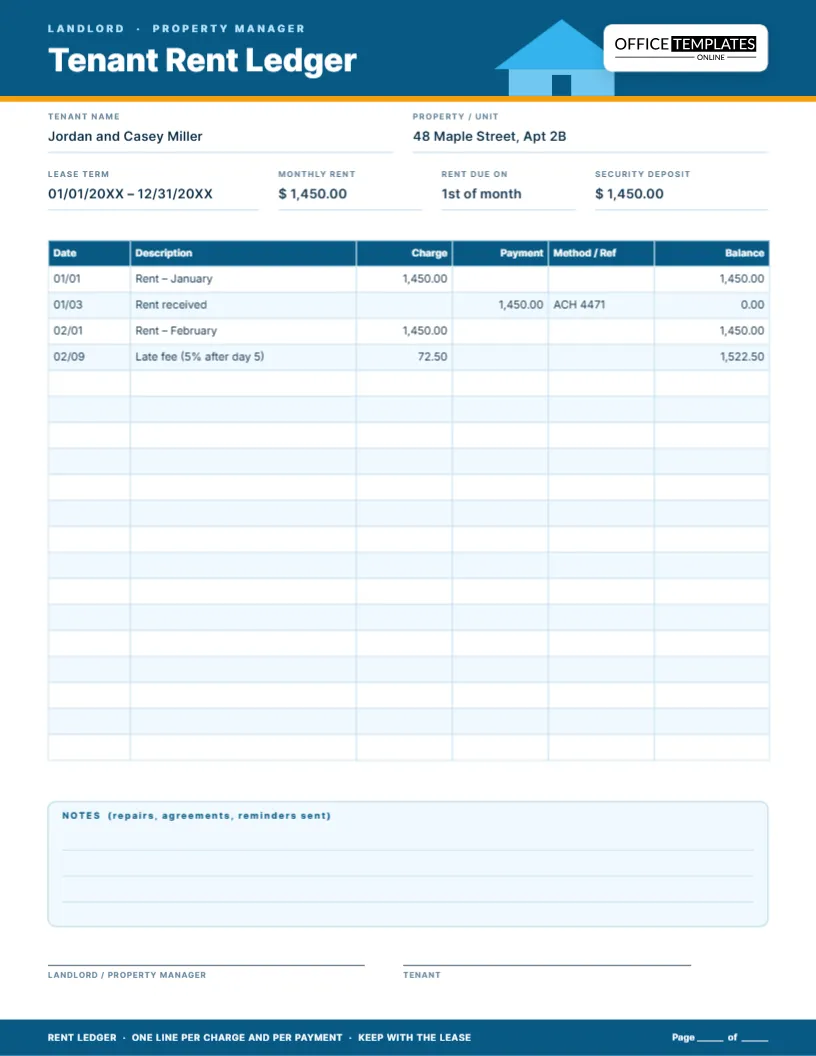
Ask a landlord which document they wish they had kept more carefully, and many will name the rent record. Rent is paid by transfer, by cheque, sometimes in cash, on the first of the month or the fifth. Late fees are applied, waived or forgotten. A year later, the tenant says they paid in March and the landlord is sure they did not. A tenant rent ledger settles that argument in ten seconds. This blue template is a one-page record for each tenancy, with every charge and payment in date order and a balance that always shows what is owed.
Whose page is this?
The ledger is a working record for anyone who collects rent: private landlords with one flat, small property managers with a dozen, community housing groups and family members who look after a relative’s rental. It is also useful for tenants, who can ask for a copy at the end of a lease as proof of their payment history.
Six facts about the tenancy, at the top
Before the table there are two rows of fields that capture the agreement.
- Tenant name, including every adult named on the lease.
- Property / unit, the address and unit number.
- Lease term, the start and end dates.
- Monthly rent, the agreed amount.
- Rent due on, the day of the month payment is expected.
- Security deposit, the amount held at the start of the lease.
Reading the six columns
The table is simple on purpose, so that a page is quick to fill in and easy for a tenant to follow.
- Date of the charge or the payment.
- Description names the item: rent for a given month, a late fee, a utility share or a repair charge.
- Charge raises the balance.
- Payment lowers the balance.
- Method / Ref shows how the money arrived: cheque number, transfer reference, cash receipt.
- Balance is the running amount owed, or zero when the tenant is up to date.
A few months in the life of a ledger
The sample rows show a typical pattern. On 01/01 rent of 1,450.00 is charged, so the balance is 1,450.00. On 01/03 the tenant pays by ACH, and the balance returns to zero. On 02/01 the February rent is charged, and on 02/09 a late fee of 72.50, which is five percent of the rent, is added because payment did not arrive within the grace period, bringing the balance to 1,522.50. Every line has a date and a reason, so a tenant can see exactly how the number was reached.
Late fees without the arguments
Most late fee disputes are about what the lease says and when the fee was added. Writing the fee as its own line, with the words “Late fee” and a short note of the rule, keeps things transparent. Check your lease and local rules, because many places limit the size of a late fee, require a grace period or require written notice. This template is a record-keeping tool, not legal advice, so make sure the rules you apply are the ones that apply where you are.
The notes panel
A ruled box near the bottom is headed Notes (repairs, agreements, reminders sent). It is where the human details go: the date a reminder was sent, a payment plan agreed by email, a repair request, a key returned. Those short notes often matter most when a dispute arises, because they show what was said and when.
Monthly routine for a small landlord
- On the first of each month, add the rent charge and any recurring fee.
- Record every payment the day it arrives, with the method and reference.
- Update the balance after each line.
- If rent is late, send a written reminder and note the date in the notes panel.
- Apply any fee only as the lease permits, and record it as a separate line.
- Give the tenant a copy of the page whenever they ask.
Handling the security deposit
A deposit is not income and normally is not part of the rent balance. It is held for the tenant, and rules on where it must be kept and when it must be returned vary widely. Record the amount in the header as a reminder, and keep the detail of any deductions, receipts and return date in the notes panel or in a separate deposit record.
Customizing the ledger
- Enter the tenant, property, lease dates, rent amount, due day and deposit.
- Delete or overwrite the sample lines with the real charges and payments.
- Add a row for each new charge, or delete extra blank rows.
- Change the blue colours from the toolbar if you want a different look.
- Download as PDF, PNG or JPG for your files or to share with the tenant.
Paper or PDF: keeping it tidy
The sheet is US Letter portrait, 8.5 by 11 inches, with room for 19 lines. A year of monthly rent plus the occasional fee fits comfortably on one page. Print at 100 percent and add it to the tenancy folder with the lease, the inspection report and correspondence, or save the PDF with a name such as 48-maple-street-2b-miller-2026. Two signature lines at the bottom let the landlord and tenant confirm the balance when a lease ends.
Landlord queries, briefly answered
Can I use one ledger for two tenants in the same unit?
Yes, if they share a lease and pay together. List both names in the tenant field.
What if rent changes during the lease?
Edit the monthly rent field and add a note on the date of the change, then charge the new amount from that month on.
Should utilities go on the same page?
If you bill them to the tenant, yes. Add a description such as Water, March, so the charge is easy to see.
Does this work for a commercial lease?
It works well for a simple one. For leases with service charges and indexation, use a separate schedule alongside it.
A clear payment record is fair to landlord and tenant alike. Open the template, add your first tenancy and keep every charge and payment in one place.


