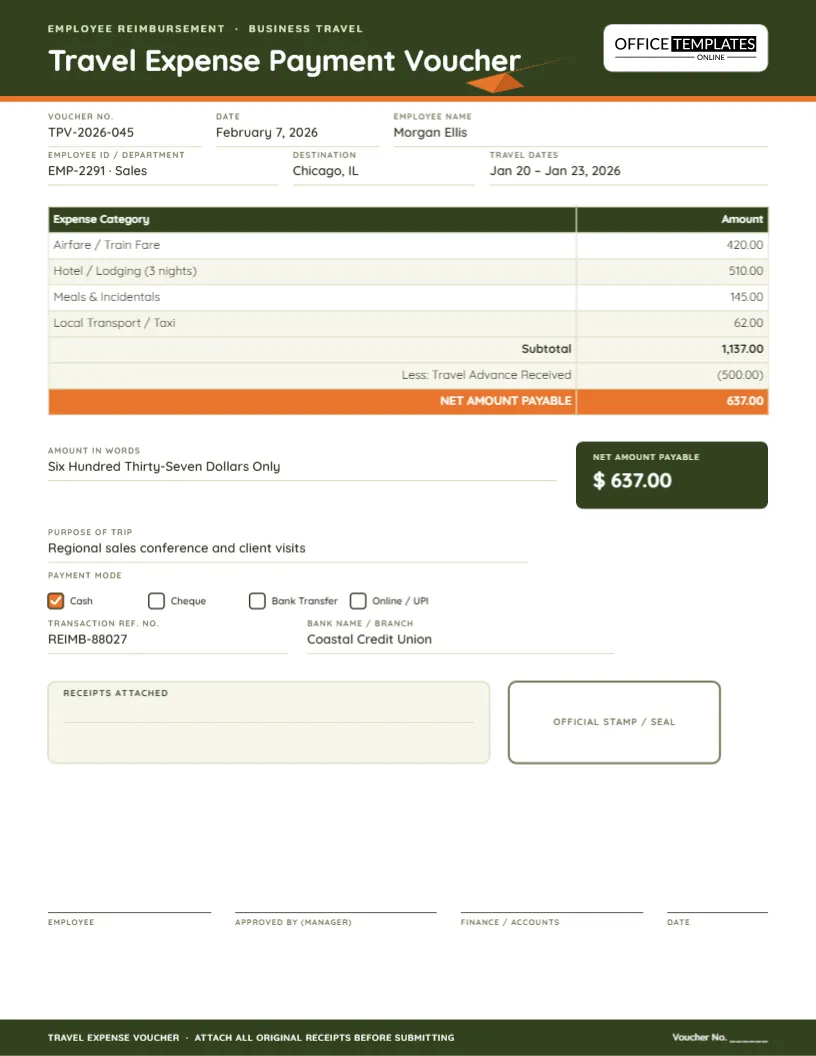
A business trip usually means several separate costs – airfare, a hotel, meals, local transport – that need to be added up, checked against any advance the employee already received, and settled with a final reimbursement. A travel expense payment voucher puts that whole calculation on one page instead of a loose pile of receipts and a follow-up email asking “so how much do I actually owe you?”
The template is built around that exact sequence: list the expenses, subtotal them, subtract any advance already paid out before the trip, and land on a clear net amount – whether that is a reimbursement owed to the employee or, occasionally, a smaller amount owed back to the company if the advance was generous.
What the form covers
- Voucher number, date and the employee being reimbursed
- Employee ID or department, destination and travel dates
- An expense-category table covering airfare or train fare, hotel, meals and local transport
- A subtotal, a travel-advance deduction and a highlighted net amount payable
- The purpose of the trip, payment method, a receipts-attached note, an official stamp area and signature lines
Design at a glance
One page, US Letter portrait, 8.5 x 11 inches, in an olive and burnt-orange palette with a small paper-plane motif, a light touch that says “travel” without leaning on any one destination or transport type. Quicksand keeps the headings friendly and approachable, suited to an internal HR or finance form employees fill out themselves rather than a strictly formal accounting document.
Why separate this from a general expense voucher
Travel expenses have a shape a general reimbursement form usually does not account for cleanly: a pre-trip cash advance that needs to be deducted from the final total, and a natural grouping into a handful of standard categories that make the expense easy to review at a glance rather than as one long undifferentiated list of receipts.
Who this reimbursement form suits
- Employees returning from a business trip and submitting expenses for reimbursement
- HR and finance teams processing travel reimbursements for a whole office
- Sales teams that travel regularly for client visits and conferences
- Small businesses without expense-management software who still need a clear process
- Nonprofits reimbursing volunteers or staff for approved travel
- Freelancers or consultants billing a client for travel costs incurred on their behalf
- Managers approving travel spend before it is settled with finance
Ideas for the purpose-of-trip field
- Client meeting, site visit or contract negotiation
- Conference, trade show or industry event attendance
- Team offsite, training session or company retreat
- Vendor visit or supplier facility inspection
Filling out the form
- Update the voucher number, date and employee name.
- Fill in the employee ID or department, destination and travel dates.
- Edit the expense table rows to match the actual receipts – airfare, hotel, meals, local transport, and any other category.
- Update the subtotal, the advance deduction (or remove that row if no advance was given) and the net amount payable.
- Add the purpose of the trip and check the payment method for the reimbursement itself.
- Fill in the transaction reference and bank fields, and note that receipts are attached.
- Download as a PDF to route for approval, or PNG/JPG for a quick internal share.
Tips for smoother travel reimbursements
- Set a clear policy on what counts as a reimbursable category before the trip, not after
- Require original receipts for every line, and note on the voucher if one is missing and why
- Reimburse advances separately from routine payroll so the two never get confused
- Process travel vouchers promptly; a long delay after a trip is one of the most common employee complaints about expense processes
- Keep a running per-employee file so annual travel spend is easy to summarize at year end
- Agree spending limits per category before travel, especially for hotels and meals, to avoid awkward conversations after the trip
Printing and routing for approval
The page is US Letter, 8.5 x 11 inches, and prints cleanly at full size. Export a PDF to route through an approval chain by email, or keep a PNG or JPG copy for a quick reference alongside scanned receipts in a shared folder.
Approval workflow
A typical flow is: employee fills in the voucher and attaches receipts, a manager signs off in the “Approved by” line, and finance countersigns before releasing payment. Keeping all three steps on one document, rather than in separate emails, makes it much easier to see where a reimbursement is stuck if it is taking longer than expected.
Travel voucher questions, answered
What if there was no travel advance for this trip?
Leave the advance row at zero, or delete it from the table; the subtotal will simply equal the net amount payable.
Can I add a category the table doesn’t already list?
Yes, click into the table and add a row for anything not already covered, such as parking, visa fees or conference registration.
What if the employee owes money back because the advance was too large?
The net amount will come out negative in that case; note in the notes area that this is a repayment owed to the company rather than a reimbursement.
Do I need to attach the original receipts separately?
Yes, this voucher summarizes the expenses; keep the original or scanned receipts attached to the approval email or filed alongside the PDF.
Can this be used for a multi-employee group trip?
It works best per employee; issue one voucher per traveler so each person’s expenses and reimbursement stay clearly separated.
Is this suitable for international travel with multiple currencies?
Yes, just note the currency used for each receipt in the description if expenses were incurred in more than one currency, and convert to your base currency for the totals.
What if a receipt is lost?
Note it in the notes area with the amount and category as best remembered; many companies allow a signed declaration in place of a missing receipt below a small threshold.
Open the travel expense payment voucher, add up the trip’s costs against any advance, and settle the reimbursement with a clear, professional record.