Every construction site, workshop yard and renovation project needs to tell workers and visitors what protective equipment is required before they step past the gate. A clear Hard Hat Area sign Template does that at a glance, and it also shows inspectors, clients and neighbours that the site takes safety seriously. This Hard Hat Area Sign Template combines the familiar language of industrial safety signs, black-and-yellow hazard stripes and a CAUTION header, with a row of blue personal protective equipment symbols and a practical strip for site contact and permit details.
What’s on the Sign
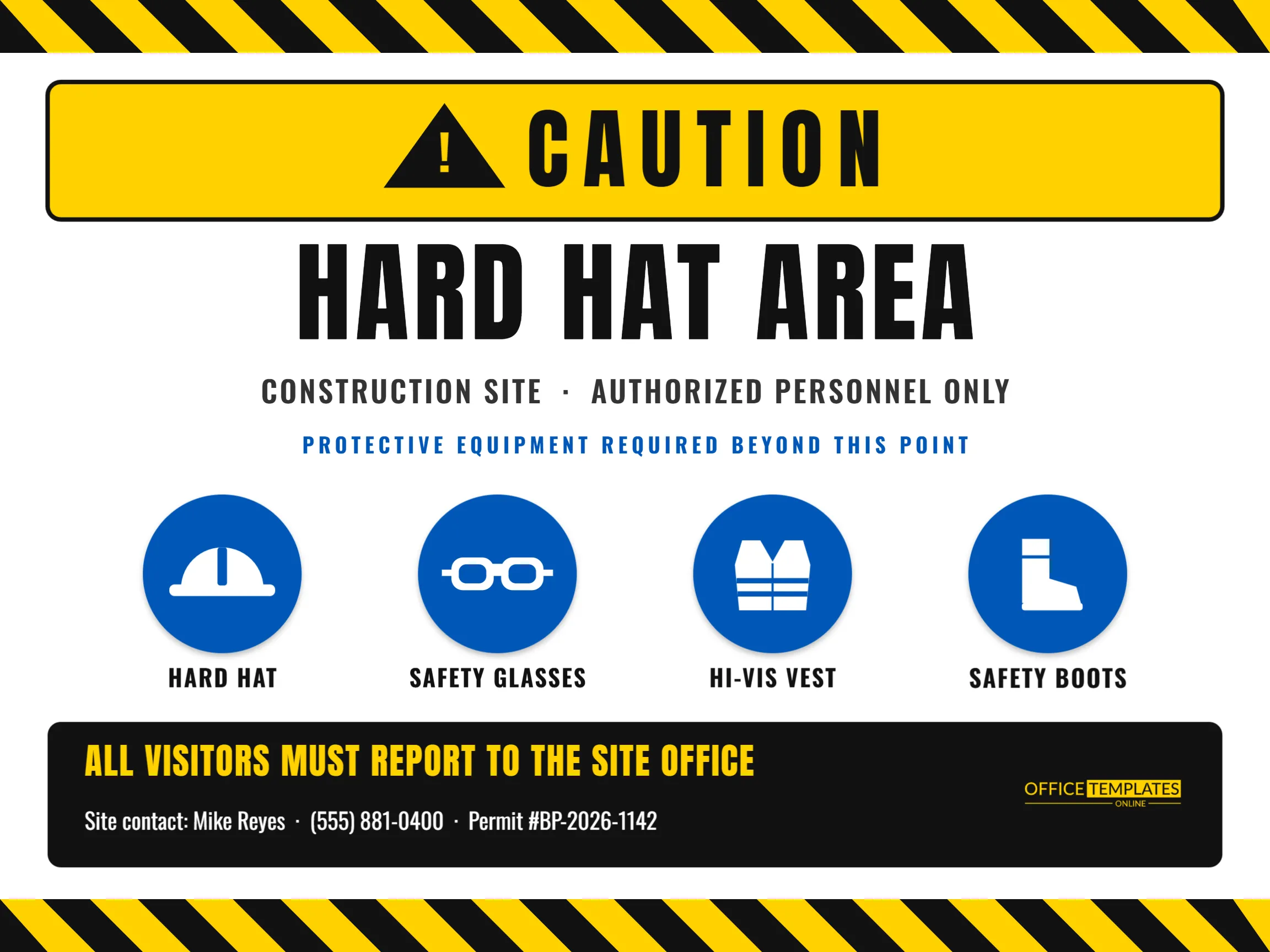
The sign is 24 x 18 inches in landscape, a common size for site-entrance and fence signs that is large enough to read from a vehicle. Bands of diagonal black and yellow hazard stripes run across the top and bottom edges. Beneath the top band, a yellow CAUTION header panel with a thin black outline carries a black warning triangle with an exclamation mark and the word CAUTION in heavy black Anton letters.
The centre reads HARD HAT AREA in very large black capitals, with CONSTRUCTION SITE · AUTHORIZED PERSONNEL ONLY underneath and a blue line announcing that protective equipment is required beyond this point. Four solid blue circles, the colour used for mandatory-action symbols, show white pictograms of a hard hat, safety glasses, a hi-vis vest and safety boots, each labelled below in bold Oswald capitals. A black panel near the bottom says ALL VISITORS MUST REPORT TO THE SITE OFFICE in yellow, followed by the site contact, phone number and permit number in white, with our logo in yellow on the right.
Understanding the Colours
| Colour | Meaning on safety signs | Where it appears here |
|---|---|---|
| Yellow with black | Caution: a potential hazard | Header panel and hazard stripes |
| Blue with white symbol | Mandatory action: you must do this | PPE discs |
| Black with white or yellow text | Information and instructions | Visitor and contact strip |
These conventions come from widely used safety-sign standards in the US and internationally. Keeping them makes the sign instantly understood by workers from different backgrounds and trades.
Adapting the PPE Row
Different sites require different equipment. Each blue disc is a plain circle, the white pictogram on it is its own small group, and each label is a separate text box, so you can change the row to match your site:
- Add hearing protection near demolition, cutting, or heavy machinery.
- Add gloves for handling materials, glass, or chemicals.
- Add a respirator or dust mask where there is dust, silica or paint spray.
- Swap boots for fall protection on sites with work at height.
To add a symbol, duplicate a disc, then insert a new icon from the editor’s Elements panel, colour it white, and place it on the disc. Keep the row to four or five symbols; more than that becomes hard to read from a distance.
Filling In Site Details
- Replace Mike Reyes with your site supervisor or safety manager, and add their phone number.
- Enter your building permit number where required; many jurisdictions require the permit to be posted on site anyway, and some contractors like to show the number on their signs too.
- Change the second line under the headline to name the project, such as Riverside Apartments – Phase 2.
- If you have a site office trailer, add its location: Site office at GateB.
Where Site Signs Belong
Put a sign at every entrance to the site, including vehicle gates, pedestrian gates, and any gap in the fencing that people might use. Mount it on the fence or on posts at eye level, facing people as they approach. Inside larger sites, additional signs at the entrances to specific zones, such as scaffolding areas or building entrances, remind workers to check their PPE as they move around. Keep signs clean and replace them if they are damaged or faded; a battered sign sends the wrong message about site standards.
Printing for Construction Conditions
Construction signs face dust, rain, sun and the occasional knock from equipment. Download the PDF and order a 24 x 18 inch aluminium composite or corrugated plastic sign with a UV laminate. Aluminium composite is sturdier for long projects; corrugated plastic is fine for short jobs and is easy to zip-tie to temporary fencing. For site offices and welfare cabins, a US Letter print, scaled to fit, makes a matching sign for the door.
Signs Are One Part of a Safety System
A sign tells people what is required; it does not replace training, supervision or the equipment itself. Keep spare hard hats, glasses and vests at the site office for visitors, make sure new workers receive a site induction, and follow the regulations that apply to your work, such as OSHA rules in the United States or your national equivalent. Your insurer or safety consultant can advise on any specific signage required for your type of project.
Other Uses for This Design
The same layout suits warehouses, factory floors, loading docks, workshops, farms with machinery, and school technology rooms. Change HARD HAT AREA to SAFETY GLASSES REQUIRED, PPE REQUIRED BEYOND THIS POINT, or FORKLIFT TRAFFIC, adjust the PPE row, and the sign fits a new environment.
Construction Sign Questions
Can I change CAUTION to WARNING or DANGER?
Yes, but those words have specific meanings in safety standards: WARNING and DANGER are for more serious hazards and usually use orange or red headers. Change the header colour along with the word.
Can I add our company logo?
Upload your logo and place it in the black strip or in the white space beside the headline.
Does it come in portrait?
Change the canvas to 18 x 24 inches and stack the PPE discs in two rows of two.
Can I print it in other languages?
Yes. Add a second line under each label or under the headline, for example, CASCO OBLIGATORIO, so every worker on a multilingual crew understands the requirement.
Safety Starts at the Gate
Choose your PPE symbols, add your site contact and permit, and post the sign at every way in. A clear, professional sign reminds everyone, every day, what it takes to go home safe.