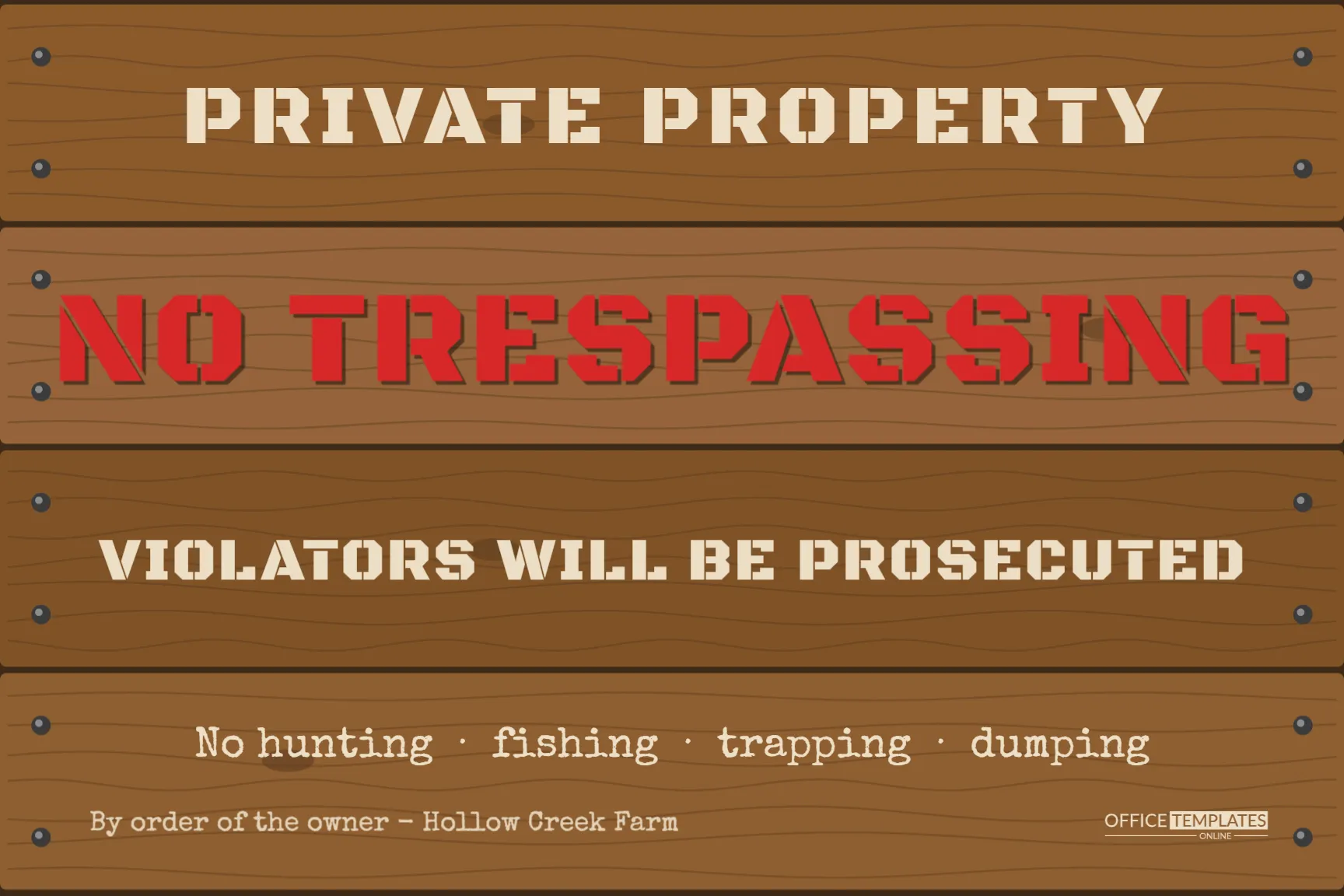
Farms, woodland, cabins, ranches, and rural homes all share a problem: people wander in, often without meaning any harm, because nothing tells them the land is private. A No Trespassing Sign Template draws a clear line. This version does it with character. Instead of a generic plastic warning, it looks like a sign painted onto rough wooden boards and nailed to a fence post, which suits a rural setting and still makes the message impossible to miss.
Painted Boards, Stencil Letters
The sign is 18 x 12 inches in landscape. It is built from four horizontal wood planks in slightly different shades of brown, with dark gaps between them. Each plank has faint wavy grain lines, a knot or two, and round nail heads near both ends, so it reads as real timber from a distance. The lettering looks as if it was sprayed through a stencil: PRIVATE PROPERTY in cream across the top plank, NO TRESPASSING in large red letters with a soft shadow across the second, and VIOLATORS WILL BE PROSECUTED in cream across the third. These use Black Ops One, a bold military-stencil typeface. The bottom plank lists what is not allowed (No hunting · fishing · trapping · dumping) and the line By order of the owner – Hollow Creek Farm in Special Elite, a worn typewriter face, with our logo in cream on the right.
Is a Sign Enough? Posting Land Properly
In many places, a clearly posted sign is what turns wandering onto land into trespassing that can be enforced. Rules for posting land vary between states and countries. Some areas specify a minimum sign size, the lettering height, the owner’s name, and how far apart signs must be along a boundary, often every few hundred feet and at every entrance, gate, and trail. Several US states also accept purple paint marks on trees or posts as a legal no trespassing notice. Check your local law or ask your county office before relying on signs alone, and keep a note of where and when you posted them.
Posting Plan for Rural Property
| Location | Why a sign belongs there |
|---|---|
| Main gate and driveway | The most common way in; sets the tone for visitors |
| Every field gate and farm track | Hunters and walkers often use these |
| Along roadside boundaries | Stops people pulling over and wandering in |
| Waterfronts and ponds | Fishing access is a frequent cause of trespass |
| Corners of woodland | Tells hunters where public land ends |
Changing the Wording
- Click the bottom plank’s list and change it to match your concerns, for example: No hunting · No ATVs · No camping.
- Replace Hollow Creek Farm with your farm, estate, or family name, or use By order of the owner alone.
- Change the top line to POSTED, KEEP OUT, or PRIVATE ROAD if those fit better.
- For a friendlier message, try PRIVATE PROPERTY on the top plank and Please respect our land on the third.
Each plank is a separate group with its own grain and nails, so you can recolour an individual board, change the brown to a grey weathered-barn tone, or delete a plank and resize the sign for a shorter message.
Making It Weatherproof
Outdoor signs face sun, rain, and frost. For long-term use, download the PDF and order an aluminium or composite panel with a UV-resistant laminate at 18 x 12 inches; it will outlast paper or card many times over. Corrugated plastic is lighter and cheaper for a large number of boundary signs. For a quick temporary sign, print it on US Letter at home, laminate it, and staple or zip-tie it to a post. Mount signs at a height where they are visible from a vehicle and above tall grass, and never nail signs to trees on land that is not yours.
The Look Without the Wood
Printing the planks rather than painting real boards has practical advantages. The letters stay sharp for years, you can make twenty identical signs in one order, and the printed wood never rots or warps. If you like the look, the same design works as a cabin or ranch welcome sign: change the red line to WELCOME and the rest to your family name and year.
Dealing with Trespassers Calmly
Signs prevent most problems, but occasionally someone ignores them. Most trespassers are walkers, dog owners, anglers or hunters who simply did not realise where the boundary was. A calm conversation, pointing out the sign, usually resolves it. If people keep coming back, take photos showing both the person or vehicle and your sign, note the date and time, and contact your local police non-emergency line or game warden rather than confronting anyone yourself. Good records, including photos of your posted signs, make it much easier for the authorities to act.
Some landowners also add a friendly second sign near popular paths, pointing walkers toward a nearby public trail. Giving people somewhere else to go is often the quickest way to stop them cutting across your fields.
Questions Landowners Ask
Can I use it in a city?
Of course. It suits side yards, garden gates, workshops and vacant lots, anywhere a rustic look fits.
Is red the best colour for the warning?
Red on brown is strong and traditional. If your boards are darker, you can switch the red to a bright orange for more contrast.
Can I add a phone number?
Yes, add it to the bottom plank, for example, Permission requests: (555) 123-4567. Some owners are happy to allow walkers who ask first.
How many signs will a large property need?
Count every gate, track, trailhead, and stretch of road frontage, then add signs along long boundaries so one is always visible from the next. A farm of a few dozen acres can easily need ten to twenty signs, which is why ordering printed panels in a batch saves time and money.
Mark Your Boundaries
Customise the wording, check your local posting rules, and put up a sign at every way in. A clear, good-looking sign protects your land without making your property feel hostile to neighbours who pass by.