Yard signs remain one of the most visible parts of any local campaign. They build name recognition street by street, show that neighbours support a candidate, and remind voters that an election is coming. For school board, city council, county, state, or ballot-measure campaigns, a good sign is simple: the candidate’s name as large as possible, the office, and a patriotic look that feels confident without being cluttered. This Campaign Yard Sign Template delivers exactly that in navy, red, white, and gold.
Anatomy of a Winning Yard Sign
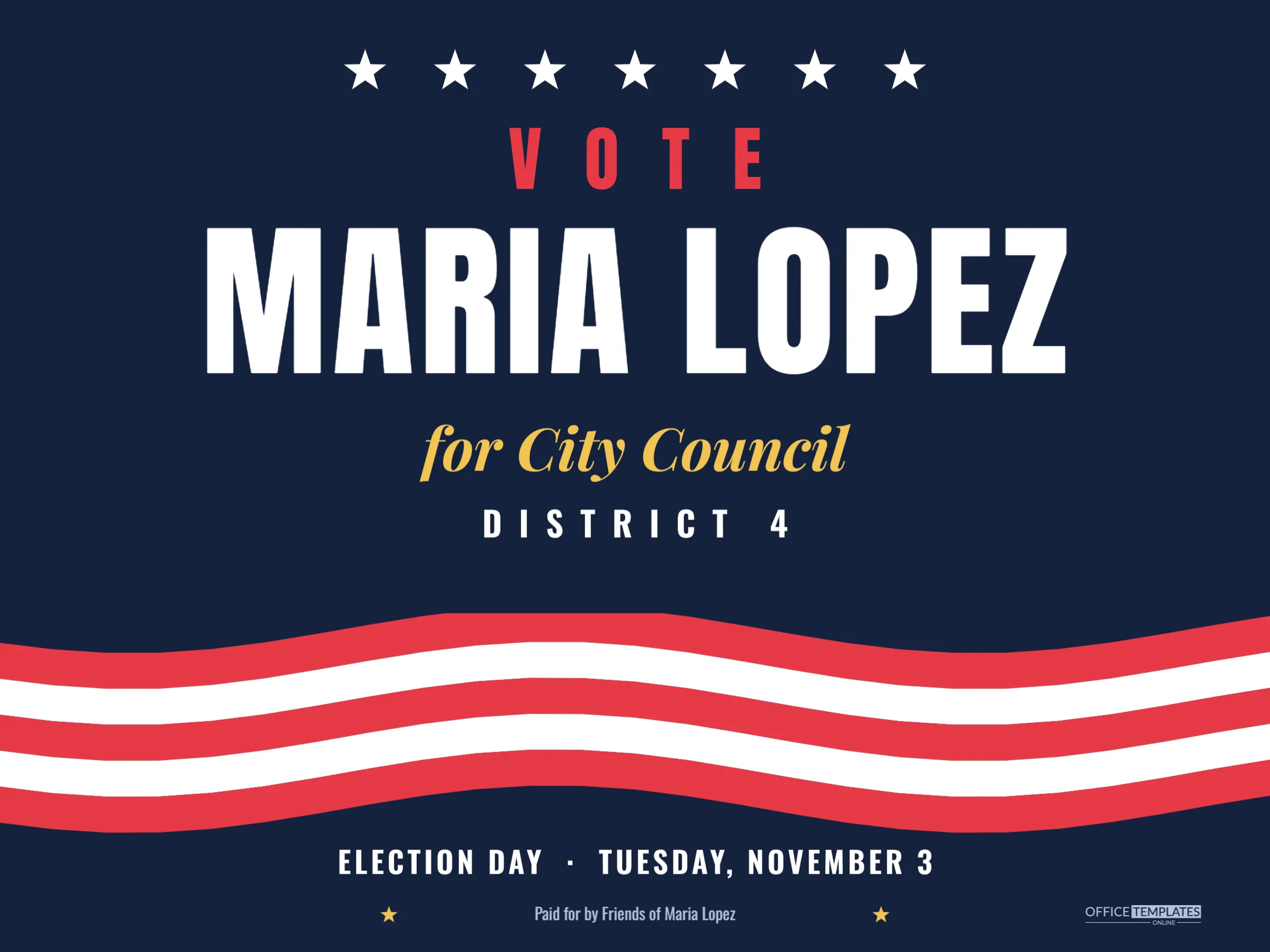
The sign is 24 x 18 inches in landscape, the standard size for corrugated plastic campaign signs on wire H-stakes. The background is deep navy. A row of seven white stars runs across the top. Below them, VOTE is spelled out in widely spaced red Anton capitals, then the candidate’s name, MARIA LOPEZ, fills almost the full width in huge white letters. The office follows in gold Playfair Display italic, for City Council, and DISTRICT 4 sits beneath it in spaced white capitals.
The lower third is a bold band of red and white stripes that wave gently across the sign like a flag in the wind. Below the stripes, ELECTION DAY · TUESDAY, NOVEMBER 3 is set in white, and a small line reads Paid for by Friends of Maria Lopez, with a gold star on each side. Our logo sits discreetly in the bottom-right corner in muted blue-grey.
The Name Is the Message
Drivers see a yard sign for two or three seconds. In that time, the only thing they will remember is a name, so the name must be the biggest element by far. Use the name voters will see on the ballot. If the candidate goes by a nickname, such as Bob instead of Robert, many campaigns use the familiar name in large type, but check what the ballot will show and any local rules on names in campaign materials. Short names can go even larger; very long names may need a slightly smaller font or two lines.
Disclaimer and Legal Requirements
Campaign signs usually need a paid-for-by disclaimer. In the United States, federal election rules require disclaimers on many types of campaign communications, and most states have their own rules for state and local races that specify who must be named, the wording, and sometimes the minimum type size. Many towns also regulate where political signs can be placed, how large they can be, and how soon before and after an election they may be displayed. Check with your local election office or campaign treasurer before ordering signs, and update the disclaimer line to exactly match the required wording.
Wording for Different Races
| Race | Top line | Office line | Bottom line |
|---|---|---|---|
| City council | VOTE | for City Council · District 4 | Election Day date |
| School board | ELECT | for School Board | Putting students first |
| Re-election | RE-ELECT | Mayor | Keep Springfield moving |
| Ballot measure | VOTE YES | on Measure B | Fund our parks |
| Early voting push | VOTE EARLY | candidate name + office | Early voting dates |
Setting Up the Candidate’s Details
- Click the candidate’s name and type the new name. If it is long, reduce the font size until it fits on one line with a small margin.
- Edit the office and district lines.
- Change VOTE to ELECT, RE-ELECT, or VOTE YES as needed.
- Update the election date line, or change it to a slogan or website.
- Enter the correct disclaimer wording in the bottom line.
- If your campaign has its own colours, select the navy background and the stripe band to recolour them. The stars and stripes are grouped, so each group recolours as one piece.
Colour Choices Beyond Red, White and Blue
Red, white and blue is traditional, but many campaigns choose other colours to stand out, especially in races where every candidate uses the same palette. Green and white can suggest environmental priorities; purple, teal or orange can be distinctive. Whatever you choose, keep the name in the lightest colour on the darkest background, or the reverse, for maximum contrast at a distance.
Ordering and Placing Signs
Download the PDF and order corrugated plastic signs at 24 x 18 inches with H-stakes. Most campaigns order in bulk; printing both sides is worth the extra cost because signs on corners are seen from two directions. Ask supporters for permission before placing signs on their lawns, and focus on busy streets, intersections, and near polling places where allowed. Keep a list of where every sign is, so volunteers can check them, replace damaged or stolen signs, and collect them all promptly after the election, which many towns require.
Beyond the Yard
The same design works for a window poster, a table sign at a campaign event, or a social media graphic. Download a PNG for your website and social pages, and a US Letter PDF for volunteers to print and display at home. Consistent design across everything a campaign puts out helps voters recognise the candidate quickly.
Volunteer Sign Crews
Signs only help if they are standing. Many local campaigns organise a small sign crew: a few volunteers with a car, a stack of signs, spare stakes and a map of supporter addresses. They deliver new signs, straighten bent ones after storms and replace any that go missing.
Campaign Sign FAQ
Can I add a photo of the candidate?
Yard signs are usually text-only because photos are hard to see from a moving car. For posters and flyers, a photo can work well; add it on the left and shift the text to the right.
Can I add a website or QR code?
Add a short website under the date line, or a QR code in a corner for walk-up signs at events.
Is this sign non-partisan?
Yes. It uses traditional civic colours and no party symbols. Add party branding if your race is partisan and your campaign wants it.
Put the Name on Every Street
Enter the name, office, and disclaimer, check your local rules, and get signs into supporters’ yards. A bold, readable sign is one of the simplest ways to turn quiet support into visible momentum.