A printed menu on each plate tells guests that this is not just dinner; it is an occasion. At a Diwali dinner party, where the table is set with the best plates and diyas glow along the centre, a tall menu card adds a finishing touch that guests notice and often take home. This 4 x 9 inch card is the classic tall menu shape that fits neatly on a dinner plate or tucked into a folded napkin.
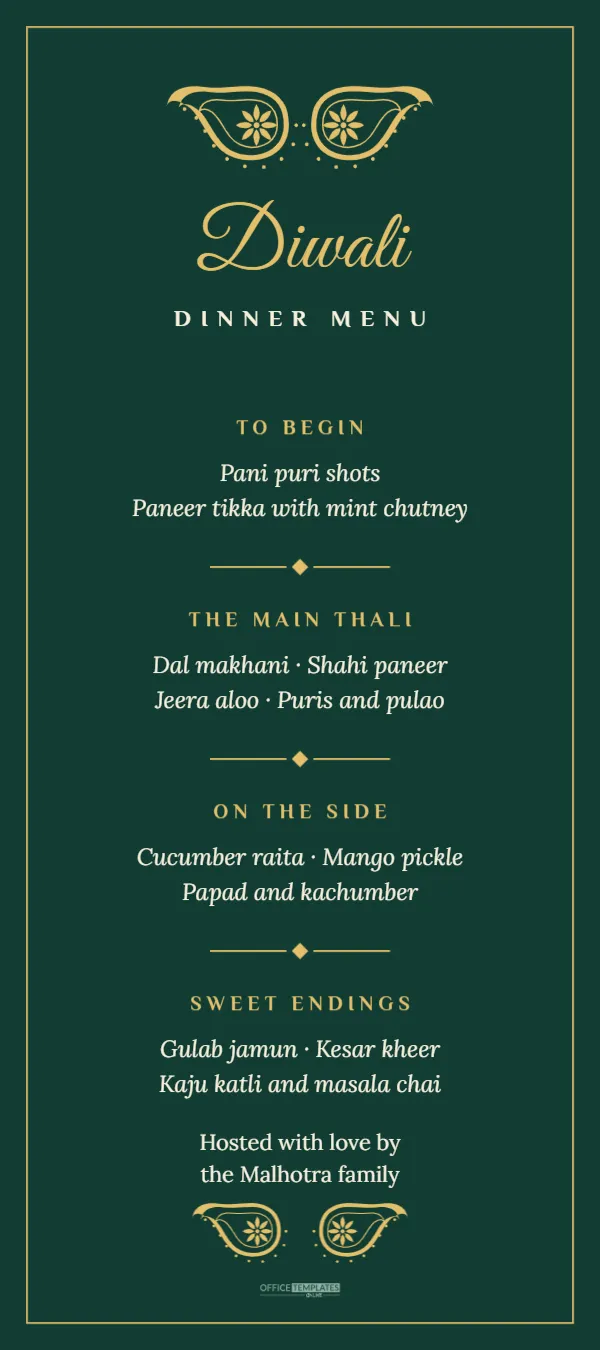
Menu Card Specification
| Feature | Detail |
|---|---|
| Size | 4 x 9 inches, portrait |
| Background | Deep emerald green with a fine gold frame |
| Ornament | A pair of gold paisleys facing each other at the top and the bottom |
| Title | Diwali in gold Great Vibes script, DINNER MENU in spaced Philosopher capitals |
| Courses | Four sections with gold headings, two lines of dishes in ivory Lora italic, gold dividers between |
| Sign-off | Hosted with love by the Malhotra family |
The Sample Menu
The card comes with a complete vegetarian Diwali dinner that shows how the layout reads when filled:
- To begin: pani puri shots and paneer tikka with mint chutney.
- The main thali: dal makhani, shahi paneer, jeera aloo, puris, and pulao.
- On the side: cucumber raita, mango pickle, papad, and kachumber.
- Sweet endings: gulab jamun, kesar kheer, kaju katli, and masala chai.
Replace any line with your own dishes. Each course holds two lines comfortably; separate dishes with a middle dot, as in the sample, to keep lines short.
Designer’s Notes
Emerald is a less expected colour for Diwali than red or orange, which makes the card feel elegant and modern while the gold paisleys and script keep it festive. The paisley, or ambi, is a motif found on Indian shawls, saris and tablecloths, and placing two paisleys face to face creates a small, balanced ornament without needing a large illustration. The paisleys are repeated at the foot of the card so the top and bottom feel like one design.
The narrow format means every line is centred. Short dish names look best; if a dish name is long, put it on its own line.
Writing a Menu Guests Enjoy Reading
- Use the dish names your family uses, even if they are regional. Guests love learning that the kadhi is Nani’s recipe.
- Add a small descriptor where it helps: paneer tikka with mint chutney rather than just paneer tikka.
- Group dishes by course rather than listing everything, so guests know what to save room for.
- Mention sweets by name. At Diwali, they are the highlight for many guests.
Editing the Four Course Menu
- Click each course heading to rename it, for example CHAAT CORNER or DESSERT TABLE.
- Click the two italic lines under each heading and type your dishes.
- Change the host line to your family name.
- If you have five courses, reduce the spacing by moving each section up slightly and copy a heading, dish block, and divider for the fifth course.
- Download as PDF for printing.
Printing Menu Cards for Every Place
Download the card as a PDF. Two 4 x 9 cards fit side by side on a portrait US Letter sheet (8 of its 8.5 inches wide), with a little room for trimming; a print shop can also print on 4 x 9 card stock directly. Use a heavy matte card of 300 gsm or more so the card stands up when propped against a glass. The emerald background covers the whole card, so ask for full bleed at a print shop. At home, print at the highest quality and trim with a paper cutter for clean edges.
Styling the Table Around the Menu
Place one card on each folded napkin or in the centre of each plate. Pair it with gold or brass cutlery, cream napkins tied with a marigold or a strand of kalava thread, and small diyas along the centre of the table. For a guest name on each card, add a text line under the host line, or use the place cards on the site to sit beside each menu.
Emerald, Maroon or Cream Menu Cards
Click the background to change the emerald to deep maroon, navy, plum, or black. Gold works on all of them. If your table linen is bright, a cream background with dark text gives a softer look; change the ivory text to a deep colour and keep the gold accents. The paisleys use one gold swatch each; select them to change it.
Using the Card for Other Occasions
The same card works for a Diwali office lunch, a Lakshmi Puja dinner, a Bhai Dooj meal or a Navratri feast. Change the title word and update the dishes. In 2026, Diwali falls on Sunday, November 8; many families hold dinner parties on the Saturday before or the weekend after.
Tall Menu Card Questions
Can I add the date?
Add a line under DINNER MENU, such as Saturday, 7 November 2026, in small gold capitals.
Can I list prices for a restaurant?
For a restaurant menu with prices, the Diwali special thali menu in this collection is a better fit.
Will it print on A4?
Two cards also fit side by side on a portrait A4 sheet, with slightly narrower margins.
Adding a Personal Note to Each Card
For a small dinner, consider writing each guest’s name by hand at the top of their menu card in gold pen, or adding a short line on the back thanking them for coming. Guests often keep personalised menus as a memory of the evening. If you prefer printed names, add a text line under DINNER MENU and change it for each guest before downloading, which takes a minute per card.
After the party, keep one menu card in your recipe folder. Next Diwali, it reminds you what you served, which dishes disappeared first, and what you would change.
Set a Table to Remember
Type your menu, print a card for every guest, and place them on the plates before the first diya is lit. It is a simple touch that turns a family dinner into a Diwali celebration.