Nursing hours do not fit a nine-to-five pattern. Shifts run twelve hours, nights cross midnight, handover can stretch a shift by twenty minutes, and a float shift sends you to another unit. A normal timesheet struggles with all this. This US Letter sheet records each shift by date and type, with start and end times that can run over midnight, a meal break, and the net hours, so that pay and rosters match the real working week.
A Heartbeat Line Across the Header
The header is deep teal with a thin pulse line running along the bottom in translucent white, rising and falling in the style of a monitor trace. The words Nursing and Healthcare appear in small, spaced mint capitals, and Shift Timesheet in large white Raleway below. Source Sans Pro carries the body text. The design is calm and clinical without being cold.
Name, Unit, Role and Pay Period
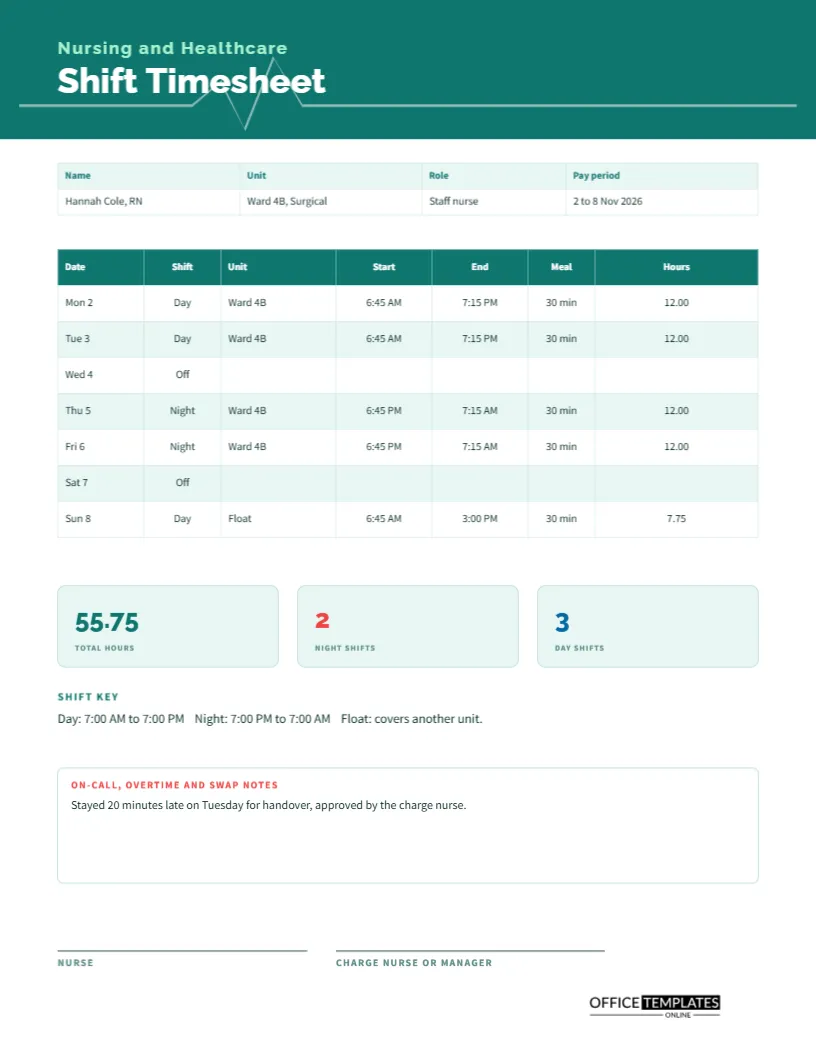
The strip lists the name, the unit, the role, and the pay period. The sample is Hannah Cole, RN, on Ward 4B, Surgical, as a staff nurse for the period 2 to 8 November 2026. Healthcare organisations often run unit-level budgets, so the unit matters as much as the name when payroll codes the hours.
One Week of Shifts
| Date | Shift | Unit | Start | End | Hours |
|---|---|---|---|---|---|
| Mon 2 | Day | Ward 4B | 6:45 AM | 7:15 PM | 12.00 |
| Tue 3 | Day | Ward 4B | 6:45 AM | 7:15 PM | 12.00 |
| Thu 5 | Night | Ward 4B | 6:45 PM | 7:15 AM | 12.00 |
| Fri 6 | Night | Ward 4B | 6:45 PM | 7:15 AM | 12.00 |
| Sun 8 | Float | Float | 6:45 AM | 3:00 PM | 7.75 |
Wednesday and Saturday are off, and a thirty-minute meal break comes off each shift.
Shifts That Cross Midnight
A night shift starting at 6:45 PM on Thursday ends at 7:15 AM on Friday. The sample shows the end time as 7:15 AM without a date change, and the hours as 12.00. When you write your own, list the shift on the date it started. This is the usual convention and prevents the same night being counted on two lines.
Early Start and Handover Time
Notice the 6:45 AM and 7:15 PM times in the sample. Many wards ask staff to arrive fifteen minutes before the official start for handover and stay fifteen minutes after. Recording the real times protects staff who are asked to stay late and gives managers a fair picture of the time needed for safe handovers.
Three Summary Tiles
Under the table, three tiles show total hours (55.75), night shifts (2), and day shifts (3). Night shifts are shown in red because many employers pay a differential for them, and many staff track them for health reasons. The total is your first check against the roster, and the shift counts help when you claim allowances.
Shift Key
A small key explains the codes: Day runs 7:00 AM to 7:00 PM, Night runs 7:00 PM to 7:00 AM, and Float covers another unit. Edit the key to match your hospital or care home, including any short shifts, such as an early or a late. A clear key helps agency staff and new starters read the page correctly.
On-Call, Overtime and Swap Notes
A box with a red heading records extras. The sample says stayed 20 minutes late on Tuesday for handover, approved by the charge nurse. Overtime, on-call hours, swaps, and training sessions all go here with the approver’s name. In healthcare, the person who approves an overtime claim is often not the person who signs the roster, so recording them avoids queries.
Steps for Completing the Sheet
- Write your name, unit, role, and pay period.
- List each shift on the date it started.
- Enter the real start and end times and the meal break.
- Work out the net hours.
- Add overtime or swap notes and have them approved.
- Total the tiles, sign and hand the sheet in.
Float, Agency and Bank Staff
Float nurses cover several units, and agency or bank staff may work for different wards in the same week. The unit column lets you record each assignment separately. For agency work, write the agency name in the notes and attach any booking confirmation, as the hours may be billed through a different channel.
Records and Confidentiality
The sheet contains no patient information and should not. Keep it that way: never write patient names or details. File the signed sheets as your employer requires, and keep a personal copy for your own records, because a clear history of shifts can be useful for pay queries and registration renewals.
Checking Rest Between Shifts
Looking down the Start and End columns helps you see rest periods. A day shift followed by a night shift within a short time is a common cause of fatigue, and many organisations set a minimum rest rule. The sheet will not enforce a rule, but it makes patterns visible so that you and your manager can act on them.
Editing Shift Codes and Tiles
Everything on the page is editable. Replace the units, change the key, add a column for allowances, or retitle a tile to count weekend shifts. The table is a real Table object, so it supports Add Row and Edit Table Data. After any change, retype the tiles, because totals are typed text.
Signatures and Printing
Lines for the nurse and the charge nurse or manager sit at the foot. The page is US Letter portrait and prints well in colour or black and white.
Keeping Night Differentials and Weekend Pay Straight
Many employers pay extra for nights, weekends and holidays. The shift column makes it easy to count them, and the notes box can record any extra allowance that applied. At the end of the period, compare your sheet with your pay slip line by line, and raise any difference with payroll while the dates are fresh.
Nurse Timesheet Questions
Is it suitable for care home staff?
Yes. Retype the unit and role. Care homes use the same shift patterns.
Can I record a 10-hour shift?
Yes. Enter the real start and end times and update the key.
Does it replace the hospital system?
No. It is your own record and a backup for pay queries.