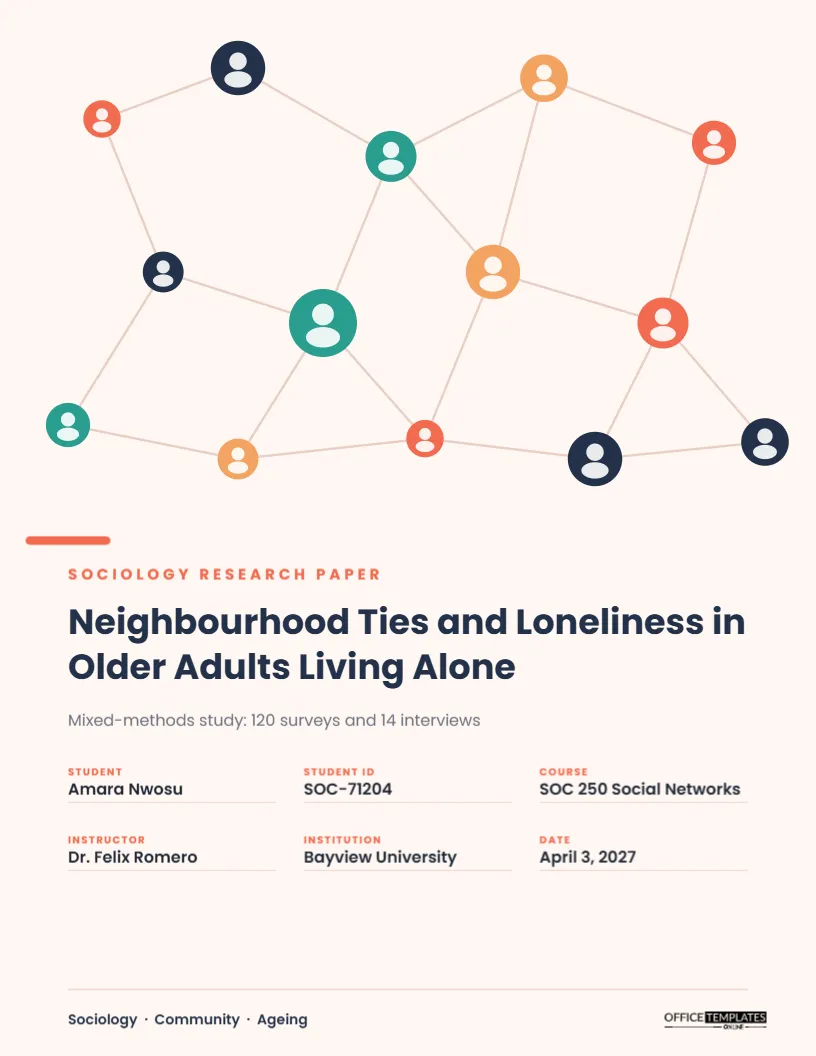
Sociology studies how people are connected: through families, neighbourhoods, workplaces, institutions and online platforms. This cover shows those connections directly. Across the top half of the page, fourteen small figures in coral, navy, teal and sand are linked by thin lines into a social network, with one larger figure at the centre. It is the kind of diagram sociologists actually draw when they map relationships, and it gives your paper an image that belongs to the discipline.
A Network Diagram as Cover Art
The page background is a warm off-white with a hint of peach. The network fills the top half: each person is a coloured circle with a simple white head and shoulders, and pale lines join neighbours into a web. Some people are linked to many others; some sit at the edges with only one or two ties. Below the network, a short coral bar leads into a coral label, Sociology Research Paper, and the title, Neighbourhood Ties and Loneliness in Older Adults Living Alone, set in navy Poppins. A grey line describes the study: Mixed-methods study: 120 surveys and 14 interviews. Six details sit in three columns, and a footer line lists three keywords, Sociology · Community · Ageing, beside the logo.
What the Network Means
Social network analysis is a real method in sociology. Researchers map who is tied to whom and measure things like density (how connected the group is), centrality (who is most connected), and bridges (people who link otherwise separate groups). On this cover, the larger teal figure near the middle is the most central person. You do not need to use network analysis in your paper for the image to work; it represents social ties in general. But if your paper is about networks, you can point to the cover in your introduction.
The Study Line: Methods First
Sociology instructors care about method, so the cover gives it a line of its own. Be specific. The sample says exactly what was done and how much: 120 surveys and 14 interviews. Other examples:
- Secondary analysis of the General Social Survey, 2010-2022
- Ethnographic fieldwork at two community centres over six weeks
- Content analysis of 300 news articles on housing
- Twelve semi-structured interviews with gig workers
- Comparative case study of three cities’ homelessness policies
If your paper is theoretical, write a theoretical essay followed by the main theorists, such as Durkheim and Putnam.
Six Details in Three Columns
The details are Student (Amara Nwosu), Student ID (SOC-71204), Course (SOC 250 Social Networks), Instructor (Dr. Felix Romero), Institution (Bayview University), and Date (April 3, 2027). The three-column layout keeps the bottom half of the page airy. Click any value to edit it; the coral labels can be renamed if your course uses different terms.
Sociological Theories and Matching Titles
| Theory or concept | Example title |
|---|---|
| Social capital | Bowling Alone Online? |
| Social Capital in Neighbourhood Facebook Groups | |
| Strength of weak ties | Weak Ties and Job Finding Among Recent Immigrants |
| Anomie | Anomie and Isolation in Rapidly Gentrifying Neighbourhoods |
| Intersectionality | Race, Gender and Access to Mentorship in Engineering Programs |
| Cultural capital | Cultural Capital and First-Generation Students’ Sense of Belonging |
Choosing a Title With a Population
Sociology titles should usually name the group studied. Loneliness is a topic; Loneliness in Older Adults Living Alone is a research focus. Adding the social mechanism, Neighbourhood Ties, tells the reader what you think explains it. Keep the title clear rather than clever, so readers can find it in a database later if you publish or present the paper.
Customizing the People and Colours
The whole network is a single group, so it moves and resizes as one image. To change colours, ungroup it and recolour individual people; for example, colour people by a category in your study, such as age group or neighbourhood, and explain the colours in a caption on the first page. To simplify, delete a few figures and their lines. The coral accent bar and labels can be changed to match any palette; teal, purple and green all work with the navy title.
Ethics When Studying People
Sociology research with human participants usually needs ethics approval and informed consent, and data must be anonymised. If your study involved interviews or surveys, consider replacing Student ID with Ethics approval and the approval number. Never use real names of participants in your paper; use pseudonyms and say so in your method section. Small communities can make people identifiable even without names, so also avoid exact street names and distinctive job titles.
Linking the Cover to Your Sociological Imagination
C. Wright Mills described the sociological imagination as the ability to see how private troubles connect to public issues. The cover image is a neat visual shorthand for that idea: each figure is an individual life, and the lines are the social structures that shape it. Many students open their introduction with exactly this move, starting with one person’s experience, such as an older woman who has not spoken to a neighbour in a week, and widening the lens to the patterns in census data. If your paper does that, the network on the cover sets up the argument before the first sentence.
Keywords in the Footer
The footer line lists three keywords. Journals ask for keywords to help indexing, and practising this early is useful. Pick three to five terms that someone searching for your paper might type, such as social isolation, older adults, and neighbourhood. Edit the line by clicking it.
Print Quality for Network Lines
The page is US Letter, 8.5 x 11 inches. The off-white background and thin network lines print well on most printers; lines may look lighter on inkjet printers set to draft quality, so choose normal or best quality. Download as a PDF for online submission.
Sociology Cover Questions
Can I use this cover for an anthropology or social work paper?
Yes. Change the label to Anthropology Research Paper or Social Work Research Paper; the network image suits both.
Should I explain the network image in my paper?
Not unless your paper uses network analysis. It is a cover illustration.
Can the details be in two columns instead of three?
Yes. Move the fields into two columns and widen them if your course name is long.