Biology is the science of living things, and a biology lab report cover should feel alive. This one does it with a DNA double helix that runs the full height of the page, a microscope badge, and a cluster of translucent cells. At the same time, it stays practical: every detail a lab instructor needs, from lab section to partner names, has its own labelled line. Use it for enzyme labs, osmosis experiments, microbiology cultures, plant physiology investigations, and any course from introductory biology to upper-level cell biology.
The DNA Helix Strip and the Rest of the Layout
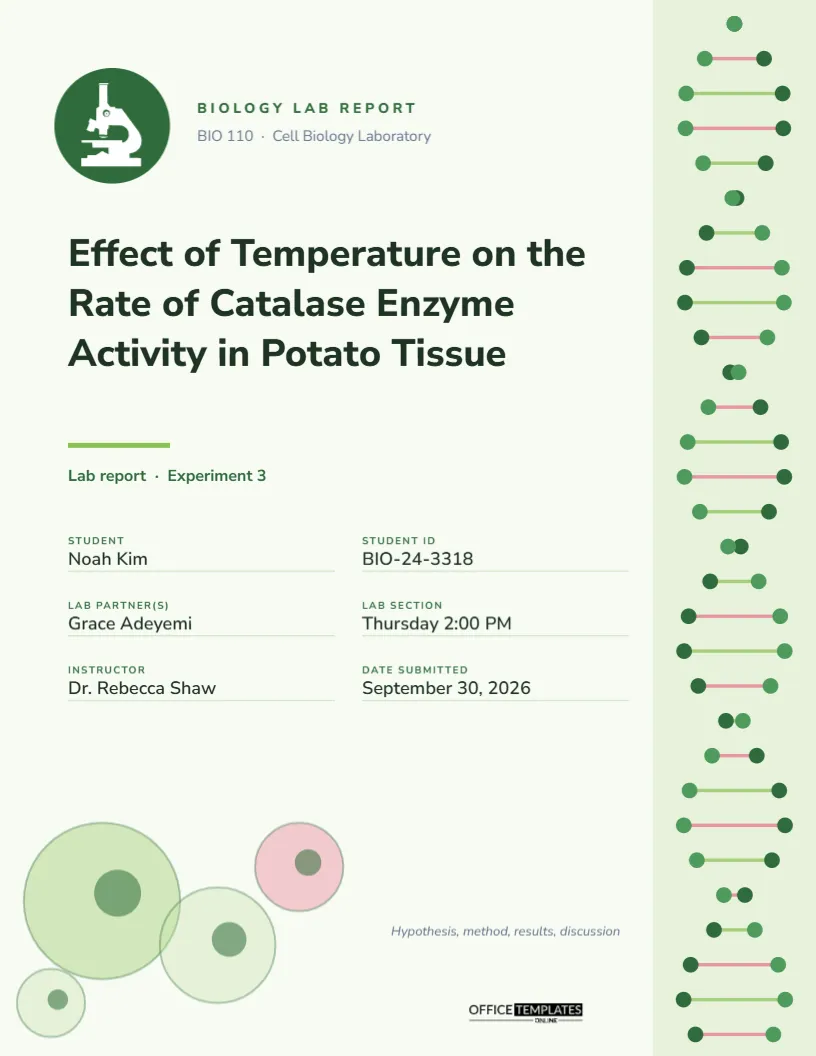
The page has a pale green-white background. On the right, a light green strip runs from top to bottom, and inside it a double helix twists down the whole page: two strands of dark and mid-green nucleotide dots joined by alternating lime and pink base-pair rungs. In the top left, a solid green circle holds a white microscope icon, next to the label Biology Lab Report and a course line, BIO 110 · Cell Biology Laboratory. The title, Effect of Temperature on the Rate of Catalase Enzyme Activity in Potato Tissue, is set in bold Nunito Sans, followed by a short lime rule and Lab report · Experiment 3. Six labelled detail lines sit in two columns. Toward the bottom left, soft overlapping cells in lime, pale green, and pink float above the footer, with a reminder line: Hypothesis, method, results, discussion.
Lab Details You Can Fill In
- Student: Noah Kim
- Student ID: BIO-24-3318
- Lab partner(s): Grace Adeyemi
- Lab section: Thursday 2:00 PM
- Instructor: Dr. Rebecca Shaw
- Date submitted: September 30, 2026
Each label and value is a separate text box with a hairline underneath. Click the value and type. The labels can be changed too: Lab section might become Bench number or Group depending on how your course is organised.
Titles That Tell the Reader the Variables
The best biology lab titles name the independent variable, the dependent variable, and the organism or tissue. Lab 3 tells the reader nothing. Enzymes is too broad. Effect of Temperature on the Rate of Catalase Enzyme Activity in Potato Tissue says exactly what was changed (temperature), what was measured (rate of catalase activity), and in what material (potato tissue). Use the same pattern: Effect of [independent variable] on [dependent variable] in [organism or system]. Your title will usually run to two or three lines in the space provided, which is fine.
A Sample Biology Title for Every Common Lab
| Lab topic | Example title |
|---|---|
| Osmosis | Effect of Sucrose Concentration on Mass Change in Potato Cylinders |
| Photosynthesis | Effect of Light Intensity on Oxygen Production in Elodea |
| Microbiology | Inhibition of E. coli Growth by Garlic Extract on Agar Plates |
| Respiration | Effect of Temperature on CO? Production by Germinating Peas |
| Genetics | Inheritance of Eye Colour in Drosophila melanogaster Crosses |
| Ecology | Species Diversity of Leaf-Litter Invertebrates in Two Woodland Sites |
Remember that scientific names of species, such as Drosophila melanogaster or Escherichia coli, are written in italics. Select just the species name in the title box and set it to italic.
Recolouring the Helix
The helix is a single group, so you can move or resize it in one piece. To change its colours, ungroup it and recolour the strands and rungs, or simply change the background strip behind it. Navy and sky blue work well for a marine biology report; purple and pink suit a genetics course; orange and brown feel right for an ecology or soil biology report. The microscope is an editable vector, so its colour can be changed from its swatches, and the green circle behind it is a plain shape.
Making the Cells Fit Your Topic
The cluster of translucent circles near the bottom suggests cells under a microscope, each with a darker nucleus. It is decoration, so you are free to change it. For a plant biology report, recolour them all green; for a blood or immunology lab, make them red and pale pink. If you need space for a longer reminder line or an extra field, move the cluster or delete it.
What Graders Look For After the Cover
The reminder line on the cover lists four sections, but most biology rubrics expect a fuller structure: title, abstract, introduction with a hypothesis, materials and methods written in past tense, results with labelled figures and tables, discussion that compares results with the hypothesis and published data, conclusion and references. Use the reminder line as a prompt and update it to match your own course rubric. A tidy cover will not rescue a weak discussion, but it does start the grader off with a good impression.
Print and Submission Notes
The page is US Letter, 8.5 x 11 inches. The helix strip runs to the page edges, so a home printer will leave a thin white border; that is normal. If you are submitting online, download as a PDF and combine it with your report. For a printed submission, the light background uses little ink and the helix prints cleanly on both inkjet and laser printers. Avoid printing on recycled grey paper, which dulls the greens.
Reusing the Cover Across the Semester
Most biology courses have weekly or biweekly labs. Fill in your name, ID, section, and instructor once and save the design. For each new lab, change the title, experiment number, partner names, and date. Your covers will look consistent, and you will never lose marks for missing the lab section. Name each saved file with the experiment number and topic, for example Bio110_Lab03_Catalase.pdf, so the whole semester is easy to find when you revise for the practical exam.
Biology Cover Page Questions
Can I put an image of my results on the cover?
It is better not to. Results belong in the results section. If you want an image, keep it decorative, such as a microscope photo, and small.
Is this suitable for AP Biology or high school labs?
Yes. Change Student ID to Class period and Instructor to Teacher if that suits your school.
How many partners can I list?
Two or three names fit in the partner line. For larger groups, write the group number instead.