A Spec Sheet and Designer Notes for the Nordic Envelope
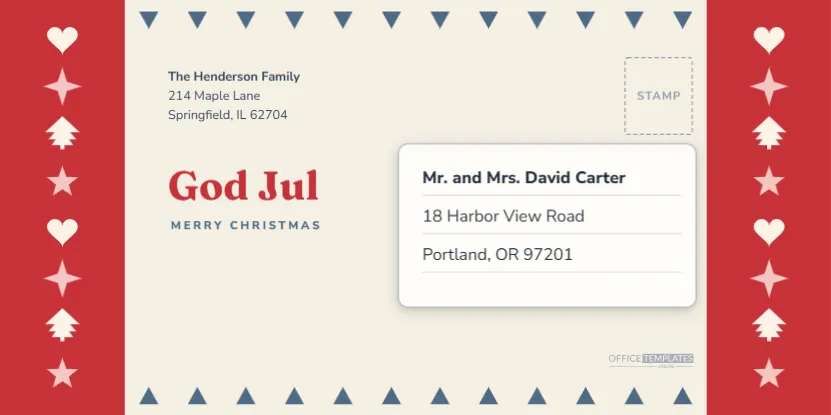
This is a DL envelope design, 220 by 110 millimetres, which is the standard long envelope used across Europe and many other countries for letters folded in three and for A5 cards folded in half. The design draws on Scandinavian folk patterns, with simple hearts, stars and trees, repeated in tidy rows.
| Feature | Detail |
|---|---|
| Size | DL, 220 by 110 mm, landscape |
| Side bands | Red, 1.3 inches wide, on both left and right |
| Pattern | Heart, star, tree, star, repeated down each band |
| Top and bottom edge | Row of twelve grey blue triangles |
| Centre colour | Warm cream |
| Fonts | Fraunces for the greeting, Nunito Sans for the address |
| Address panel | White rounded panel with a thin blue outline |
Designer’s Notes: Why Symmetry Matters
Scandinavian design is known for balance. The two red bands mirror each other, and the triangles above and below point toward the centre. This symmetrical frame makes the address panel feel calm and orderly. If you adjust one band, adjust the other so the page stays balanced. When you move to another envelope size, scale both bands together.
Designer’s Notes: A Limited Palette
Only four colours are used: red, cream, a grey blue and soft pink. That restraint is what makes the design feel Nordic. The pink appears only as stars and the cream as hearts and trees inside the red bands, so the shapes look cut from paper. If you change the palette, stay with three or four colours, and make sure the contrast between the shapes and the band is strong enough to read.
The Greeting
God Jul is Swedish, Danish and Norwegian for Merry Christmas, and it is written in Fraunces, a soft serif with warm, slightly wonky curves. Beneath it, MERRY CHRISTMAS in spaced capitals in grey blue serves as a translation for readers who do not know the phrase. Other greetings you could use are Glædelig Jul, Hyvää Joulua for Finnish, or Gleðileg jól for Icelandic. Check spelling with a native speaker if you are not sure.
Editing the Pattern
- Select a band and drag to resize it.
- Click a pattern shape to recolour it. The hearts are cream, the stars are pink and the trees are cream.
- Copy a shape and move it to extend the pattern if you widen the band.
- Click the grey blue triangles to change their colour or delete them for a plainer top and bottom.
- Edit the address and greeting like any other text box.
Postal Notes for DL Mail
The DL size is widely accepted by postal services for standard letters, though weight and thickness limits vary by country. A single folded sheet and a thin card usually fit within the lowest tariff, while photographs or small gifts may not. Keep the address block at the centre right, as designed, and leave the bottom strip free of decoration so that sorting machines can read it. The red side bands are far from the address, which also helps.
Printing the Red Bands
Large red areas ask for good printing. Use quality settings and a bright white paper. If your printer cannot print to the edge, ask a print shop to print full bleed on a DL blank. A matte finish gives a folk art look, and a satin finish deepens the red.
Nordic Envelope Queries
Can I use it for a New Year or a winter wedding?
Yes. Replace God Jul with a different phrase and the pattern works for any winter celebration.
Can the bands be moved to the top and bottom?
Yes. Rotate the bands and the pattern shapes together, then adjust the triangles.
Does the template include a card?
No. It is only the front of the envelope.
Setting a Nordic Table to Match the Envelope
A Scandinavian Christmas table is simple and bright. Use white plates, red napkins and a few sprigs of fir, and place a small paper heart at each setting. The same hearts, stars and trees from the envelope can be cut from paper and hung on the tree. Candles are the other essential, and a few white ones in plain holders complete the look.
Traditions Behind the Hearts and Stars
Paper hearts, woven in red and white, are a classic Danish tree decoration, and straw stars are common across the Nordic countries. The envelope uses simplified versions of these shapes. If you know a family tradition, add a small line on the card about it, so the envelope and the message tell the same story.
Mailing Cards Internationally in a DL Envelope
A DL envelope is a common choice for international mail. Write the country name in capitals on the last line of the address, and use the postal code format of the destination. Check postage rates and delivery times at your post office, and post early, since December is the busiest month of the year for overseas mail.
Choosing Paper That Feels Nordic
A clean white or pale cream stock with a smooth, slightly matte finish fits the Nordic look. Recycled papers in off white work too. Avoid heavy gloss, which makes the folk pattern look too commercial. A thin red and white string around a stack of cards finishes the parcel in a few seconds.
Combining the Envelope With Paper Heart Baskets
Woven paper hearts are a classic Scandinavian craft, and children enjoy making them from red and white paper. Fill one with sweets and tuck it into a gift bag with a card in this envelope. The hearts on the envelope echo the baskets, and the whole set looks planned.
Wording a Letter Folded Into Three for This Envelope
A standard letter folded in thirds fits a DL envelope, with the address showing if you use a window version. Fold the sheet so the writing is inside, and start with a clear greeting. Keep the letter short, and sign by hand. If you add a small photograph, place it between the folds so it does not slip out. The Nordic bands on the outside will already have set a warm tone.
Checking Contrast Before You Print in Red
Strong red areas can hide faint details. Print a test page and look at the cream hearts and pink stars on the red bands, since they should be crisp and clear. If they look muddy, adjust the pink to a lighter tint or increase the heart size slightly. A quick check saves a batch.