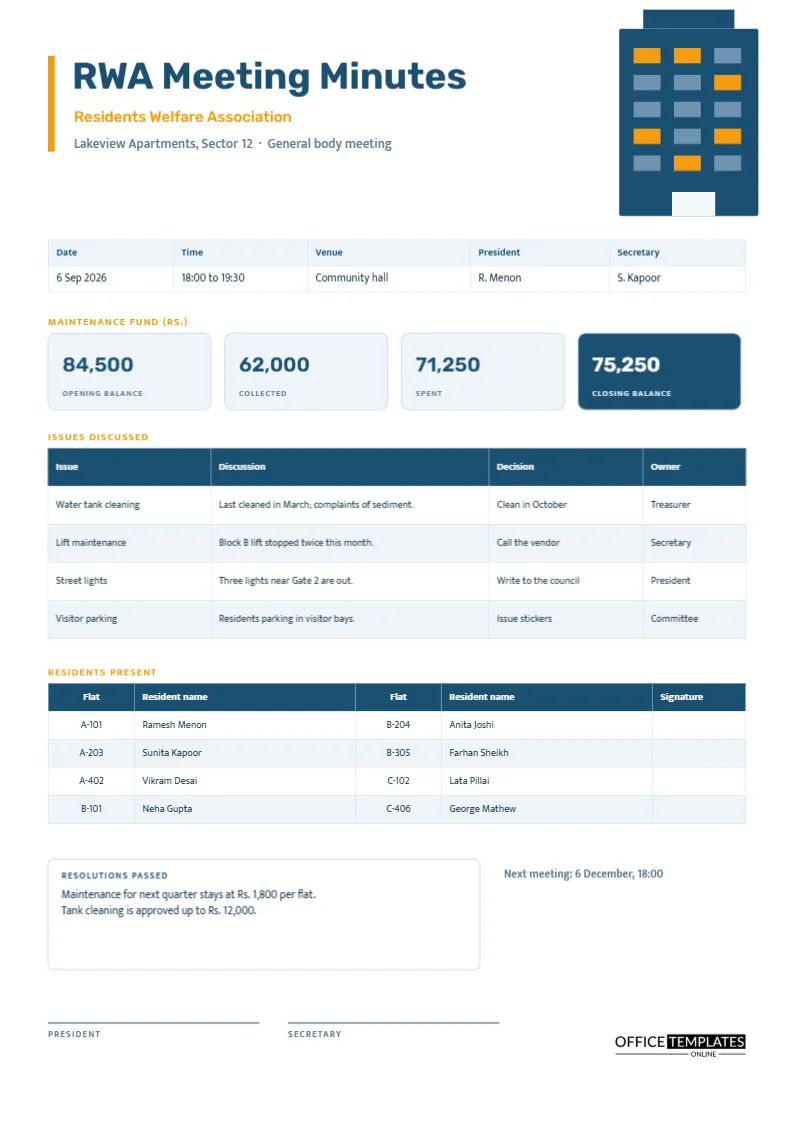
In many apartment colonies and housing societies, the residents’ welfare association keeps daily life running: water tanks, lifts, security guards, street lights, and the maintenance fund that pays for them. Its meetings can be lively, and memories differ about what was promised. This minutes format gives the secretary a clear, tidy sheet that records issues, decisions, money, and who attended, with a signature column for the residents present.
How to Hold a General Body Meeting, Step by Step
The page is most useful when the meeting itself follows a simple order. Here is a sequence many associations use.
- Send a written notice at least a week before, stating the date, time, venue, and agenda.
- Collect signatures as residents arrive, flat by flat.
- Confirm that enough members are present to start.
- Read the maintenance fund summary.
- Take each issue in turn, recording the decision and the person responsible.
- Read out the resolutions before closing, and fix the next date.
An Apartment Tower in the Corner
The top right of the page holds a tall navy block of flats with a flat roof and a rooftop tank, windows in amber and soft blue, and a pale doorway at its base. The lit amber windows suggest the lights of an apartment building in the evening. On the left, an amber bar stands beside the title RWA Meeting Minutes, set in bold Rubik, and the line Residents Welfare Association below it in amber. Body text is Mukta, a clear typeface that suits both English and Indian-language names.
The Maintenance Fund in Rupees
Four tiles show the opening balance, collections, spending, and closing balance. The sample uses Rs. 84,500 at opening, Rs. 62,000 collected, and Rs. 71,250 spent, which leaves Rs. 75,250 at closing. The last tile is dark navy, so the closing figure stands out. Follow this simple check each month.
| Line | Amount in Rs. | How to confirm it |
|---|---|---|
| Opening balance | 84,500 | Match last month’s closing figure |
| Add collected | 62,000 | Total of receipts issued |
| Less spent | 71,250 | Total of vouchers paid |
| Closing balance | 75,250 | Opening plus collected minus spent |
The Issues Table
The main table has four columns: issue, discussion, decision, and owner. The sample covers water tank cleaning, lift maintenance, street lights, and visitor parking. Each row ends in a decision and a named office-bearer, so there is no confusion later about who has to call the vendor or write to the council. Keep the discussion column to a sentence and the decision to a clear action.
Why Flat-Wise Signatures Matter
The lower table lists residents present by flat number and name, with a signature column. Signatures prove attendance and show that residents were informed of decisions. They also settle questions about whether a particular resident was present when a collection amount was agreed. The sample uses flat numbers in the form A-101 and B-204. After printing, residents sign in the blank column by hand.
Recording Resolutions Clearly
A box on the lower left records resolutions passed. In the sample, maintenance for the next quarter stays at Rs. 1,800 per flat and tank cleaning is approved up to Rs. 12,000. State the amount and the period, because a vague resolution invites a later argument. Read each resolution aloud before closing the meeting and ask whether anyone objects.
Handling Complaints Between Neighbours
RWA meetings often bring neighbour disputes to the surface. Keep these out of the general minutes. Record only that a matter was raised and referred to a small group or to the office-bearers. Naming people in the minutes can inflame a situation and, in some cases, create legal difficulties.
Customising the Format
Change the association name, sector, and location in the subtitle, and retype the issues for your own colony. The tower and its windows are simple shapes you can recolour. Both tables are real Table objects, so use Edit Table Data and the Add Row button to include more residents. If your association collects in a different currency or uses the rupee symbol, retype the labels and values.
Notice, Quorum and Local Rules
Requirements for notice and quorum depend on your registration, your bye-laws and the rules of your state. This format records what happened. It does not decide what the law requires, so check your own documents and, for important decisions, seek advice from a person who knows local rules.
Sharing the Minutes in the Colony
Many colonies post the minutes on a notice board and share a copy in the residents’ messaging group. Download the page as a PDF so that fonts and layout stay the same on every phone. Keep the signed original in the association’s file.
Collecting Maintenance Dues Fairly
Disputes over maintenance charges are among the most common problems in a housing society. A page that records the agreed amount per flat, the quarter it applies to, and the date of the resolution gives the treasurer firm ground when a resident questions a bill. If different flats pay different amounts, because of size or facilities, write the rule in the resolution and note where the schedule of charges is kept. Clear, dated records reduce friction and build trust.
Keeping Records for Audit and Handover
Societies change office-bearers, and a new team should be able to pick up the file and continue. Keep the signed minutes, the fund statements, receipts and vouchers together for each financial year. When accounts are audited, the minutes show that expenditure was approved, which is often the first thing an auditor asks to see. A tidy folder saves hours of searching during a handover.
Printing the Colony Minutes on A4
The page is A4 portrait. Leave the printer on actual size and leave the signature column wide enough for a pen. If many residents attend, print an extra attendance sheet with the same columns.
Questions From Secretaries
Can I add a column for mobile numbers?
Yes, though think about privacy. Share contact details only if residents agree.
Is this suitable for a gated community?
Yes. Rename the association and keep the sections for issues, funds, and attendance.