Small money, big headaches
Every office has a tin, an envelope or a drawer with a little cash in it. It buys milk, stamps, parcel fees, a taxi for a late meeting. Because each purchase is tiny, nobody feels the need to write it down, and at the end of the month the tin holds less than anyone can explain. A petty cash ledger fixes that with almost no effort. This rose-coloured template gives you a clean record of every coin that goes in or out, and a reconciliation strip that shows in seconds whether the tin is right.
How an imprest fund works
The neatest way to run petty cash is the imprest system. You start with a fixed float, say 500.00. Whenever someone spends from it, they hand in a receipt and the custodian writes a voucher. At any moment, the cash in the tin plus the receipts must equal the float. When the tin runs low, the custodian claims back exactly what was spent, and the float is restored. Because the float never changes, any shortage or surplus stands out immediately.
The four header fields
- Custodian is the one person responsible for the cash, which matters more than any other control.
- Fund / imprest amount is the float you start with.
- Period is the month or quarter the page covers.
- Department identifies whose fund it is, useful when several teams keep their own.
Seven columns to keep the tin honest
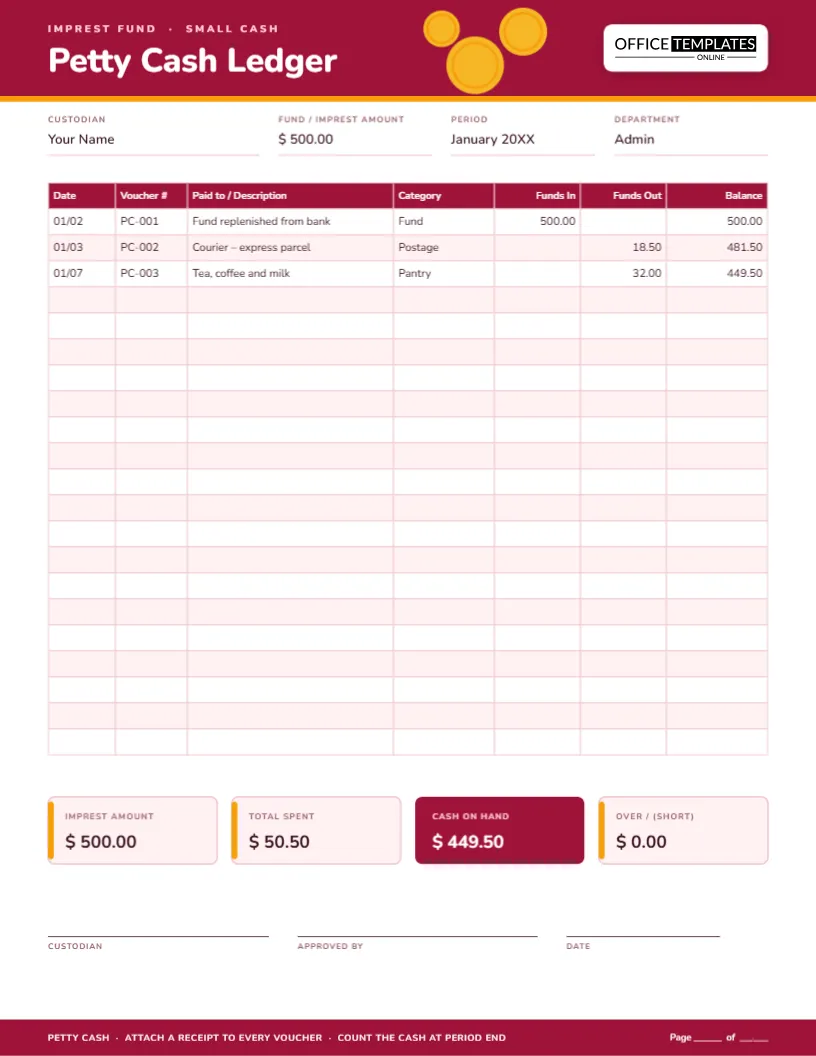
The ledger table has room for each detail an auditor or a manager might ask about.
- Date the money moved.
- Voucher #, a running number such as PC-001 that matches a numbered voucher and its receipt.
- Paid to / Description says who was paid and why.
- Category groups the spending: postage, pantry, travel, cleaning and so on.
- Funds In records money added to the tin, such as the opening float or a replenishment.
- Funds Out records every payment.
- Balance is the cash that should be in the tin after each line.
The sample lines show the fund starting at 500.00, a courier bill of 18.50 dropping it to 481.50 and pantry supplies of 32.00 taking it to 449.50.
The reconciliation strip
Four tiles across the bottom do the checking for you. Imprest amount is the fixed float. Total spent is the sum of the Funds Out column. Cash on hand, filled in dark rose, is what you physically count in the tin. Over / (short) is the difference. If the float is 500.00, total spent is 50.50 and the tin holds 449.50, the difference is zero, and the fund is exactly right. Anything else is a discrepancy to explain before you replenish.
Controls that protect the custodian
- Keep the cash in a locked box, and give the key to one person.
- Never pay out without a receipt, or a signed note when no receipt exists.
- Number vouchers in order and never skip or reuse a number.
- Do not mix personal money with the fund, even to cover a shortage.
- Count the cash on a regular schedule, and let someone else count it sometimes.
- Set a limit on single payments, above which a normal payment method is used.
Category ideas to make month-end easy
Choose categories that match the expense accounts in your books, so replenishment is a simple posting. Common ones are postage and courier, refreshments, stationery, cleaning supplies, local travel, minor repairs, staff welfare and sundry. Use the same words each time so a filter or a sort at month end is instantaneous.
Running the fund from start to finish
- Draw the float from the bank and record it as the first line under Funds In.
- For each payment, complete a voucher, attach the receipt and write a line in the ledger.
- Update the balance after every line.
- When the balance falls to your minimum, total the Funds Out column.
- Count the cash, fill in the four tiles and check that the difference is zero.
- Present the vouchers for replenishment, record the top-up under Funds In, and sign in the custodian and approved by boxes.
Who needs a petty cash ledger
- Small offices and start-ups with a cash tin
- Schools, nurseries and church offices
- Restaurants and shops with a float for small purchases
- Construction sites with a site cash box
- Clubs and volunteer groups
- Bookkeepers who set up controls for clients
Adapting the sheet to your fund
- Type the custodian’s name, the float and the period in the header.
- Rename the category examples to match your own expense headings.
- Clear the sample rows or use them as a guide.
- Recolour the header and tiles if you would like a different palette.
- Download as PDF, PNG or JPG.
Print settings for a working document
The page is US Letter portrait, 8.5 by 11 inches, with 21 lines in the ledger table. Print it at 100 percent scale on standard paper. Keep the current page on top of the box, and clip vouchers behind it in number order. The footer reminds the user to attach a receipt to every voucher and to count the cash at the end of the period, which is the habit that makes the system work.
What people wonder about petty cash
How large should the float be?
Big enough to cover a month or two of small expenses, but small enough that a loss would not hurt. Many offices choose between 100.00 and 500.00.
Can I record a payment without a receipt?
Only when unavoidable, such as a parking machine. Write a voucher with the details and have the payee or a manager sign it.
What if the tin is short?
Record the difference in the Over / (short) tile, investigate, and post it to a cash short and over account if it cannot be found.
Is petty cash allowed for wages?
Usually not. Wages, large purchases and anything that needs an audit trail should go through the bank.
A small ledger protects a small fund and the person looking after it. Open the template, set your float and keep the tin honest from the first day.