Walk around any business and you will see things that will last for years: computers, vehicles, desks, machinery, shelving. Accountants call them fixed assets, and they are treated differently from everyday expenses. Instead of charging the whole cost to one month, you spread it over the years the asset is useful, a process called depreciation. To do that properly you need a list of every asset, what it cost, when it was bought and how much of its value has been used up. That list is the fixed asset ledger, also known as a fixed asset register, and this slate-and-gold landscape template is built to hold it.
What belongs in a fixed asset ledger
An asset is generally recorded when it is expected to be used for more than a year and costs more than the amount your business chooses as a minimum, often called the capitalisation threshold. A laptop probably qualifies, and a box of pens does not. Each qualifying asset gets one line with a unique ID, so it can be tracked from purchase to disposal.
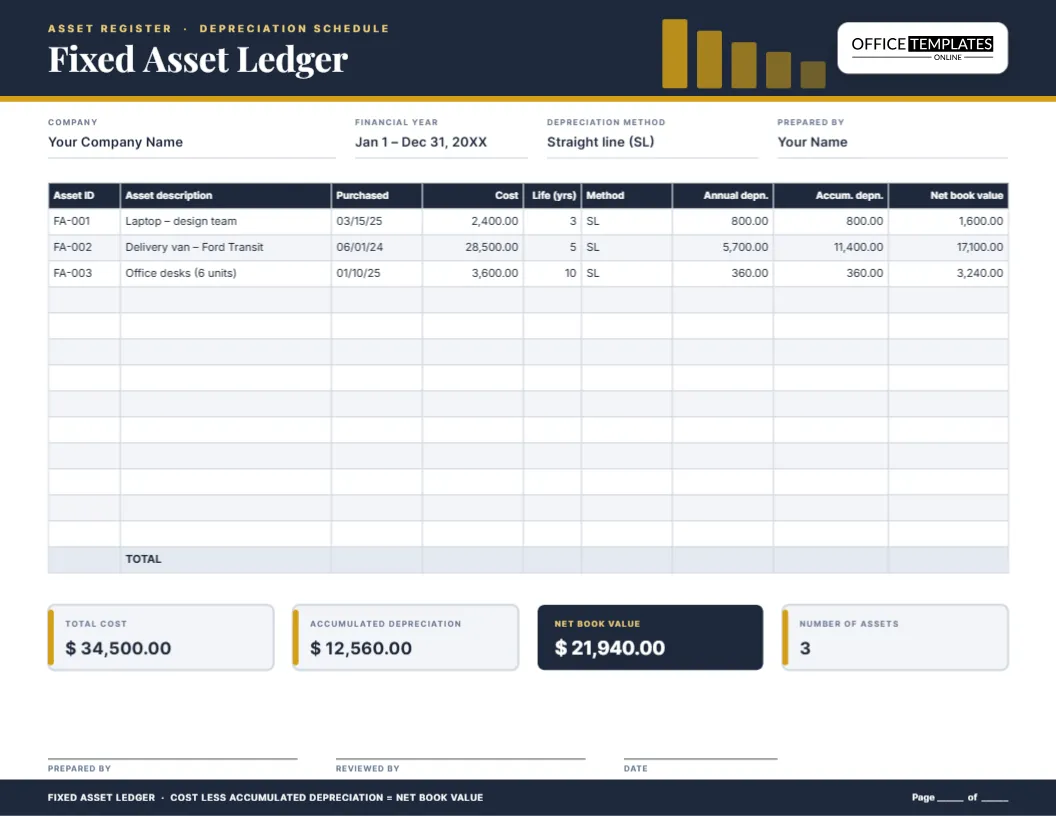
Nine columns, left to right
- Asset ID, a unique code such as FA-001, ideally on a label stuck to the item.
- Asset description, detailed enough to identify it, with model or serial number if you have them.
- Purchased, the date it was bought or put into use.
- Cost, the purchase price plus costs to get it ready for use, such as delivery and installation.
- Life (yrs), the number of years you expect to use it.
- Method, for instance SL for straight line.
- Annual depn., the depreciation charged each year.
- Accum. depn., the total depreciation charged so far.
- Net book value, cost minus accumulated depreciation.
Straight-line depreciation in one formula
The simplest method spreads cost evenly: annual depreciation equals cost minus expected salvage value, divided by useful life in years. The sample rows assume no salvage value to keep the sums clear.
- A laptop costing 2,400.00 with a three-year life is depreciated at 800.00 a year. After one year, accumulated depreciation is 800.00 and net book value is 1,600.00.
- A van costing 28,500.00 with a five-year life is depreciated at 5,700.00 a year. After two years accumulated depreciation is 11,400.00 and net book value is 17,100.00.
- Six desks costing 3,600.00 with a ten-year life are depreciated at 360.00 a year. After one year net book value is 3,240.00.
The totals row and the four tiles
A shaded TOTAL row at the bottom of the table is for the sums of cost, annual depreciation, accumulated depreciation and net book value. Below the table, four tiles repeat the essentials: Total cost, Accumulated depreciation, Net book value (in dark slate) and the Number of assets. In the sample, the three assets cost 34,500.00, have accumulated depreciation of 12,560.00 and a net book value of 21,940.00, and the tiles add up in the same way. Those are the figures that feed your balance sheet.
Where the ledger fits in your year-end
- List every asset acquired during the year, with cost and date.
- Calculate the year’s depreciation for each asset, part-year if it was bought mid-year and your policy calls for that.
- Add it to accumulated depreciation and work out the new net book value.
- Total the columns and agree them with the fixed asset accounts in your general ledger.
- Note any disposals, write-offs or assets that are no longer in use.
- Sign the page as prepared and reviewed.
When an asset is sold or scrapped
Do not delete the line. Write the disposal date, the sale proceeds and the net book value at that date in the space beside it, or add a row underneath. Comparing proceeds with net book value gives the gain or loss on disposal, which needs to go into your accounts. Keeping the line means the history remains available for an auditor, and the total cost column continues to reconcile with the ledger.
Book depreciation and tax depreciation
The depreciation in your accounts is often different from what tax rules allow. Many tax systems have their own rates, allowances or first-year deductions. This template is best used for your accounting records. If your tax schedule differs, keep a second copy or add columns for tax cost and tax depreciation so the two can be compared, and ask your accountant which rules apply where you are.
Who keeps a fixed asset ledger
- Small businesses preparing annual accounts
- Non-profits that must show asset values to funders
- Schools and clinics with equipment to track
- Farms and workshops with machinery
- Landlords with fittings and appliances
- Accountancy students practising the year-end
Making the ledger yours
- Type the company, financial year, method and preparer in the header.
- Replace the three sample assets with your own.
- Add rows if you have more than thirteen assets.
- Fill in the TOTAL row and the four tiles at year end.
- Change the slate and gold colours from the toolbar if you wish.
- Download as PDF, PNG or JPG.
Layout, labels and audit trail
The page is US Letter landscape, 11 by 8.5 inches, so the nine columns fit without squeezing. Print at 100 percent scale, keep the current year’s page on top of last year’s and label the physical assets with their IDs so that a walk-round check can be done quickly. A yearly count that matches the register to the actual items is a routine that auditors appreciate.
Asset register worries, eased
What should the useful life be?
Use your best estimate of how long the business will use the asset, and apply it consistently. Your accountant can advise on typical lives for each class of asset.
Do I depreciate land?
Land is usually not depreciated. Record it in the ledger if you want a complete list, but leave the depreciation columns blank.
What about assets I already own?
Enter them with their original cost and date, plus the accumulated depreciation to date, and continue from there.
Is this different from an inventory ledger?
Yes. Inventory is stock you plan to sell. Fixed assets are items you use in the business over several years.
A complete asset register makes year-end simpler and audits calmer. Open the template, list your assets and let the net book value tell the story.