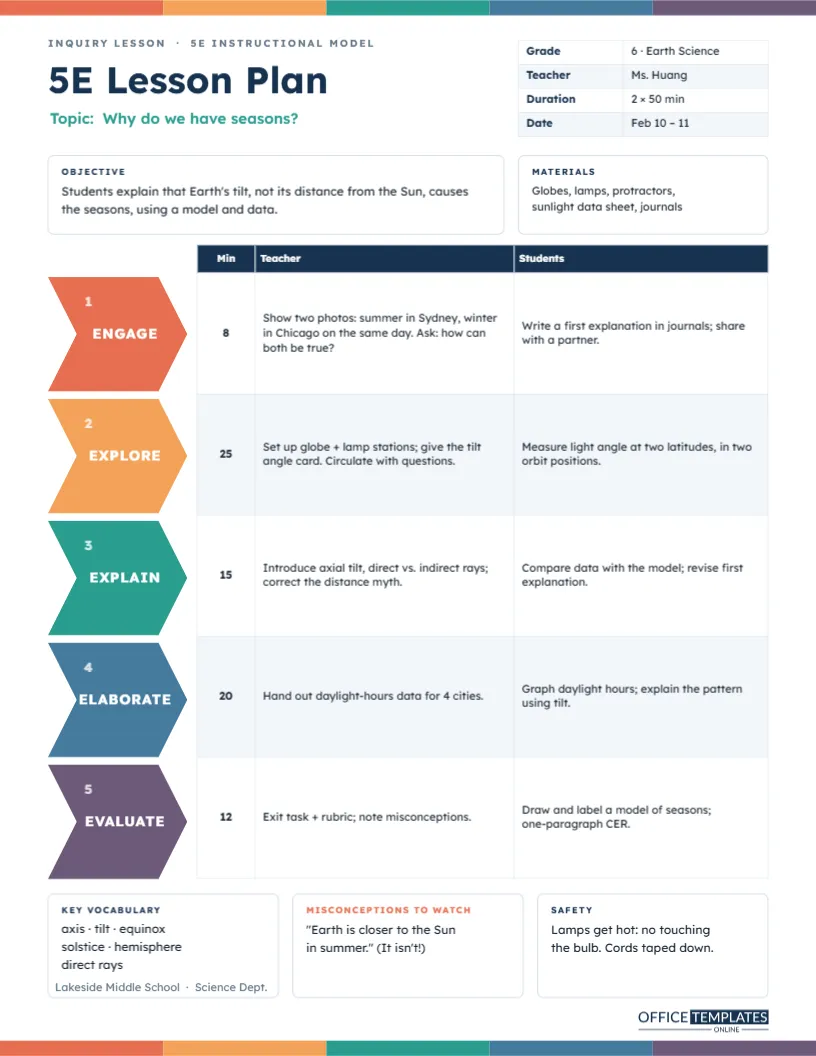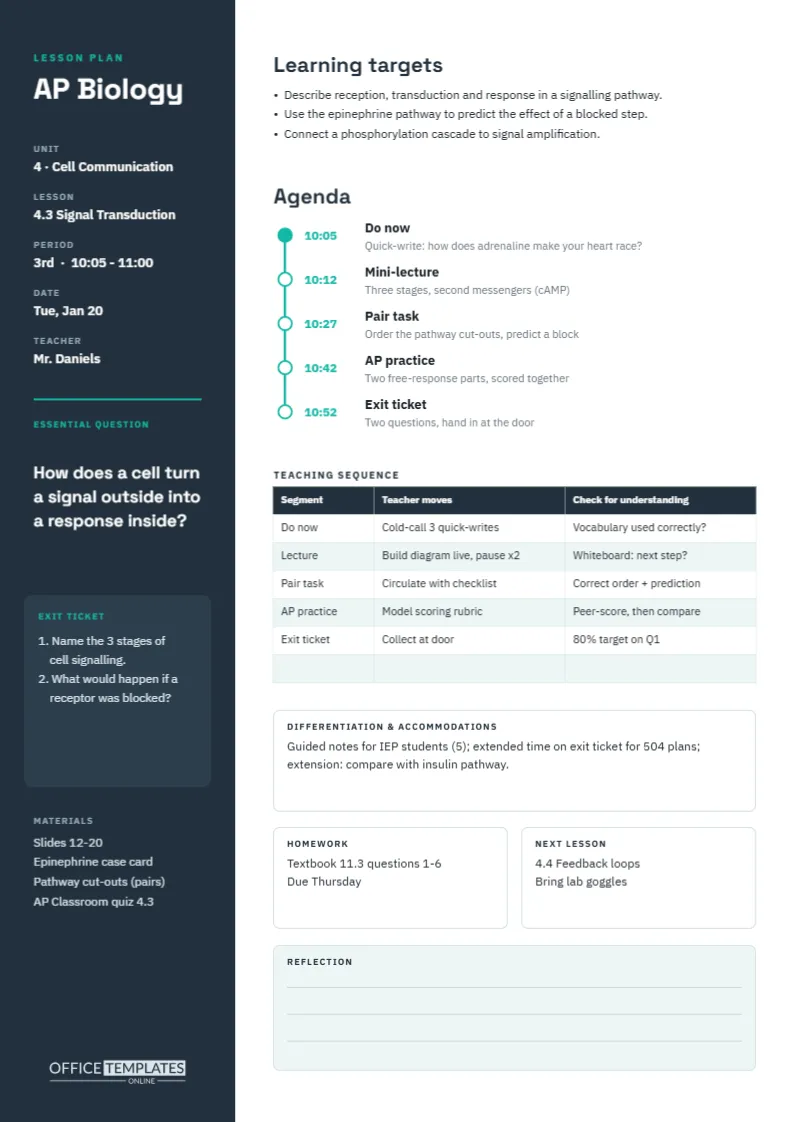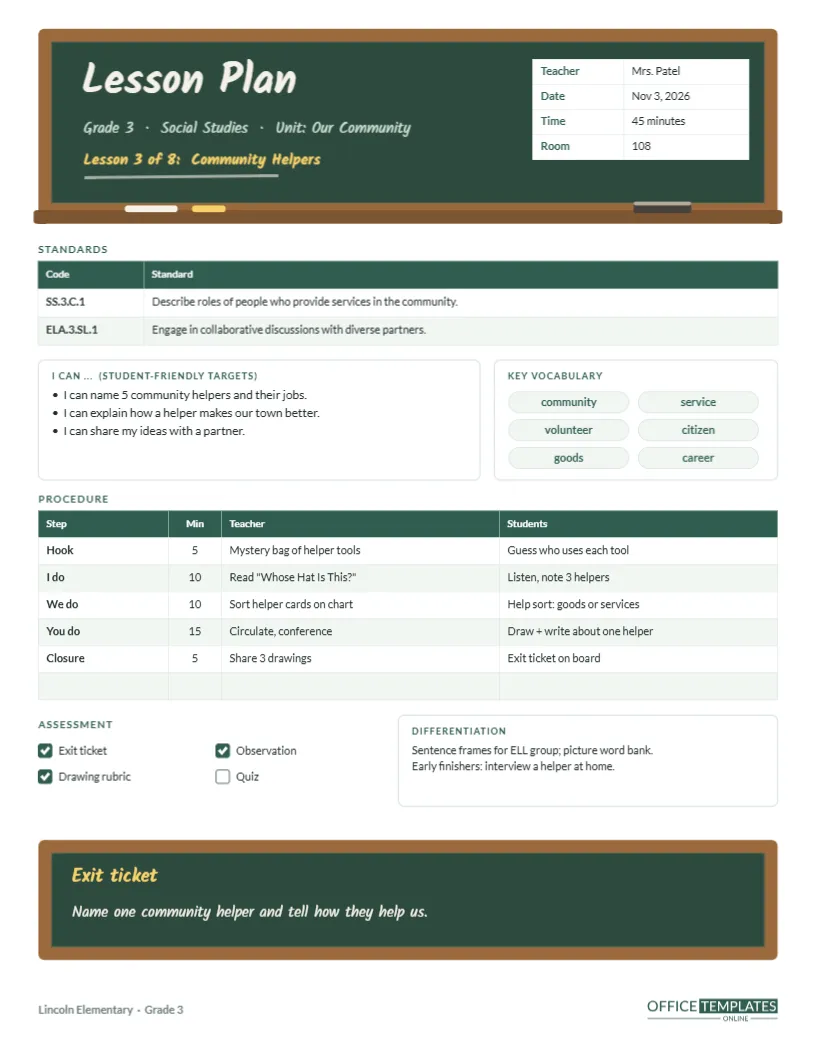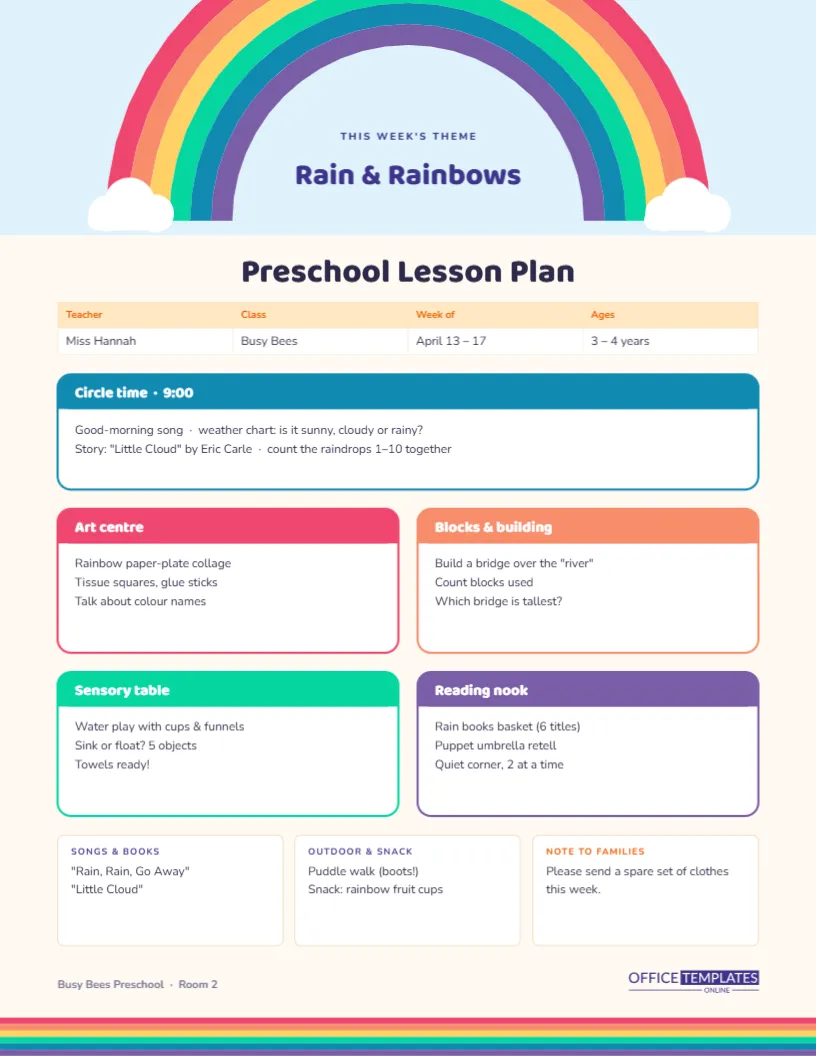
Guided reading is small-group teaching at its most precise. Four to six readers at a similar level read the same carefully chosen book while the teacher listens in, prompts, and teaches one point that the group needs right now. With several groups a day, teachers need a plan that fits the routine, captures notes on each child, and is quick to fill in. This Guided Reading Lesson Plan does that, and it starts with an open book.
An Open Book at the Top
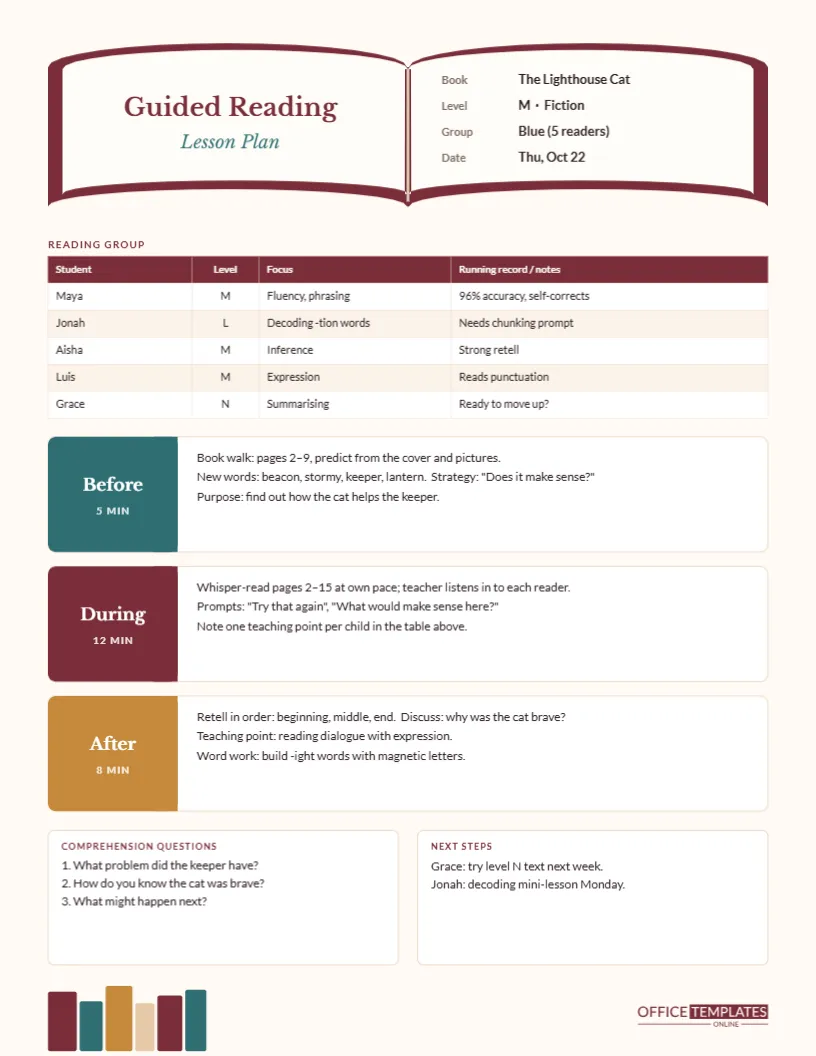
The header is an illustration of an open book seen from above: two burgundy covers with gently curved cream pages and a fine spine line down the middle. The left page holds the title, Guided Reading in Libre Baskerville with Lesson Plan in teal italic underneath. The right page lists the book details: book title, level, group, and date. The sample is The Lighthouse Cat, level M fiction, for the Blue group of five readers on Thursday, October 22.
Reading Group Table
Under the book, a real editor table tracks each student in the group:
| Student | Level | Focus | Running record/notes |
|---|---|---|---|
| Maya | M | Fluency, phrasing | 96% accuracy, self-corrects |
| Jonah | L | Decoding -tion words | Needs chunking prompt |
| Aisha | M | Inference | Strong retell |
| Luis | M | Expression | Reads punctuation |
| Grace | N | Summarising | Ready to move up? |
The notes column is where the real value lies. Over a few weeks, it shows you which children are ready to move up a level and which need more support.
Before, During and After Reading
Three horizontal bands divide the lesson into its classic phases. Each band has a coloured label block on the left, teal for Before, burgundy for During and amber for After, with the minutes underneath, and the plan written to the right.
Before (5 minutes): a book walk-through of pages 2 to 9, predictions from the cover and pictures, four new words (beacon, stormy, keeper, lantern), a strategy reminder and a purpose for reading. During (12 minutes): students whisper-read at their own pace while the teacher listens to each one and prompts. After (8 minutes): an ordered retell, a discussion question, one teaching point, and quick word work.
Prompts Worth Keeping Handy
- Does that make sense? Does it look right? Does it sound right?
- Try that again and think about what would make sense.
- Look at the first part of the word. Is there a chunk you know?
- Read it like the character is talking.
- What do you think will happen next? Why?
Add your favourite prompts to the During band so they are in front of you when a reader gets stuck.
Comprehension Questions and Next Steps
Two boxes close the plan. Comprehension questions list three questions to ask after reading, moving from literal (what problem did the keeper have?) to inferential (how do you know the cat was brave?) to predictive. Next steps records decisions for individual readers: Grace tries a level N text next week, and Jonah gets a decoding mini-lesson on Monday.
Book Spines in the Footer
Six book spines in burgundy, teal, amber, and cream stand in a row in the bottom-left corner, a small library that echoes the open book at the top of the page. They are a single group, so you can recolour or remove them.
Planning a Week of Groups
Most teachers meet each guided reading group two to five times a week, depending on need. Make a copy of the file for each group and keep the same book for two or three sessions. Update the group table after each session, so by Friday you have a running record of the week for every child.
Choosing the Right Book
A guided reading text should be at the group’s instructional level: challenging enough that students need some support, but not so hard that they lose meaning. Many teachers aim for 90 to 94 percent accuracy on a first read. Record the level in the header and the accuracy in the notes column.
Using It With Other Levelling Systems
The sample uses letter levels, but the Level column accepts any system your school uses: numbers, colour bands, Lexile measures, or year-group bands. Change the header detail to match.
Printing for the Reading Table
Download as PDF and print a stack for the week. Keep them on a clipboard at the guided reading table, with a pen, so you can write notes in the table as you listen to each child.
What the Rest of the Class Is Doing
Guided reading only works if the other students can work independently. Plan literacy stations before you start: independent reading, word work, listening, writing, and a partner-reading corner, with clear instructions and a signal for when to rotate. A short note at the top of each plan, such as Stations: rotation 2, helps you keep the groups and stations in sync.
Running Records in Brief
A running record is a quick, structured listening check: a child reads about 100 words aloud while you mark errors and self-corrections. Divide the words read correctly by the total to get the accuracy rate. Above 95 percent, the text is easy; 90 to 94 percent suits guided reading; below 90, it is too hard for now. Record the figure in the notes column.
Guided Reading Plan FAQ
Can I add a sixth student?
Yes. Use Add Row in the reading group table.
Can I change the minutes for each phase?
Yes. The minutes are text inside each coloured label block.
What size is it?
US Letter, 8.5 x 11 inches.
Does it suit book clubs for older readers?
Yes. Rename the bands Discuss, Read and Respond and use the table for roles.
How many students should be in a group?
Four to six is typical; small enough to listen to every child read during the session.
Can I use it for one-to-one tutoring?
Yes. Use one row of the table and expand the notes; the before, during, and after bands work the same way with a single reader.