Some days need a checklist. Other days need a page to simply write on. A diary is where students put the things that do not fit anywhere else: the joke that made the whole class laugh, the argument with a best friend, the nervous feeling before a match, the quiet pride of a good grade. Writing it down helps make sense of it, and years later those pages become some of the most precious things a person owns.
A Keepsake Journal on Every Page
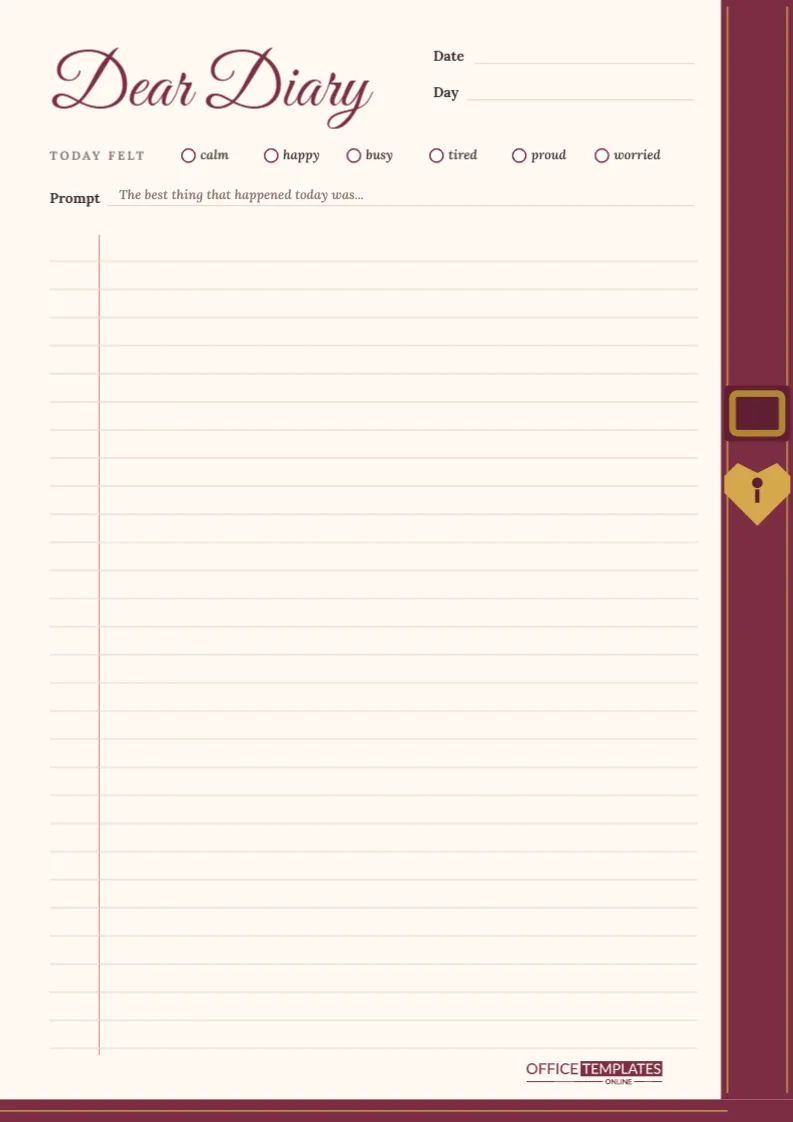
This template is designed to look like the classic lockable diary many of us remember. The A4 portrait page (210 x 297 mm) is printed on a warm cream background. A burgundy leather strap runs down the right edge, trimmed with gold stitching on both sides. Halfway down, the strap passes through a small leather buckle and ends in a gold heart-shaped padlock with a keyhole. The same burgundy strap runs along the bottom edge, stitched in gold, so the page is wrapped like the corner of a leather journal.
The title Dear Diary is written in the romantic script of the Great Vibes font, in burgundy, with lines for Date and Day beside it.
What Is on the Page
- Today felt: six little circles to tick next to calm, happy, busy, tired, proud, and worried, written in italic Lora.
- Prompt: a line for the day’s writing prompt, pre-filled with an example in italics: The best thing that happened today was…
- Writing lines: twenty-nine softly coloured ruled lines with a pink margin line on the left, giving plenty of space for a full diary entry.
Our logo sits discreetly in burgundy at the foot of the writing area.
A Month of Diary Prompts
Blank lines can be intimidating. When nothing comes to mind, type one of these into the Prompt line before printing, or simply choose one to start with.
- The best thing that happened today was…
- Something that surprised me this week
- If I could change one thing about today
- A conversation I keep thinking about
- Three things I’m looking forward to
- My favourite place at school, and why
- Something I learned that I want to remember
- A time I felt brave
- What my perfect Saturday would look like
- A letter to myself one year from now
- The funniest thing I saw or heard this week
- Someone I admire and what I admire about them
- A worry I have, and what I could do about it
- A memory from when I was little
- If I could learn any skill instantly
- What friendship means to me
- The song that describes my week
- Something I’m proud of that nobody noticed
- A place I want to visit one day
- What I’d tell a new student starting at my school
Why the Mood Line Comes First
Starting with a quick tick next to how the day felt is a gentle warm-up. It takes two seconds and often unlocks what to write about: a tick next to worried tends to lead straight into the reason. Over weeks, flicking back through the ticked moods also shows patterns, such as busy days that always come before tired ones, which can help students understand themselves a little better.
How to Write When You Don’t Know What to Say
Many people stare at the first line of a diary page and give up. A few simple tricks help. Start with the facts: what you did, who you saw, what you ate. The feelings usually follow once the pen is moving. Write the way you talk, as if telling a close friend about your day; spelling and neat handwriting do not matter here. If a whole page feels like too much, set a small target, such as five lines or five minutes, and stop when you reach it. And do not worry about writing something important every time. Ordinary entries about ordinary days are often the ones that feel most precious when you read them again years later, because they capture exactly what life was like at that age.
Keeping a Diary Private
The printed padlock is decorative, but privacy is real and worth respecting. Some tips for students and families:
- Keep finished pages in a folder or binder that stays in your own room.
- Agree as a family that diaries are private unless the writer chooses to share.
- If you type entries in the editor, download them to your own device and do not leave them open on shared computers.
- Remember that a diary is a safe place for feelings, but if something serious is worrying you, talk to a trusted adult as well as writing about it.
Making the Diary Your Own
- Click the title to personalise it, for example, Dear Diary · Maya or My Journal.
- Change the mood words to ones that fit you better: excited, bored, lonely or grateful.
- Recolour the strap from burgundy to navy, forest green or dusty rose; the strap, buckle and padlock are one grouped object, so they change together.
- Type your own prompt into the Prompt line before printing, or delete the example text to leave it blank.
Printing and Binding Your Diary
Print on A4 at Actual size. The cream background prints as a soft tone; if you prefer to save ink, change it to white before downloading. For a proper journal feel, print a month of pages on slightly heavier 100 gsm paper and bind them with a ring binder, a comb binding from a print shop, or simply a pretty folder. Fountain pen users should choose thicker paper to avoid ink showing through.
Dear Diary FAQs
Is this for children or teenagers?
Both. Younger writers enjoy the heart padlock and prompts; teenagers often appreciate the plain, generous writing space.
How often should I write?
Whenever you like. Some people write every night; others write once a week or only when something important happens. There is no wrong way.
Can I use it as a reading or learning journal instead?
Yes. Change the prompt to Today I read… or Today I learned… and it works just as well.
Unlock the Page
Print a few pages, choose a prompt, and start writing. Today’s ordinary moments are tomorrow’s memories, and a diary is where they are kept safe.