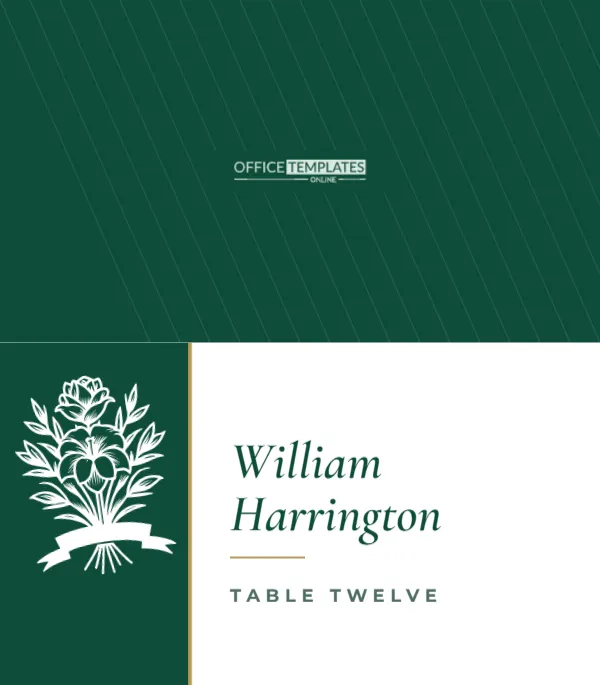
Emerald is the jewel tone of luxury weddings: deep green velvet bridesmaid dresses, emerald tablecloths under gold candlesticks, and lush green floral walls. Paired with crisp white roses, it feels both classic and dramatic. This place card uses those two colours in a strong, structured way. A narrow emerald panel runs down the left side of the front, holding a white line drawing of a rose bouquet; a gold rule separates it from the white name area, and the guest’s name is set on two lines in an elegant italic serif.
A Side Panel Instead of a Border
The card is 3.5 x 4 inches flat and 3.5 x 2 inches folded. Its front is divided into two zones. On the left, about a third of the width, an emerald panel holds a bouquet of white roses drawn in fine line art. A vertical gold line marks the edge of the panel. On the right, the guest’s first name, William, and surname, Harrington, are stacked in italic Cormorant Garamond in emerald. A short gold rule sits below them, followed by Table Twelve in spaced grey-green capitals. The background is emerald with very faint diagonal lines, like the sheen on velvet, and the logo is in a pale mint.
Why Stack the Name on Two Lines
Stacking first name and surname gives the name more presence in a narrow space and lets each word be larger. It also creates a clean left edge that lines up with the gold rule and table line, which looks deliberate and editorial. Long surnames such as Harrington or Montgomery fit comfortably on their own line, which can be difficult in a single-line layout.
Editing the Two-Line Name
- Click the first name and type the guest’s first name.
- Click the surname and type their surname.
- For titles, add them to the first line: Dr. William or Mrs. Eleanor.
- Update the table line.
- Download the card and repeat for the next guest.
For couples on one card, put both first names on the first line (William & Clara) and the surname on the second.
Emerald Weddings: What Goes Well With It
| Element | Pairs with emerald |
|---|---|
| Metals | Gold, brass, antique bronze |
| Flowers | White roses, white orchids, white anemones, greenery |
| Accent colours | Blush, champagne, black, deep burgundy |
| Fabrics | Velvet, satin, silk |
| Venues | Historic ballrooms, libraries, conservatories |
The Rose Line Art
The bouquet on the panel is a line-art illustration, which keeps it light against the dark green rather than heavy. It is an editable vector: select it to change its colour, for example, to gold for a more opulent card or to blush for a softer one. You can also replace it with another illustration from the editor’s library, such as a single lily, a monogram or a laurel, as long as it reads well at about one inch wide.
Recolouring the Panel
The emerald panel, the back and the name colour work together. To change the theme, select the panel and the back and pick a new dark jewel tone, such as sapphire, ruby or amethyst, then change the name to match. Keep the gold line; it ties any jewel tone together. The white rose art stays legible on any dark colour.
Name Card Etiquette at Formal Dinners
At formal weddings, guests are usually addressed with honorifics. Married couples traditionally sit apart at large tables to encourage conversation, so each has an individual card. Use the guest’s preferred title: Dr., Professor, Judge, the Reverend, Captain. If you are unsure how someone prefers to be addressed, use first and last name without a title; nobody is offended by their own name.
Printing Emerald Faithfully
Emerald can print slightly dull or too blue on some printers. Print a test and compare with your fabric swatches. Adjust the shade by selecting the panel and back and nudging the colour warmer or cooler. A matte cardstock setting at high quality gives even coverage on the panel and back. Let the cards dry before folding.
Trimming and Folding
The emerald panel touches the left edge and the bottom edge of the front, so trim exactly on the outline. Score across the centre where the emerald back meets the white front, and fold with the white side out. When the card stands, the emerald back gives the opposite side of the table a solid band of colour.
Table Styling for Jewel Tones
Set the card on a gold charger with a white napkin, or lean it against a crystal glass. Tall brass candlesticks, white tapered candles and low arrangements of white roses with dark greenery complete the look. Emerald velvet table runners or napkins echo the card’s back panel.
Other Elegant Occasions
The design suits winter galas, Christmas dinners with an emerald and gold theme, St. Patrick’s Day dinners, milestone anniversary parties and award dinners. Replace the table line with the event name or a guest’s role.
Planning a Jewel-Tone Stationery Suite
If emerald is your wedding colour, carry the same side-panel structure through the rest of your stationery for a consistent identity. A tall menu with an emerald strip down one edge, a seating chart with emerald table headings and a welcome sign with a white rose drawing on emerald all look like members of one family. Choose one gold tone and one emerald tone and record their colour codes, so every piece, whether printed at home or by a professional, matches. Guests notice coordination subconsciously; the room feels considered rather than assembled from separate purchases.
Keeping Cards Clean Before the Event
Dark panels show fingerprints and smudges more than white paper. Handle printed cards by their edges, store them in a box rather than loose in a bag, and ask whoever sets the tables to place the cards last, after glasses and cutlery are polished and in position.
Emerald Card Questions
Can I put the panel on the right?
Yes. Move the panel and line to the right edge and right-align the text.
Can I use a single line for the name?
Delete the surname box and type the full name on the first line, reducing the size slightly.
What size is the folded card?
3.5 inches wide and 2 inches tall.