Some weddings call for something trendy. Others call for something that will look just as right in the photographs thirty years from now. This place card belongs to the second group. It pairs warm ivory with antique gold, sets each guest’s name in a flowing copperplate-style script, and frames everything with a fine double border, like engraved stationery. It suits ballrooms, country estates, church receptions, garden marquees and any celebration where the table linen is crisp, and the candles are tall.
Ivory, Gold and a Double Frame
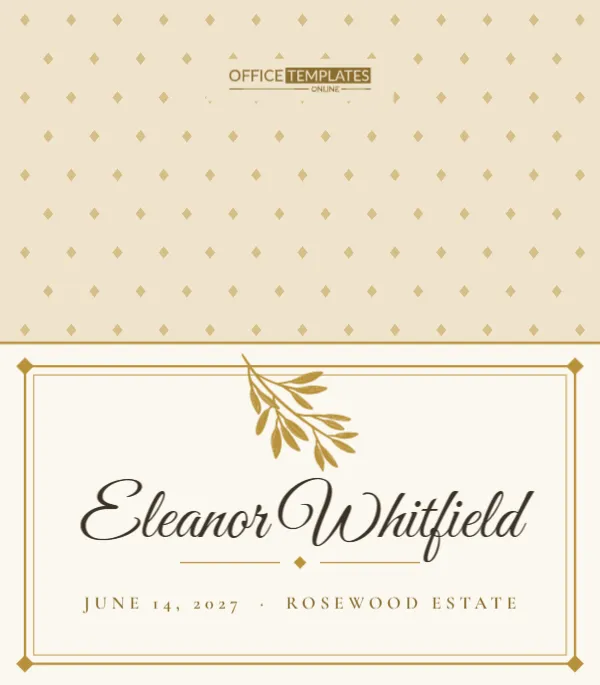
The card prints flat at 3.5 x 4 inches and folds in half to stand as a 3.5 x 2 inch tent. The lower half is the front. A thin gold rule runs around it, with a hairline gold rule tucked just inside, and tiny gold diamonds sit at the four corners where an engraver would place ornaments. A gilded olive sprig crowns the top of the panel. The guest’s name, Eleanor Whitfield in the sample, is set in Great Vibes, a graceful script. Below it, a short gold rule with a diamond at its centre separates the name from one line of small capitals: the date and venue, June 14, 2027 · Rosewood Estate. The upper half, which becomes the back once folded, is a soft champagne tone covered in a lattice of tiny gold diamonds, with a narrow gold line marking the fold.
What Belongs on a Traditional Place Card
Etiquette guides agree on one rule: the guest’s name comes first and stands alone. Formal receptions often use full names with titles (Mr. Charles Whitfield, Dr. Amelia Grant), while relaxed weddings use first and last names. Children can be listed by first name only. The date and venue line is optional. It turns each card into a small keepsake, and many guests slip their card into a pocket or handbag at the end of the night. If you prefer the cleanest look, delete that line and the rule above it and let the name breathe.
A Quick Naming Guide for Formal Seating
| Guest | How to write the name |
|---|---|
| Married couple, separate cards | Mrs. Eleanor Whitfield and Mr. James Whitfield |
| Doctor or professor | Dr. Amelia Grant |
| Military officer | Captain Thomas Reed |
| Clergy | The Reverend Paul Morgan |
| Child at the family table | Lucy |
| Plus-one whose name you know | Mr. Daniel Hart |
Avoid Guest on a card wherever possible. Ask the guest for their companion’s name when they RSVP; it makes the companion feel welcome rather than anonymous.
Personalising Each Card in the Editor
Click the name and type over it. The script font, size, and centring stay in place. Then update the date and venue line, or select it and press Delete. To produce a full set, type the first guest’s name, use Download As to save a PDF or PNG, then change the name and download again. A spreadsheet of names beside your screen makes the process quick. Check each name against the RSVP list as you go, because a misspelled name on a place card is the one detail guests always notice.
Matching the Gold to Your Invitations
Every gold element can be recoloured. The olive sprig is an editable vector, so its colour swatches appear when you select it; the frame lines, corner diamonds and rules are simple shapes. Rose gold works beautifully with blush flowers, silver suits winter weddings, and a deep bronze pairs well with autumn dahlias. The diamond lattice on the back is grouped, so one selection lets you recolour or delete the whole pattern. The champagne back can switch to ivory, pale grey, or soft blush.
Long Names and Two-Line Names
Script fonts take more horizontal space than plain type. Names up to about eighteen characters fit at the current size. For longer names, reduce the font size a few points instead of making the text box wider, so the name stays inside the double frame. Couples sharing one card (Eleanor & James Whitfield) can sit on two lines; press Enter after the ampersand and shrink the size slightly.
Card Stock That Flatters Gold
Home printers cannot print metallic gold, so the gold here prints as a warm ochre tone. On bright white paper it looks flat; on ivory or cream card stock it looks rich and close to foil. Choose a smooth cardstock of around 80 to 110 lb cover (216 to 300 gsm), which folds cleanly without cracking and stands firmly on the table. For true metallic gold, send the PDF to a print shop that offers digital foil, or ask about gold toner.
Cutting and Folding Neatly
- Print at 100% scale, never fit to page, so the card stays exactly 3.5 x 4 inches.
- Trim with a paper trimmer or a craft knife and metal ruler; scissors leave wavy edges that show against a straight frame.
- Score along the fold before folding: run a bone folder or the back of a butter knife along a ruler on the gold fold line.
- Fold with the printed front facing out and press the crease flat under a heavy book for a few minutes.
Styling the Table Around the Card
Classic place cards look best with a little breathing room. Stand each card on the charger plate above the dessert fork, or lean it against the water glass. A single sprig of real olive or eucalyptus tucked behind the card echoes the gilded sprig on the front. If you are using gold-rimmed glassware or gold cutlery, the card becomes part of a coordinated setting rather than an afterthought.
When to Print and Who Places Them
Print place cards after your final RSVP deadline, usually two to three weeks before the wedding, and keep a few blank spares for last-minute changes. Sort the finished cards by table in labelled envelopes. On the day, give them to your planner, venue coordinator, or a trusted friend with a copy of the seating chart so they can be set out before guests walk in.
Questions Couples Ask About This Design
Can I add a table number?
Yes. Replace the date line with Table Four or add a new line under it in the same small capitals.
Will it work for an anniversary or vow renewal?
Absolutely. The ivory and gold palette suits any formal celebration; update the date line to match.
Can I remove the logo on the back?
It sits on the back panel. You can select and delete it before downloading.