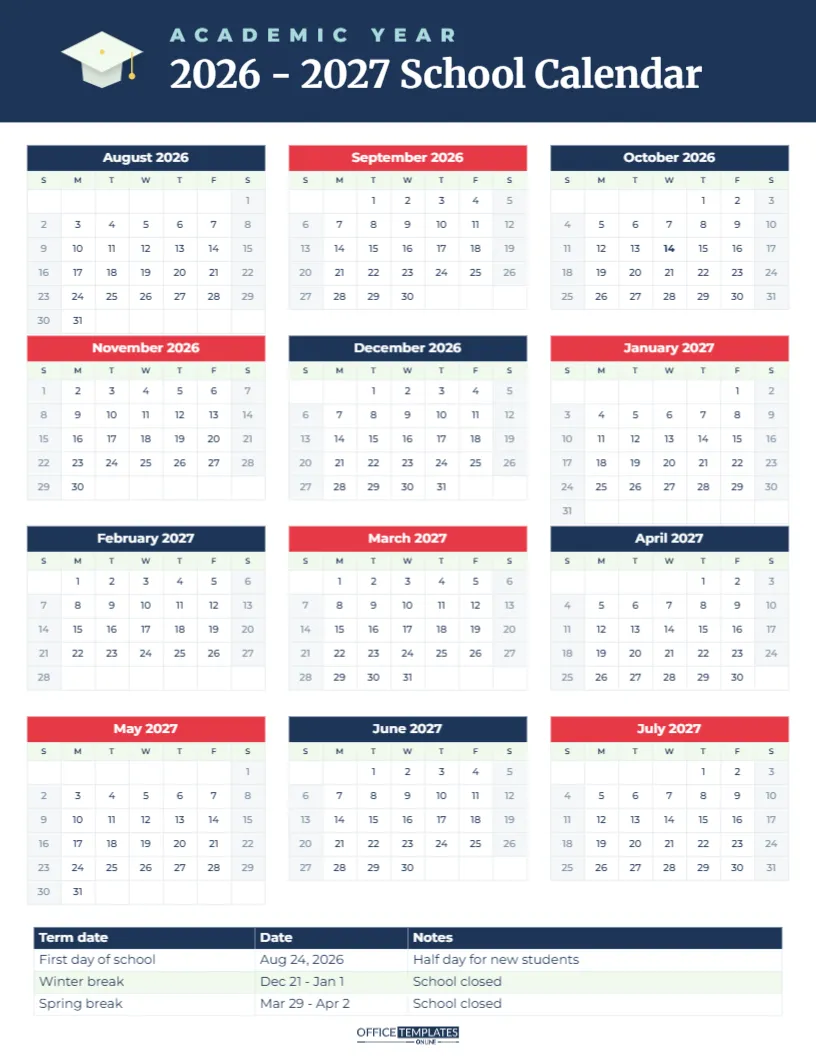
School years do not start in January. They start in late summer, with new pencils and new timetables, and they end the following July. An academic calendar follows that rhythm, putting the whole school year on a single page from August 2026 to July 2027. Teachers, parents, students, and school offices all rely on one, and this version is clean, readable, and easy to update.
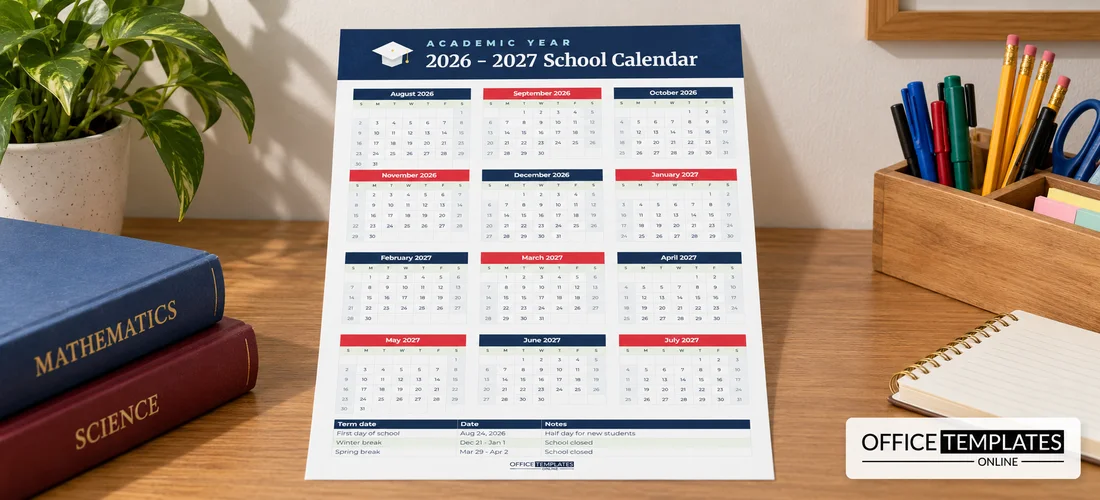
The Page at a Glance
The calendar is US Letter, 8.5 x 11 inches, portrait. A deep navy header carries a cream and gold mortarboard on the left, ACADEMIC YEAR in pale blue spaced capitals, and 2026 – 2027 School Calendar in Merriweather, a sturdy serif font. Below the header, twelve small month calendars are arranged three across and four down, beginning with August 2026 and ending with July 2027.
The month title bars alternate deep navy and bright red, which makes each month easy to find. Weekday initials sit on a pale mint row, dates are centred in each square, and weekends are lightly shaded. Under the months, an editable table lists term dates with columns for the event, the date, and notes. The OTO logo sits at the foot in navy.
Walking Through the School Year
A school year has a shape, and the calendar makes it visible. Here is how the year usually unfolds, and what to mark in each stretch.
Late Summer: August and September
The first row of the calendar covers August, September, and October. Mark the first day of school, any staggered starts for new students, the first parent evening, and picture day. In many schools, September is also when after-school clubs begin. Writing these on the calendar early helps families plan childcare and transport before the busy weeks arrive.
Autumn Term: October to December
The second stretch runs from October to December. Mark half-term or fall break, Halloween and harvest events, parent-teacher conferences, winter concerts, and the last day before the winter break. Many teachers also note report deadlines and assessment weeks here, because the end of the first term is often the busiest time of the school year.
Winter and Spring: January to April
The third row of months holds the new calendar year and the long spring term. Mark the return date after winter break, mid-year exams, the spring half-term or ski week, spring break and any school trips. February and March often hold book weeks, science fairs and sports days, so this is a good place to use a second colour.
Summer Term: May to July
The final row covers May, June and July. Mark final exams, graduation or moving-up ceremonies, sports day, the end-of-year party and the last day of school. Many families also mark the first weeks of summer camps or holiday plans here, so the end of one year flows smoothly into the next.
The Term Dates Table
| Term date | Sample entry | What to change |
|---|---|---|
| First day of school | Aug 24, 2026 | Your school’s start date |
| Winter break | Dec 21 – Jan 1 | Your district’s holiday dates |
| Spring break | Mar 29 – Apr 2 | Your spring holiday |
The table on the calendar is the editor’s Table object. Click a cell to type, and use the Table options to add rows for more dates, such as teacher training days, exam weeks, or the last day of school.
Using It for Different Calendars
Every month is its own Calendar object, so each one can be changed in Calendar Options. That means the layout adapts to other academic years too. For the 2027–2028 school year, set each month one year later. Schools in the Southern Hemisphere can set the twelve months from January to December instead. Universities can use the same layout for a semester calendar by renaming the header. You can also switch the week to start on Monday for countries that use Monday-start calendars.
For Teachers: Planning Lessons Around the Calendar
Teachers can use the academic calendar to plan the year’s teaching before term begins. Count the teaching weeks in each term, mark assessment points, and spread units so that big projects do not land in the same week as concerts or trips. Seeing the whole year on one page also makes it easier to protect revision time before exams and to plan lighter weeks just before breaks, when attention is lower. Many teachers keep a copy taped inside their planner and refer to it every week.
For Families: Avoiding Clashes
For parents, the academic calendar is the key to planning holidays, appointments, and childcare. Book family trips in the breaks, schedule dentist visits on half-days, and arrange childcare for teacher training days well in advance. If you have children in different schools, print one calendar for each school and highlight the differences, so nobody is caught out by a closure day.
Colour Coding for Teachers and Families
- Red: school closed (holidays and breaks).
- Blue: exams and assessments.
- Green: trips, events and celebrations.
- Orange: deadlines for forms, fees and reports.
Highlighters work well on the small squares; add a key in the notes column of the table.
For Students: Owning Your Own Year
Older students benefit from keeping their own copy. Mark exam dates, coursework deadlines, sports fixtures and revision weeks, and count backwards from each deadline to set start dates. Seeing the year on one page helps students notice crunch periods early, such as three deadlines in the same fortnight, and plan around them rather than panicking the week before. A highlighter for each subject keeps the page readable even when it fills up.
Getting the Calendar to Every Family
Download the PDF and print on letter paper for the fridge, a teacher’s planner, or a student binder. School offices often print it on card and send it home in the first week, or post a PNG on the school website and newsletter. Because one page holds the whole year, it is the most useful document a family can receive at the start of term.
Set your school’s dates, print a copy for every family, and start the year organised.