Habits are built in tiny steps, repeated until they stick. A habit tracker makes those steps visible, and seeing a streak grow is one of the best motivators there is. This guide walks you through setting up the tracker, step by step, then explains the design.
Step 1: Choose No More Than Eight Habits
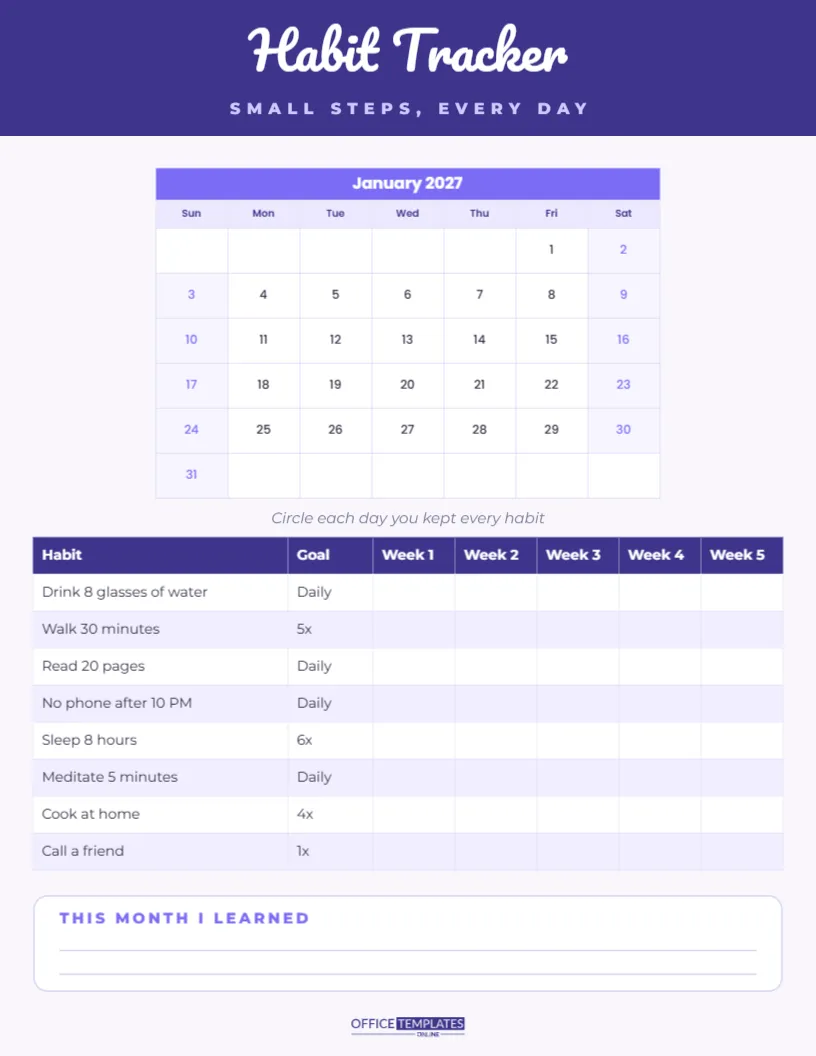
The table on the tracker has eight rows, and that is the upper limit, not a target. Most people succeed with three to five. Choose habits that are small and specific. Drink 8 glasses of water works; be healthier does not. The sample habits are drink 8 glasses of water, walk 30 minutes, read 20 pages, no phone after 10 PM, sleep 8 hours, meditate 5 minutes, cook at home, and call a friend. Click any cell in the table to replace it with your own.
Step 2: Set a Realistic Goal for Each Habit
The Goal column says how often you aim to do each habit: Daily, 5x (five times a week), or 1x. Realistic goals keep you going. If you currently walk once a week, aim for three times, not seven. You can always raise the goal next month. A habit you keep at 80% is worth far more than one you abandon in week two.
Step 3: Set the Month
The month calendar at the top is the editor’s built-in Calendar object. Select it, open Calendar Options, and choose the month and year. The title and dates update automatically. You can also start the week on Monday so the weeks line up with the Week 1 to Week 5 columns of the table.
Step 4: Track Every Evening
Each evening, take thirty seconds:
- Make a tally mark in the week column for each habit you completed today.
- If you kept every habit, circle today’s date on the calendar.
- If you missed one, just leave it; tomorrow is a new day.
Doing this at the same time each day, such as just before bed, turns tracking into a habit of its own.
Step 5: Read the Patterns Weekly
At the end of each week, look at the tallies. Which habits are easy? Which keep slipping? Often a habit fails because of timing, not willpower. If you never read in the evening, try reading at lunchtime. If walking fails on rainy days, plan an indoor alternative. Small adjustments make a big difference.
Step 6: Reflect at the End of the Month
At the bottom of the page, a white box titled THIS MONTH I LEARNED has two lines for reflection. Write one thing that helped and one thing to change next month. Then print a new page, adjust your habits and goals, and start again. Over a year, these notes reveal what really works for you, and which habits have become so natural that you no longer need to track them.
Step 7: Stack Habits Together
One of the most effective tricks is habit stacking: linking a new habit to something you already do. Drink a glass of water right after brushing your teeth. Read twenty pages right after dinner. Meditate for five minutes right after your morning coffee. Write the trigger next to each habit in the table, such as after coffee, so the cue is always visible. Stacked habits need much less willpower because the existing routine reminds you.
Step 8: Be Kind When You Miss a Day
Everyone misses days. Illness, travel, and busy weeks happen. The important rule is never to miss twice in a row. If yesterday’s square is empty, make today’s count, even with a smaller version of the habit, such as a ten-minute walk instead of thirty. The tracker is there to help you see progress, not to judge you; a month with twenty circled days is a huge success.
Step 9: Reward the Streaks
Rewards help early on. Decide in advance what a full week of circled days earns, such as a long bath, a new book, or a film night, and what a whole month earns. Write the rewards in the reflection box so you can see them every evening. Over time, the satisfaction of a long streak becomes the reward itself, but a little extra motivation in the first month makes a real difference.
How the Tracker Looks
The tracker is US Letter, 8.5 x 11 inches, portrait, on a very pale lavender background. A deep purple header holds Habit Tracker in white Pacifico script, with SMALL STEPS, EVERY DAY in lilac spaced capitals. The month calendar sits in the centre with a bright lavender title row, a pale lilac weekday row, centred dates and soft weekend shading. A small italic note reminds you to circle each day you kept every habit.
Below, the habit table has a deep purple header row and soft lilac stripes, with columns for Habit, Goal, and Week 1 to Week 5. The reflection box and the OTO logo complete the page.
Habit Ideas by Goal
| Goal | Small daily habit |
|---|---|
| Better sleep | No screens after 10 PM |
| Fitness | A 20-minute walk |
| Learning | 15 minutes of a language app |
| Calm | 5 minutes of breathing or meditation |
| Money | Log every purchase |
| Home | A 10-minute tidy before bed |
| Relationships | Send one kind message a day |
Restyling the Tracker in Mint, Coral or Grey
The lavender and purple palette is calm and encouraging. To change it, recolour the header and reflection box, set the calendar colours in Calendar Options, and the table colours in the Table Options. Mint and teal feel fresh; peach and coral feel energetic; grey and black feel minimal. Fonts are Pacifico for the title and Poppins for the rest, both Google Fonts.
Printing and Keeping Your Trackers
Download the PDF and print on letter paper. Keep the tracker somewhere you see every evening: on the bedside table, the bathroom mirror, or the fridge. Store completed months in a folder. Looking back at a year of trackers is a powerful reminder of how much small steps add up.
Pick your habits, set the month, and make tonight’s first tally. Small steps, every day.