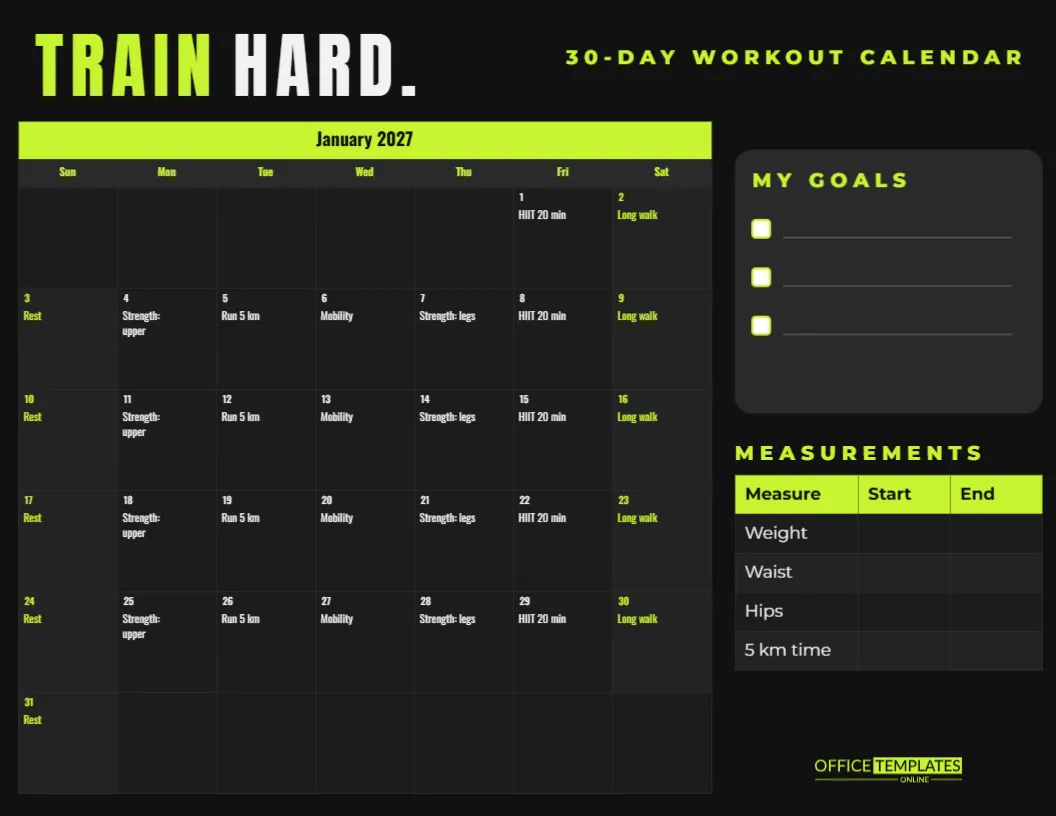
Motivation fades; plans keep going. A workout calendar puts every session on the page before the month begins, so the only decision each day is whether to lace up your shoes. This calendar is bold and dark, like a gym wall, with a full weekly training split already written into every date. Here is the month, week by week.
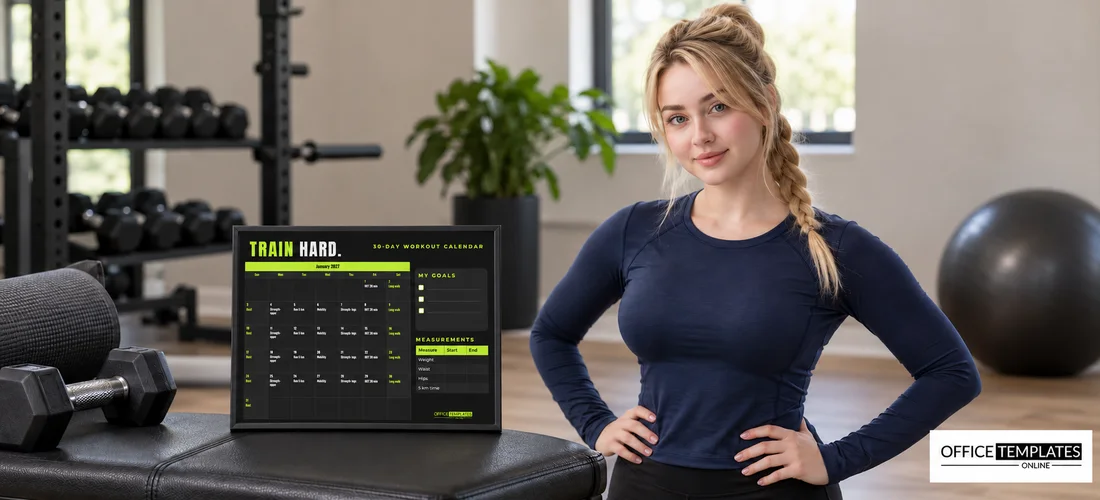
The Look: Black, Lime and Loud
The calendar is US Letter landscape, 11 x 8.5 inches, on a black background. TRAIN is written in neon lime Anton capitals and HARD. in white, with 30-DAY WORKOUT CALENDAR in lime on the right. The month calendar uses the editor’s Task Calendar style: a lime title row, dark grey weekday names in lime, charcoal date squares with white numbers, and slightly lighter weekend squares. Every date carries its workout in white.
On the right, a dark MY GOALS panel has three checkboxes with lines, and below it a MEASUREMENTS table with a lime header lists weight, waist, hips, and 5 km time, each with Start and End columns. The OTO logo sits in lime at the bottom.
Week One: Building the Routine
The sample plan follows the same split every week, so it becomes automatic: Sunday rest, Monday upper-body strength, Tuesday a 5 km run, Wednesday mobility, Thursday leg strength, Friday a 20-minute HIIT session, and Saturday a long walk. In the first week, focus on showing up rather than intensity. Use lighter weights, run at a conversational pace, and learn the movements properly. Tick each finished session or mark it with a highlighter.
Week Two: Finding Your Baseline
By week two, the routine feels familiar. Record the weights you lift and your run time in a notebook or on your phone. This is your baseline. Fill in the Start column of the measurements table if you have not already. Keep mobility day sacred; it is what keeps your joints happy as training gets harder.
Week Three: Adding a Little More
Now increase the challenge slightly. Add a set to your strength exercises, a few more seconds to your HIIT intervals, or a little pace to the run. Progress should be gradual, around 5 to 10% a week, to avoid injury. If you feel run down, swap Friday’s HIIT for an easy walk; consistency matters more than any single session.
Week Four: Testing and Celebrating
In the final full week, retest your 5 km run and your main lifts, and fill in the End column of the measurements table. Compare with your start. Even small improvements, like a minute off your run time, are real progress. Check off your goals in the MY GOALS panel, and choose a reward, such as new trainers or a massage.
The Weekly Split at a Glance
| Day | Session | Purpose |
|---|---|---|
| Sunday | Rest | Recovery and sleep |
| Monday | Strength: upper | Chest, back, shoulders, arms |
| Tuesday | Run 5 km | Cardio fitness |
| Wednesday | Mobility | Stretching, yoga, foam rolling |
| Thursday | Strength: legs | Squats, lunges, hinges |
| Friday | HIIT 20 min | Conditioning and calorie burn |
| Saturday | Long walk | Easy movement and fresh air |
Fuel, Sleep and Recovery
Training is only half of fitness; the other half happens between sessions. Aim for seven to nine hours of sleep, especially on the nights before strength days. Eat enough protein to support muscle repair, and drink water throughout the day. Sunday’s rest day is part of the plan, not a missed workout. If a muscle is sore for more than a few days, swap the next session for mobility work or a walk. Recovery is when your body actually gets stronger.
Training with a Partner
A workout calendar is even more effective when shared. Print two copies and train with a friend, partner, or colleague. Check each other’s progress at the end of each week, and agree on a shared reward for finishing the month. Accountability is one of the best predictors of sticking with a plan, and it makes the hard sessions more fun.
Tracking More Than the Scales
The measurements table deliberately includes more than body weight. Waist and hip measurements show changes that scales miss, especially when you are building muscle while losing fat. The 5 km time measures fitness rather than appearance, which many people find more motivating. Measure at the same time of day, ideally in the morning, at the start and end of the month. Add rows with the Table options for anything else you want to track, such as push-ups in a minute or resting heart rate.
Writing Your Own Plan
The workouts are notes inside the calendar. Select the calendar and open Calendar Options to see every date with its note. Change any session, for example, Swim 30 min or Football practice, and it updates on the page. If your plan changes week to week, type each date individually. Change the month and year in the same panel; the dates update automatically.
Plans for Different Goals
- Beginners: three sessions a week, with walks on other days.
- Runners: swap strength days for intervals and a long run.
- Weight loss: add a second walk and keep two strength days.
- Strength focus: four strength days, one cardio day, two rest days.
Always check with a healthcare professional before starting a new exercise programme, especially after an injury or a long break.
Recolouring the Calendar
Black and lime suit a gym or a garage training corner. For a softer look, set the calendar colours to white and teal in Calendar Options and change the background. The bold headline font is Anton; the calendar uses Oswald; any Google font can be chosen in the editor.
Printing It for the Gym Wall
Download the PDF and print in landscape. The dark design uses a lot of ink, so print one copy on good paper rather than several drafts. Put it where you train or next to your bed, so you see tomorrow’s session before you sleep and can lay out the right kit the night before.
Check the plan, set out your kit tonight, and start week one tomorrow.