Reading every day is one of the best habits a child can build, but daily reading logs often turn into a chore that parents nag about and children resent. Most of the problems come from a few common mistakes. Here they are, and how this reading calendar is designed to avoid them.
Mistake 1: Making the Log Feel Like Homework
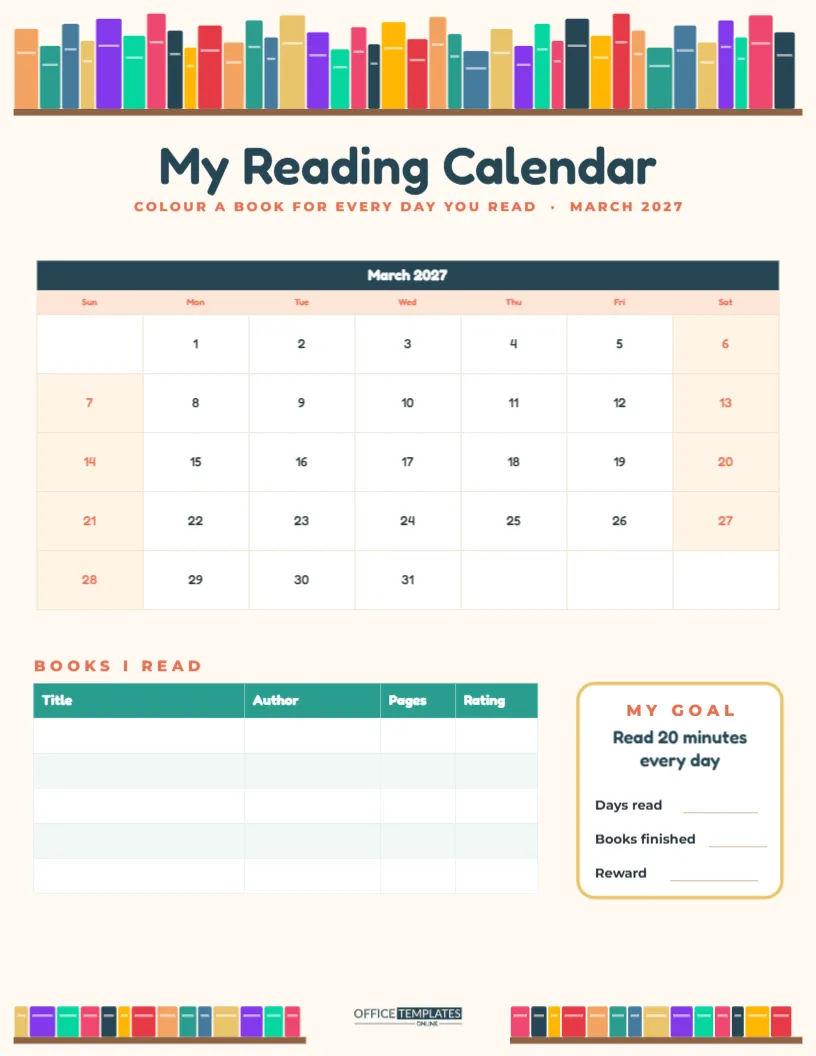
Many school reading logs are grey grids with columns for minutes and parent signatures. Children see them as paperwork. This calendar looks like a bookshop instead. A long shelf of colourful book spines in red, orange, teal, blue, yellow, purple and pink runs across the top of the page, standing on a wooden plank. The title My Reading Calendar is set in friendly rounded Fredoka, with COLOUR A BOOK FOR EVERY DAY YOU READ · MARCH 2027 in coral capitals. Two smaller bookshelves sit at the bottom corners of the page on either side of the logo, so the whole page feels like a reading corner.
Mistake 2: Tracking Minutes Instead of Days
Counting exact minutes encourages clock-watching. The main calendar asks a simpler question: did you read today? If yes, colour the date. The month calendar is large, with a navy title row, peach weekday labels, big friendly date numbers, and warm-tinted weekends. Children can colour each date like a book spine, draw a tiny book in it, or add a sticker. A month of coloured dates is far more motivating than a column of numbers.
Mistake 3: Forgetting What Was Read
By the end of a month, many children cannot remember the books they finished. Under the calendar, a BOOKS I READ table has columns for Title, Author, Pages, and Rating, with five rows for the month’s books. The Rating column is for stars or a quick score. Looking back at the list builds pride, and the ratings help children notice which authors and series they love, which makes choosing the next book easier.
The table is the editor’s Table object: add rows for avid readers, or add a column for Started and Finished dates.
Mistake 4: Setting Goals That Are Too Big
Read for an hour a day sounds great until it fails on the first busy evening. To the right of the table, a goal card with a golden border reads MY GOAL: Read 20 minutes every day. Twenty minutes is the amount many teachers recommend, and it is achievable even on school nights. Below the goal are lines for Days read, Books finished, and a Reward, filled in at the end of the month.
| Reader | Suggested daily goal | Good reading ideas |
|---|---|---|
| Ages 4 to 6 | 10 to 15 minutes, read together | Picture books, rhyming books |
| Ages 7 to 9 | 15 to 20 minutes | Early chapter books, comics |
| Ages 10 to 12 | 20 to 30 minutes | Series, adventure, non-fiction |
| Teens | 30 minutes or more | Novels, graphic novels, magazines |
Mistake 5: Only Counting “Proper” Books
Comics, graphic novels, magazines, recipe books, audiobooks, and reading to a younger sibling all count. Children who are allowed to choose what they read read more. Let them colour the date for any kind of reading, and write all of it in the table.
Mistake 6: No Celebration at the End
A month of reading deserves a reward. Agree on it at the start and write it on the Reward line: a trip to the bookshop, choosing a new book, a library visit followed by hot chocolate, or staying up fifteen minutes late to read. Celebrate the effort, even if not every date is coloured.
Why March?
The sample is set to March 2027 because March is a popular reading month in many schools, with World Book Day and reading challenges, but the calendar works for any month. It is the editor’s Calendar object: open Calendar Options to change the month and year, and the dates rebuild instantly. You can start the week on Monday and recolour the title row and weekends as well.
Giving the Bookshelf Your Child’s Name and Colours
Add your child’s name to the title (Leo’s Reading Calendar) and change the colours to their favourites. The bookshelves are grouped shapes, so you can recolour or move them in one click. Fonts are Fredoka and Montserrat, both Google Fonts, chosen for clear letter shapes that beginning readers find easy.
Mistake 7: Reading Only When Told To
The strongest readers read because they want to, not because a log demands it. Help that happen by making reading easy and pleasant: a basket of books by the sofa, a reading lamp by the bed, regular library visits and adults who read too. Read aloud to children long after they can read alone; many children love being read to well into their pre-teen years, and it exposes them to books slightly above their own level. The calendar then becomes a record of something enjoyable, rather than a reason to read.
Talk about books as well. Ask what happened in the chapter, who their favourite character is, or what they think will happen next. Those conversations do more for comprehension than any number of signed logs. Even five minutes of chat at bedtime about a favourite page keeps the habit warm and shows children that their reading matters to you, and that books are something the whole family shares.
For Teachers and Librarians
Teachers can send the calendar home at the start of each month and ask pupils to bring it back at the end; a class display of coloured calendars is a powerful reminder of how much everyone read. Librarians can use it for a holiday reading challenge with a small prize for every completed month.
Printing the Reading Log
Print one page per child per month on plain paper, and keep the finished months in a folder to show progress over the year. Put the current month on the fridge or inside the front cover of a library book bag, with coloured pencils nearby.
One book, one day, one coloured date at a time. Happy reading!