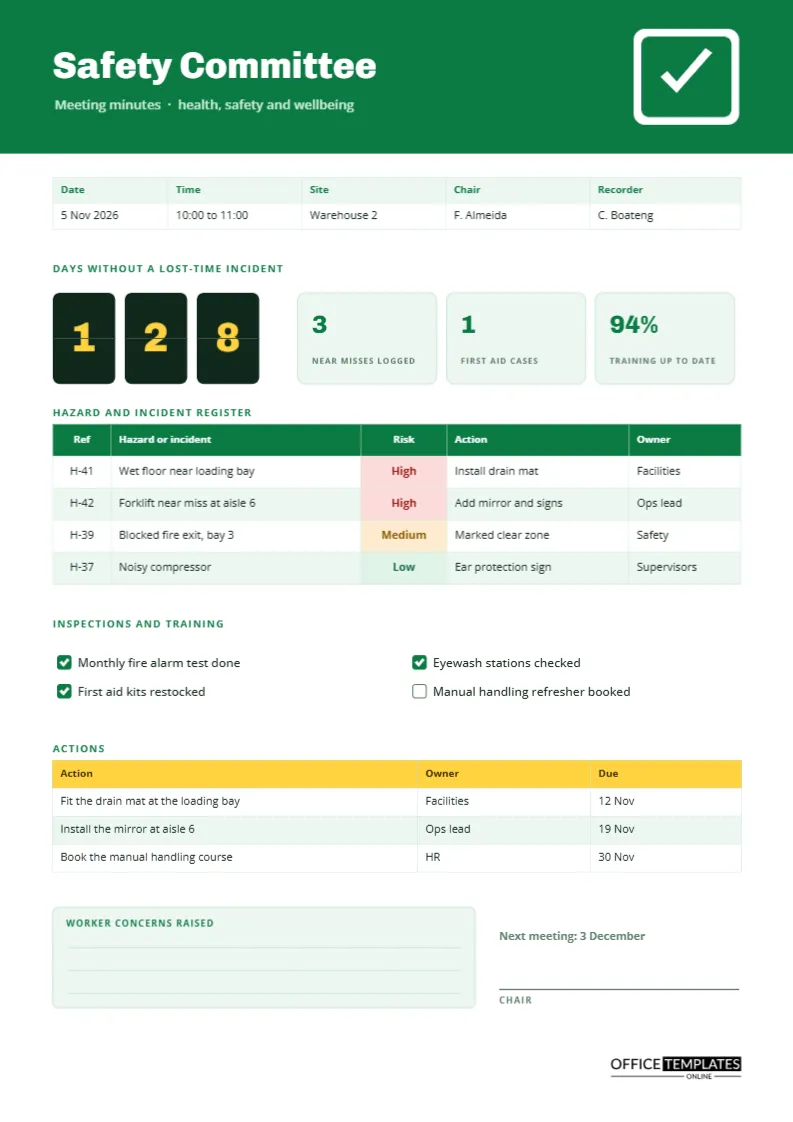
A safety committee meets for one reason: to stop people from getting hurt. Its minutes are more than paperwork, because they show that hazards were identified, that someone was given the job of fixing each one, and that workers’ concerns were heard. In many places, they are also evidence of legal compliance. This template makes the most important facts impossible to miss, starting with a counter of days since the last lost-time incident and ending with a list of actions.
A Green Sign in the Corner
The header is a solid safety green. At the top right, a white rounded square holds a smaller green square with a bold white check mark, the look of a safe condition sign. The title Safety Committee is set in heavy Chivo, with a subtitle reading Meeting minutes, health, safety and wellbeing. Green is the standard colour for safe conditions, so the page signals its purpose before any text is read.
Days Without an Incident, in Big Digits
Three dark tiles show the number 128 in yellow digits, in the style of an old flip counter, under the label Days without a lost-time incident. Next to them, three tiles show near misses logged, first aid cases, and training up to date. Workplaces often post a sign like this by the door. Putting it on the minutes makes the first item of every meeting a review of what the number means and what has changed since last time.
Reading the Safety Numbers Together
| Measure | Sample figure | What it tells the committee |
|---|---|---|
| Days without lost-time incident | 128 | Whether serious injuries are being prevented |
| Near misses logged | 3 | Where accidents almost happened |
| First aid cases | 1 | Minor injuries that need attention |
| Training up to date | 94% | Whether people know the safe way to work |
Why Near Misses Matter More Than They Look
A near miss is an accident that did not happen by luck. In the sample, a forklift nearly collided with someone in aisle six. Recording it, finding the cause, and adding a mirror and signs may prevent a real injury next time. A committee that logs more near misses is often a healthier one, because people feel safe reporting them.
The Hazard and Incident Register
The main table lists a reference, the hazard or incident, a risk rating, the action and an owner. The risk cell is coloured: red for High, amber for Medium and green for Low. The sample lists a wet floor at the loading bay, a forklift near miss, a blocked fire exit and a noisy compressor. References such as H-41 let the committee track each item across meetings until it is closed.
Rating Risk in a Way Everyone Understands
A simple method multiplies the likelihood of harm by its severity, each on a scale of one to five. A high score demands an immediate action, a medium score a planned one, and a low score monitoring. Whatever method you use, write it somewhere visible and use it consistently, so a high rating means the same thing in every meeting.
Inspections and Training as a Checklist
Four check boxes record routine checks: the monthly fire alarm test, eyewash stations, first aid kits, and a booked manual handling refresher. In the sample, the first three are ticked, and the last is not. A short checklist at each meeting keeps recurring duties from slipping.
Actions That Have Owners and Dates
A yellow-headed table lists three actions, each with an owner and date: fit a drain mat, install a mirror, and book a course. A safety action without an owner and date is a wish. The next meeting should open by reviewing these and closing the ones that are done.
Worker Concerns Raised
A tinted box with ruled lines records concerns raised by workers. The best safety committees treat these as the most valuable input. Record each concern, who raised it only if they wish and the response. Where possible, report back to the person who raised it.
Representation and Consultation
Many safety committees include worker representatives as well as managers. In some countries, consultation with workers is a legal duty. Note in the minutes who attended on which side, so that the record shows that both were present when decisions were made.
Editing the Counter and Tiles
The three digits are separate text boxes on dark tiles, so retype them each month. The smaller tiles are text boxes too. The register and action tables are real Table objects, with Edit Table Data and Add Row, and the risk cells hold typed words with a fill colour.
Printing and Posting the Page
A4 portrait. Many sites post the committee’s minutes on a safety notice board. The green header prints well in colour, and in black and white the digits and risk words keep the page readable.
Closing the Loop on Every Hazard
A hazard is not fixed when it is listed. It is fixed when the action is done, checked, and recorded. At each meeting, read the open items of the register one by one and ask whether the action is complete and whether it worked. If a mirror was fitted at aisle six, did the near misses stop? Marking an item closed only after a check keeps the register honest and builds confidence among workers that reporting leads to real change.
Sharing Safety Messages With the Whole Site
The committee’s work only matters if the workforce hears about it. After each meeting, post the page on the notice board and give a two-minute summary at the next toolbox talk. Highlight one success, such as the drain mat fitted at the loading bay, and one reminder, such as the refresher course. A steady flow of simple messages does more for safety culture than a thick policy manual.
Reviewing Trends Over a Year
Keep each month’s page in order and look back at the digits and near-miss counts every quarter. If near misses rise while injuries stay flat, people may be reporting more, or conditions may be worsening. Discuss which it is. Trend reviews turn monthly minutes into a tool for planning training, equipment, and staffing for the year ahead.
Safety Committee Questions
How often should the committee meet?
Monthly is common, and some rules require at least quarterly meetings.
Is this a legal compliance document?
It is a layout. Legal requirements vary, so check your local rules.