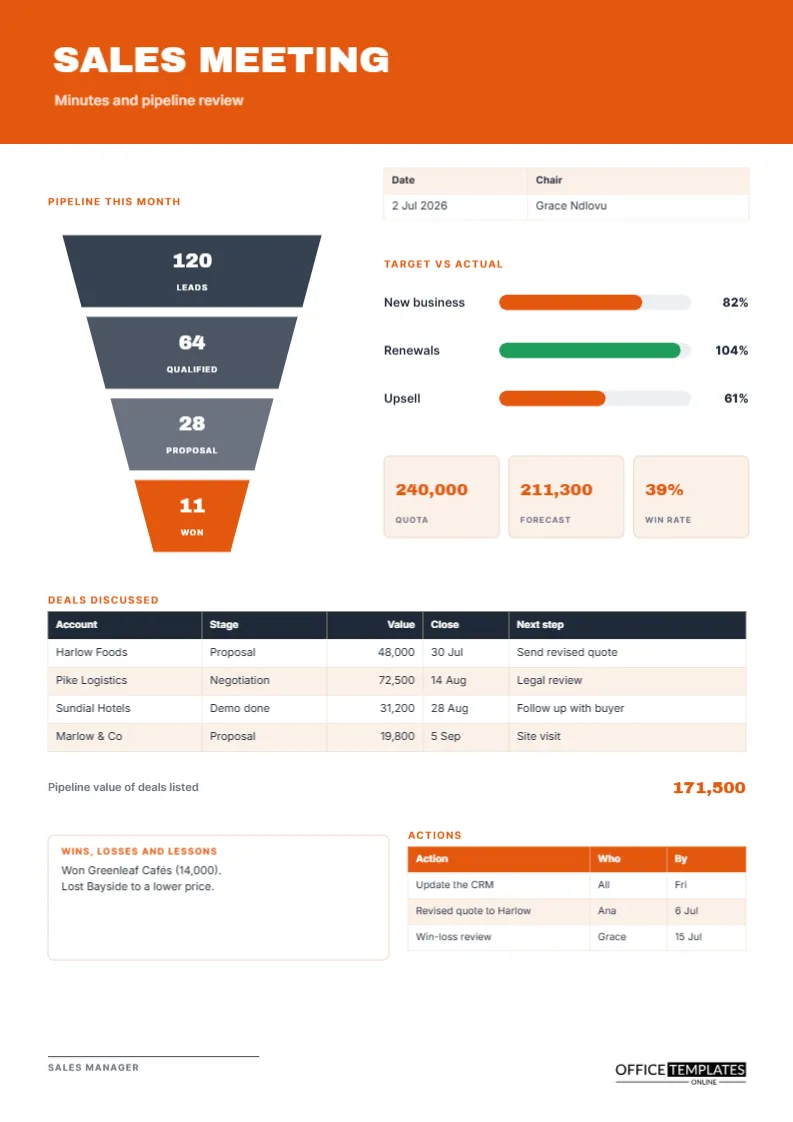
Sales meetings are crowded with numbers. Targets, forecasts, stages, close dates, and next steps all arrive at once, and the minutes often reduce them to a long paragraph that nobody can use. This template turns the numbers into pictures first and words second. A funnel shows how leads narrow to wins, three bars compare target with actual, and a compact table lists the deals that were discussed, with the pipeline value worked out at the bottom.
Why a Funnel Belongs in Sales Minutes
A funnel is the quickest way to see where a pipeline leaks. In the sample, 120 leads become 64 qualified, 28 proposals, and 11 won deals. The widest drop is between leads and qualified, which suggests the team should talk about lead quality, not closing technique. Recording the four numbers at every meeting lets you compare month to month and spot a pattern before it becomes a problem.
A Bold Orange Header and Archivo Black Type
The top of the page is a solid orange block with the title SALES MEETING in white Archivo Black and a short line below it reading Minutes and pipeline review. The rest of the page is white with charcoal table headers and orange accents, and Inter handles the small text. The funnel itself is drawn in four steps of grey, with the final Won stage in orange.
Reading Target Versus Actual
Three horizontal bars compare new business, renewals, and upsell with their targets. The sample shows 82 percent, 104 percent, and 61 percent. A bar that passes the target turns green, and the others stay orange. The scale stops just beyond 100 percent, so an over-achiever fits without running off the page. Retype the labels and drag the fills to match your own figures.
Three Tiles for Quota, Forecast and Win Rate
Under the bars, three small tiles show the quota of 240,000, the current forecast of 211,300, and a win rate of 39 percent. Use them for the figures your leaders ask about first. If your team sells in a different currency, add the symbol to the numbers.
The Deals Discussed Table
The table lists four deals with account, stage, value, expected close date, and next step. Values are right-aligned so you can add them in your head. The line beneath the table shows a pipeline value of 171,500, which is the sum of 48,000, 72,500, 31,200, and 19,800. Table cells hold typed text, so when you change a value, retype the total by hand.
Writing a Next Step a Salesperson Can Act On
| Weak next step | Better next step | What changes |
|---|---|---|
| Follow up | Send the revised quote | A named document |
| Check with buyer | Follow up with the buyer on Thursday | A person and a day |
| Legal stuff | Legal review of the contract | A defined step |
| Visit | Site visit before 5 September | A deadline |
Wins, Losses and Lessons
A white box at the lower left records one win and one loss. In the sample, the team won a cafe chain and lost an account to a lower price. A single line on why each deal went the way it did is the most valuable learning a sales team can keep. Over a year, the box becomes a rough list of what customers value.
Actions With Names and Dates
An orange-headed table on the right lists actions, owners, and dates. The sample includes updating the CRM, sending a revised quote, and holding a win-loss review. Keep actions short and specific, and review them first at the next meeting.
How Long a Sales Meeting Should Run
Many teams find thirty to forty-five minutes enough when numbers come from a shared system. Spend the first five on the funnel, ten on target versus actual, fifteen on the biggest deals, and the rest on actions. The page reflects that order from top to bottom.
Reshaping the Four Stage Funnel
The funnel is a group of four shapes with text boxes. To change the stage names, retype the labels. To add a fifth stage, copy a shape, shorten the widths of those below it, and move the group. If you sell without proposals, rename the third stage Demo.
Using the Funnel to Coach, Not Just to Count
A funnel is a coaching tool. If the drop between proposals and wins is steep, the team might review how quotes are written and followed up. If leads are plentiful but few qualify, the conversation might turn to targeting. By writing the four numbers every meeting, you give the manager an objective starting point for a conversation that would otherwise rely on opinion. Pair the funnel with the wins, losses, and lessons box, and the coaching points often write themselves.
Keeping Sales Minutes Honest
Sales figures have a way of becoming optimistic. To keep the page trustworthy, agree the definition of each stage in advance and write it somewhere visible, for example in the footer. A deal counts as a proposal only when a written quote has been sent. A deal counts as won only when a signed order arrives. When everyone uses the same rules, the numbers on the page mean the same thing from month to month and from one salesperson to another.
Printing the Sales Page
The page is A4. The orange header prints strongly in colour, so for draft copies you can change its fill to a light tint. A grayscale copy keeps the funnel readable because each stage carries its own number and label.
Sharing the Sales Page With Finance and Operations
Sales minutes are read by more people than the sales team. Finance wants the forecast, and operations wants to know which large deals might land next month, because that affects staffing and stock. Send the page the same day with a short note naming the deals most likely to close. Because the pipeline value and the close dates sit in one table, both departments can plan from it without asking for a separate report, and the sales team gains credit for being predictable.
Sales Manager Questions
Can I use this for a weekly pipeline call?
Yes. Change the date and update the funnel counts and deals each week.
Where should I record forecast changes?
Use the notes box on the lower left, or retype the Forecast tile and mention the reason beside it.