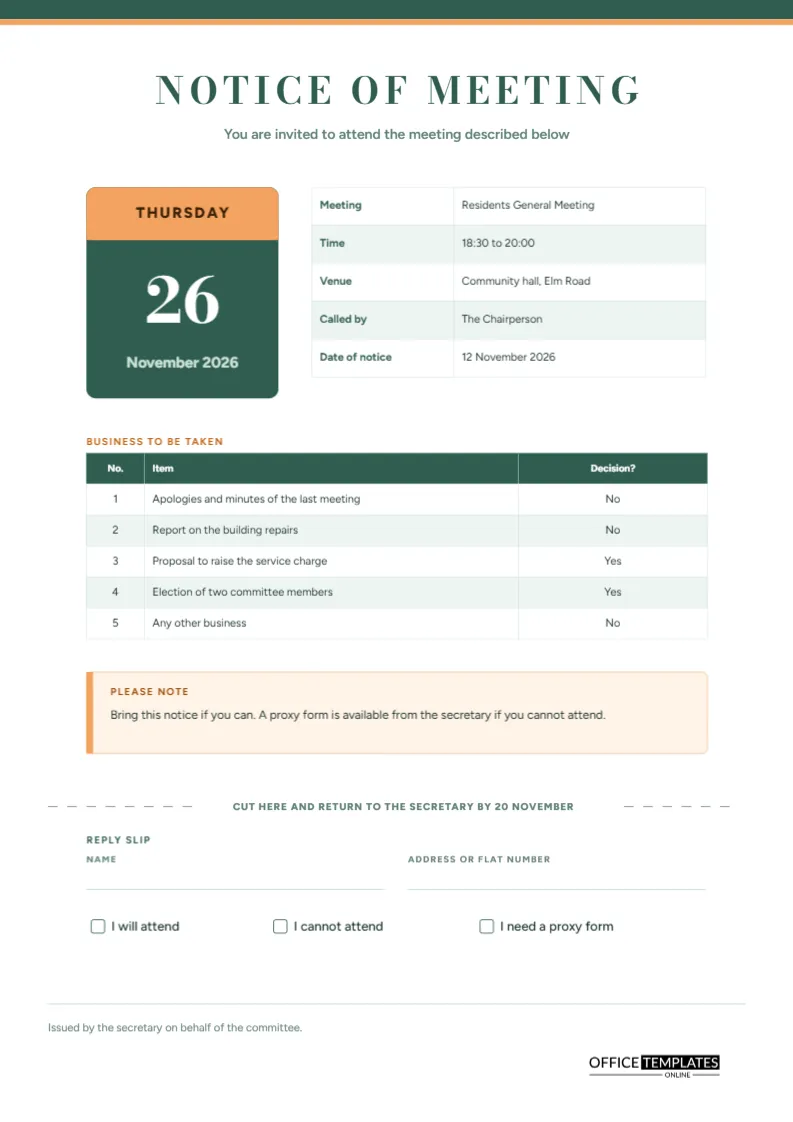
A notice of meeting is a short document with a long job. It must tell people when and where to come, what will be discussed, and whether anything will be decided. In many organisations, it is also the legal proof that members were told. The notice should be clear enough for a busy reader to understand in half a minute and formal enough to be filed as a record. This page is built for that: a large date tile, a neat details table and, at the foot, a reply slip to cut off and return.
A Calendar Tile as the First Thing You See
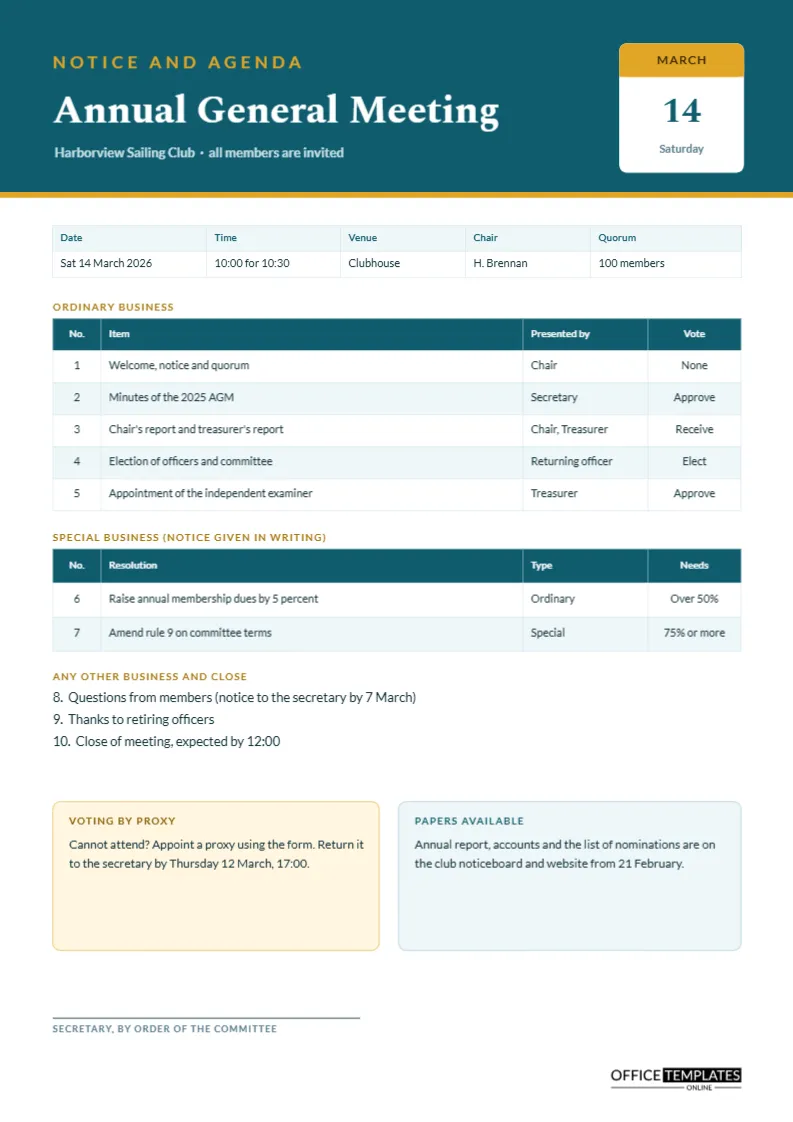
On the left of the page, a dark green tile imitates a calendar leaf. An amber band reads THURSDAY, a huge white 26 fills the centre, and November 2026 sits beneath. Next to it, a details table lists the meeting, time, venue, who called it, and the date of the notice. People look for the date before anything else, so the layout puts it where the eye lands first.
Elements of a Clear Notice
| Element | Where it appears | Why it matters |
|---|---|---|
| Date and time | Calendar tile and table | Lets people plan their day |
| Venue | Details table | Prevents wrong turns |
| Who called it | Details table | Shows the notice is authorised |
| Date of notice | Details table | Proves the notice period was met |
| Business | Business table | Tells people what will be discussed |
Green, Peach and Bodoni Type
A deep green bar with a thin peach line crosses the top of the page. The title NOTICE OF MEETING is set in Bodoni Moda capitals with wide spacing, and Figtree carries the rest. The palette is formal without being cold, so the page suits a residents’ association, a club, a company or a school equally well.
Business to Be Taken, With a Decision Marker
The table of business lists five items and a column headed Decision, with Yes or No. In the sample, a proposal to raise the service charge and the election of two committee members are marked Yes. Telling people which items involve a vote encourages attendance when it matters and helps members who can only come for a particular matter to plan their time.
The Please Note Box
A pale peach box with a peach edge carries a short note: bring this notice if you can, and ask for a proxy form from the secretary if you cannot attend. Keep the note short. People skim notices, and one clear instruction is more likely to be read than three.
A Reply Slip Under a Cut Line
Near the bottom, a row of dashes with the words CUT HERE AND RETURN TO THE SECRETARY BY 20 NOVEMBER marks the line where the notice ends and the slip begins. The slip has fields for name and address or flat number, and three check boxes: I will attend, I cannot attend, and I need a proxy form. Knowing numbers in advance helps with seating, refreshments, and quorum planning.
How Much Notice to Give
The notice period depends on your rules and sometimes on the law. Three weeks is common for general meetings, and a shorter period for committee meetings. The sample gives two weeks. Always state the date of the notice, as this page does, so that the period can be checked.
Delivering the Notice
- Email a PDF to everyone with a known address.
- Post a printed copy to those without email.
- Pin a copy on the noticeboard.
- Keep a record of the date and the method of delivery.
Handling Replies and Proxies
Collect the slips in a folder and tally them a few days before the meeting. Send proxy forms to those who ask. A list of expected attendees helps the chair see whether a quorum is likely, and gives time to follow up by phone if numbers are short.
Editing the Notice and the Date Tile
Retype the weekday, day number, month, and year in the tile. The details table and business table are real Table objects, with Edit Table Data and Add Row. The reply slip fields are simple text boxes and lines, so change the labels to fit your own needs.
Printing and Cutting the Slip
A4 portrait. If you post the notice, print on one side so the slip can be cut cleanly. Leave a clear margin around the cut line, and consider adding a small box for stamps or an address if members will return it by post.
Wording a Notice So That People Come
A notice that sounds dull will be ignored. Say what is in it for the reader: a decision about the service charge affects every resident, and the election will decide who runs the committee. One sentence in the please note box explaining why attendance matters can raise turnout noticeably. Keep the tone polite and the language plain, avoiding jargon that only the committee understands.
Making the Notice Accessible
Think about who might find it difficult to attend. State whether the venue has step-free access, whether a hearing loop is available, and whether there is an option to join online. Add a line for members to ask for large print or another format. A notice that welcomes everyone gets a better response and shows that the organisation takes inclusion seriously.
Following Up on Replies
When slips come back, tally them and note any special requests, such as a need for a proxy form or a question for the agenda. Send a short reminder to members who have not replied a few days before the date. A gentle reminder often doubles the turnout, and it is far cheaper than a meeting that fails for lack of a quorum.
Dating and Filing the Notice
File the notice with the minutes and the list of people it was sent to. The date of the notice, shown in the table, together with the delivery record, proves that the notice period was kept. Store the page in the same folder year after year, so a later committee can see how meetings were called.
Notice Questions
Is this suitable for a company board meeting?
For directors, a simpler notice or an emailed agenda is usual, but the layout can be adapted.
Do I have to include a reply slip?
No. Delete it and the cut line if you do not need replies.