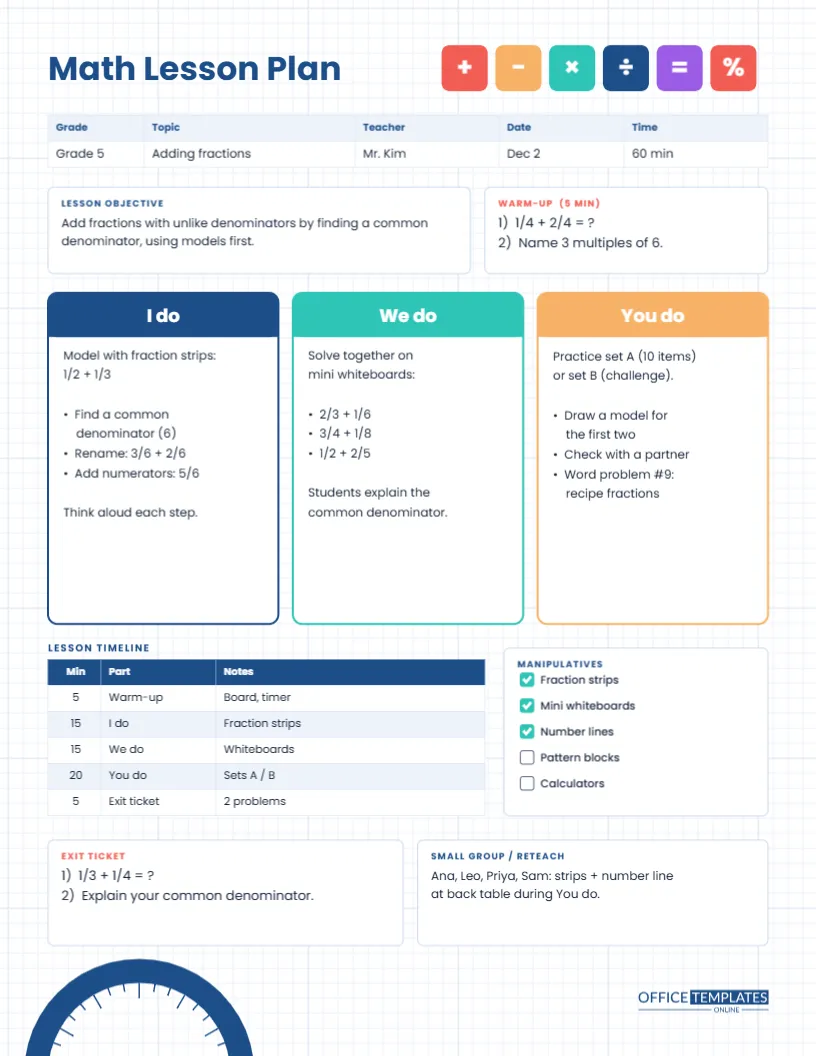
Good maths lessons tend to follow the same rhythm: a quick warm-up to activate prior knowledge, a teacher-led worked example, problems solved together, independent practice, and a short check before the bell. This maths lesson plan template is designed around that rhythm. It sits on blue graph paper, with a row of bright operation tiles in the header, and gives the three phases of gradual release their own tall coloured columns so you can plan the actual problems, not just the activities.
Graph Paper and Symbol Tiles
The whole page is covered in a light blue graph-paper grid, made with the editor’s background Pattern feature, so the plan looks like a page from a maths exercise book. Top right, six rounded tiles hold the symbols plus, minus, times, divide, equals, and percent in coral, amber, teal, navy, purple, and coral again. The title, Math Lesson Plan, is set in bold navy Poppins beside them. In the bottom-left corner, a navy protractor arc with degree ticks rises from the bottom edge, echoing the maths theme in the footer.
The Grid Is a Background Texture
Because the graph paper is a background pattern, it stays locked behind everything else and never gets in the way of editing. To change it, open Backgrounds, Pattern: make the squares bigger or smaller, fade the lines, change their colour, or remove the pattern for a plain white page.
Lesson Details and Objective
A strip under the title records grade, topic, teacher, date, and time; the sample is a 60-minute Grade 5 lesson on adding fractions with unlike denominators. The objective box states what students will do, and the coral-headed warm-up box holds two quick problems: 1/4 + 2/4, and naming three multiples of 6, which prepares students for finding common denominators.
Three Coloured Columns for Gradual Release
Three tall cards with coloured headers form the centre of the page:
| Phase | Card colour | Sample content |
|---|---|---|
| I do | Navy | Model 1/2 + 1/3 with fraction strips; think aloud each step |
| We do | Teal | Solve 2/3 + 1/6, 3/4 + 1/8 and 1/2 + 2/5 on whiteboards |
| You do | Amber | Practice set A (10 items) or set B (challenge), word problem #9 |
Writing the actual problems into each card is the key planning step. It forces you to choose examples that grow in difficulty, so the We Do problems bridge the gap between your model and independent work.
Choosing Good Examples
Pick a first example where the common denominator is easy to find, then one where one denominator is a multiple of the other, then one where students must multiply both. In the sample, 1/2 + 1/3 needs sixths, 2/3 + 1/6 only needs the thirds renamed, and 3/4 + 1/8 needs eighths. Planning this progression stops lessons from jumping too quickly to hard problems.
Timeline, Manipulatives and Small Groups
Below the cards, a timeline table lists each part with minutes and notes: warm-up 5, I do 15, we do 15, you do 20, and exit ticket 5, a full hour. To its right, a manipulatives checklist ticks fraction strips, mini whiteboards and number lines, with pattern blocks and calculators left unticked. At the bottom, the exit ticket box holds the final check, and a small-group box names the students who will work at the back table with strips and a number line during independent practice.
Using the Exit Ticket
The sample exit ticket asks students to add 1/3 + 1/4 and explain their common denominator. Sort the tickets into three piles after class. Students who got both right are ready to move on; students who found the denominator but made an adding error need a quick reminder; and students who could not find a common denominator join tomorrow’s small group.
Beyond Fractions
The structure fits any maths topic. For multiplication facts, the I do column holds an array model; for algebra, a worked equation; for geometry, a construction; for statistics, reading a graph. Edit the title row too: replace the operation symbols with ?, ?, x, and y for a high-school algebra version.
Editing the Columns
Each card is a group of shapes with a text box inside. Click the text to rewrite it; resize a card if one phase needs more space than another. The timeline is a real table, so Edit Table Data and Add Row work as usual.
Printing on Graph Paper
Download as PDF and print. The grid prints lightly, so handwritten notes stay easy to read. If you want students to use the page as a worksheet, delete the planning boxes and print the graph paper on its own.
For Maths Coaches and Interventions
Maths coaches and intervention teachers use the same three-phase structure in small groups. The small-group box at the bottom is a good place to plan who you will pull and what you will reteach, and the exit tickets from each lesson become the evidence for adjusting groups week by week.
Mistakes to Plan For
Every maths topic has predictable errors. With fractions, students often add the denominators (1/2 + 1/3 = 2/5) or forget to rename both fractions. Write the likely mistakes in the margin of the We do card and plan a question that will expose them, such as asking whether 2/5 can be bigger than 1/2. Catching a misconception during guided practice is far quicker than undoing it after a week of homework.
Maths Plan FAQ
Can I remove the protractor?
Yes. It is a group in the bottom-left corner; select it and delete.
Can I change the symbol tiles?
Yes. Each tile is a shape with a text symbol on top.
What size is it?
US Letter, 8.5 x 11 inches.
Can I turn off the graph paper?
Yes, in Backgrounds, Pattern.
Can I add a homework box?
Yes. Shrink the small-group box and add a text box for homework, or write it under the exit ticket.
Will the plan work for a 45-minute class?
Yes. Trim the You Do time to ten minutes and keep the warm-up and exit ticket; they are the parts that matter most.