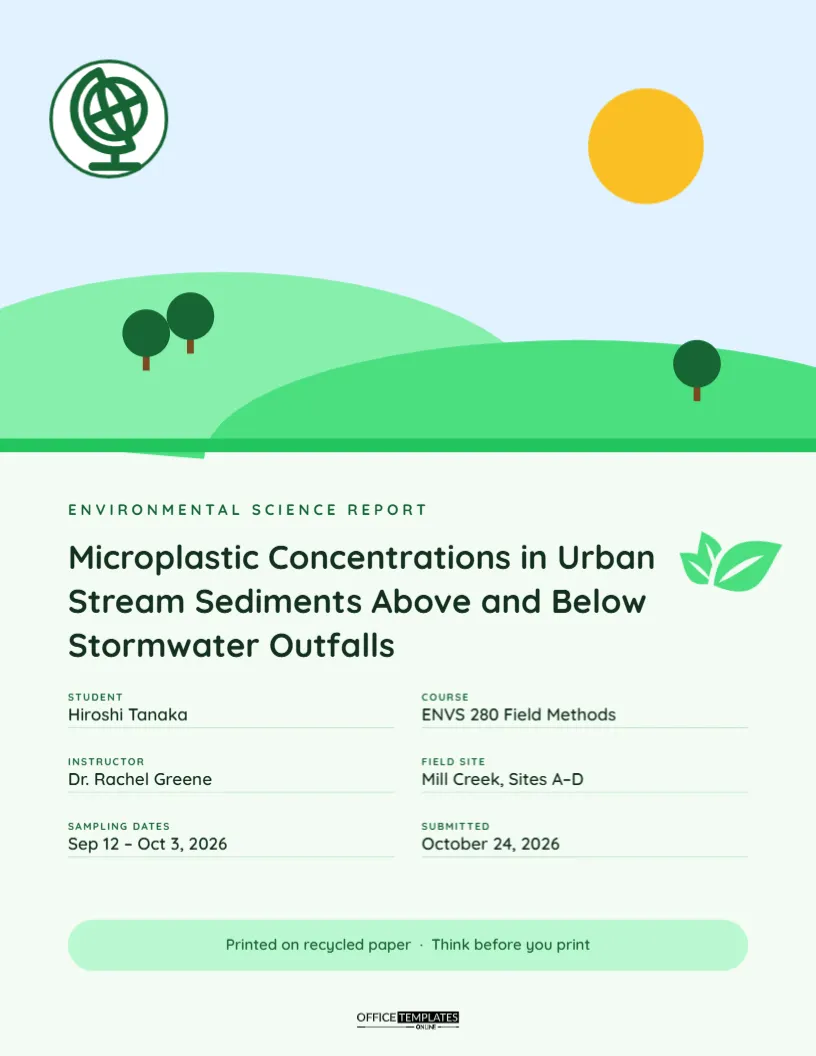
Environmental science is done outdoors. Students wade into streams, dig soil cores, count birds, measure air quality, and record weather. Their reports should feel like they came from the field, not from a filing cabinet. This cover opens with a landscape, a blue sky with a warm sun over two layers of rolling green hills dotted with trees, and puts a globe badge in the corner to remind readers that local data connects to a planetary picture. Below the landscape, the fields are designed for real fieldwork, with spaces for the field site and sampling dates.
A Landscape Across the Top
The upper part of the page is a pale sky blue. A golden sun sits on the right. Two layers of hills sweep across, a lighter green behind and a brighter green in front, edged by a darker green line. Three round trees stand on the slopes. In the top left, a white circle with a green outline holds a green globe icon. Below the hills, on a very pale mint background, a green label reads Environmental Science Report; the title, Microplastic Concentrations in Urban Stream Sediments Above and Below Stormwater Outfalls, is set in Quicksand, a rounded, friendly typeface, and a small cluster of green leaves sits to the right. Six fields fill two columns, and a pale green pill near the bottom reads Printed on recycled paper · Think before you print. The logo is centred at the foot.
Fields Built for Fieldwork
Most covers ask only for a date. Environmental reports need more, because sampling often happens over days or weeks and at specific places. This cover lists:
- Student: Hiroshi Tanaka
- Course: ENVS 280 Field Methods
- Instructor: Dr. Rachel Greene
- Field site: Mill Creek, Sites A-D
- Sampling dates: Sep 12 – Oct 3, 2026
- Submitted: October 24, 2026
Click any value to type your own. If your report is based on secondary data, change Field site to Data source and Sampling dates to Data period.
Describing a Field Site Precisely
Reports are more useful when other people can find your site again. On the cover, a short name is enough, such as Mill Creek, Sites A-D. Inside the report, give coordinates (latitude and longitude to at least four decimal places), the land use around the site, access notes, and a map. If the site is on private land or is ecologically sensitive, describe it in general terms and keep exact coordinates in an appendix shared only with your instructor.
Report Titles for Common Environmental Projects
| Project type | Example title |
|---|---|
| Water quality | Nitrate and Phosphate Levels in Agricultural Drainage Ditches During Spring Runoff |
| Air quality | PM2.5 Exposure at School Drop-Off Zones Before and After an Anti-Idling Campaign |
| Biodiversity | Pollinator Visits to Native and Non-Native Plantings on a University Campus |
| Soil science | Soil Organic Carbon Under Cover Crops Versus Bare Fallow |
| Urban ecology | Surface Temperature Differences Between Tree-Lined and Treeless Streets in July |
| Waste | Composition of Campus Recycling Bins: A Contamination Audit |
Comparison Built Into the Title
Notice how many good environmental titles compare two conditions: above versus below an outfall, before versus after a campaign, native versus non-native plantings. That comparison is the core of most field study designs, because it lets you attribute differences to a cause. The sample title, Above and Below Stormwater Outfalls, tells the reader your design immediately. If your study has a control and a treatment, put both in the title. Readers scanning a list of reports, for example on a course website or a watershed group’s resource page, can then tell at once whether your results speak to their own question.
The Recycled Paper Note
The pill near the bottom is a friendly nudge: Printed on recycled paper · Think before you print. It is especially fitting for an environmental report. If you submit only online, change it to Submitted digitally to save paper, or replace it with a one-line key finding. It is plain text on a rounded shape, so you can edit or delete it in seconds.
Changing Seasons on the Cover
The landscape is easy to adapt. The hills and trees are one group; ungroup it to recolour. For an autumn study, turn the trees orange and red and the hills golden. For winter sampling, make the hills pale grey-white and the sky a cooler blue. For a desert ecology report, change the hills to sand and terracotta and remove the trees. The sun and globe badge can stay as they are, or you can recolour the globe from its vector swatches to match.
Safety and Permits in Field Reports
Environmental fieldwork often requires permits, landowner permission, and a safety plan, especially around water. Mention these in your method section: who granted access, what protective equipment you used, and whether you sampled in pairs. Instructors value it, and it is good practice for professional environmental work, where documentation of permits and safety is routine.
Sharing the Report With a Community Partner
Many environmental courses work with watershed groups, parks departments, or local non-profits. A bright, attractive cover makes your report easier to share beyond the classroom. Before sending it to a partner, add their name on a new line under the details, such as Prepared with Mill Creek Watershed Council, and ask whether they would like a summary page after the cover.
Printing in Green
The page is US Letter, 8.5 x 11 inches. The sky and hills use more colour than the lower half, but the light tints keep ink use modest. Download as PDF for digital submission. If you do print, follow the cover’s own advice and choose recycled paper, and print double-sided for the rest of your report.
Environmental Report Cover Questions
Is this suitable for geography or earth science reports?
Yes. Change the label and, for geology, recolour the hills in rock and soil tones.
Can I add a site photo?
Yes. Add an image and place it over the sky area at a small size, keeping the title clear.
What if my project is a lab-based environmental study?
Rename the field site to Laboratory and sampling dates to Analysis dates.