When Someone Asks You for a Basic Salary Certificate
A request for a salary certificate usually arrives for a practical reason: a bank wants proof of income for a loan, a landlord wants to see that rent can be paid, a visa office needs evidence of employment, or a mortgage broker is gathering documents. The employee asks HR or a manager for a short letter. If you do not have a template, you end up writing the same letter over and over, and each version is a little different. This basic salary certificate gives you one clear format to reuse.
What the Page Contains
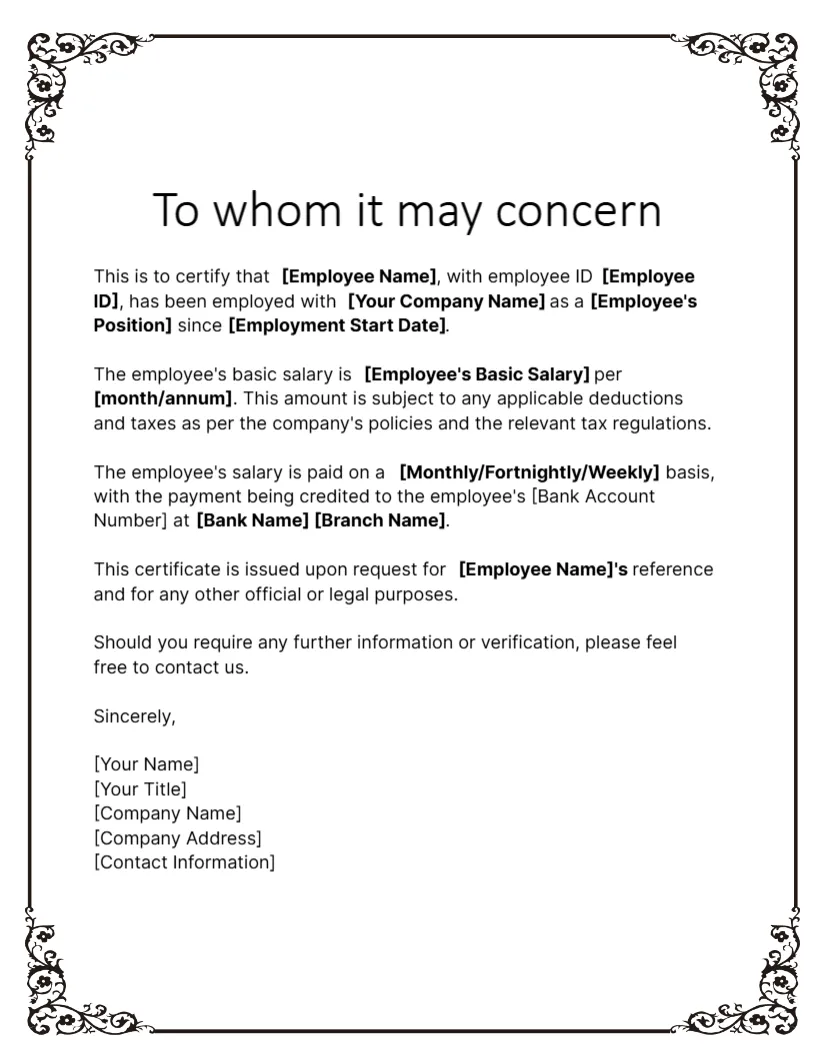
The page is Letter size portrait, 8.5 x 11 inches. A thin black line frames the sheet, and each corner carries a curl of black floral scrollwork, which makes the page look like a formal document rather than an email. The heading To whom it may concern appears in a large, plain typeface at the top. Below it, the text runs in five short blocks.
- The first confirms the employee name, employee ID, company, position and the date employment began.
- The second states the basic salary and whether it is paid per month or per year, with a note that deductions and taxes apply as set by company policy and tax rules.
- The third explains how often salary is paid, whether monthly, fortnightly or weekly, and into which bank account, bank and branch.
- The fourth says that the certificate is issued on request for the employee’s reference and for any other official or legal purpose.
- The last invites the reader to contact the company for verification, and a Sincerely block carries the signer’s name, title, company name, address and contact details.
The Square Brackets Are Your Checklist
Every item in square brackets is a blank to fill in. Go through them in order and nothing will be missed: Employee Name, Employee ID, Your Company Name, Employee’s Position, Employment Start Date, Employee’s Basic Salary, month or annum, Monthly, Fortnightly or Weekly, Bank Account Number, Bank Name, Branch Name, then your own name, title, company name, address and contact information. Delete the bracket marks when you type the real value, and delete options that do not apply, such as the two pay frequencies you do not use.
Should You Include the Bank Account Number?
The template includes the account number because some banks ask for it. Think about it before you print. A full account number on a letter that may be photocopied is a risk. Many companies show only the last four digits, or leave the line out unless the employee specifically asks. Ask the employee what the receiving organisation requires, and include no more than that.
Accuracy and Consent
A salary certificate is a statement of fact from the company. Check the salary against payroll before signing, and issue it only at the employee’s request. Salary details are personal data, so send the document to the employee rather than to a third party unless the employee has agreed. Rules about what employers must provide differ from country to country, so check with your HR adviser if you are unsure.
Turning the Page Into a Real Letter
For a more official look, add your company logo above the heading, print on your letterhead, and sign in ink. A company stamp, where customary, adds credibility. The thin border leaves clear margins, so ordinary office paper prints without clipping. A 90 to 100 gsm sheet is plenty for a letter.
If your staff are paid monthly, see the monthly salary certificate, which adds a total including allowances. For annual figures, see the annual salary certificate. For a simpler single figure layout, try the general salary certificate. All are in employment certificates.