Writers spend most of their lives on the page, so it seems only fair that the page should say something about them. This Author WriterLetterhead Template does it with a bookshelf. Your name sits above a single shelf line, and a row of colorful spines stands beside it, the last one leaning against the others the way books always seem to on a real shelf.
It is literary without being fussy, warm without being twee, and it leaves a clean parchment page for whatever you are writing, from a query letter to a note for a reader.
A Shelf of Your Own
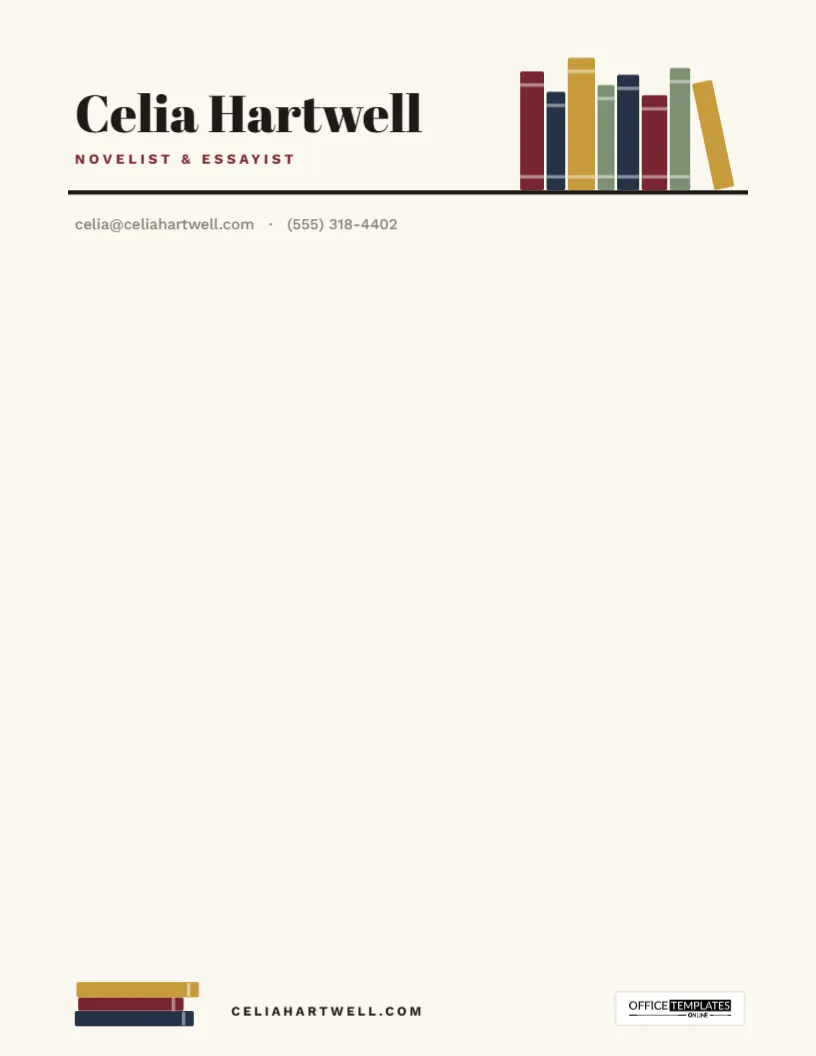
Virginia Woolf asked for a room; this letterhead offers a shelf. At the top left, your name is set in Abril Fatface, a bold display serif with the confidence of a book cover. Novelist & Essayist follows in small oxblood capitals. A dark shelf line runs across the page, and toward its right-hand end seven book spines in oxblood, navy, mustard and sage stand in a row, each with thin bands where a title would be. An eighth book leans against them.
Your email and phone sit just below the shelf. At the foot of the page, three books lie flat in a small stack beside your web address, and the Office Templates Online logo sits on a white plate on the right. The background is a warm parchment tone rather than stark white, so the page feels closer to a writer’s notebook than to an office printer.
Letters a Writer Sends
Query and submission letters
Many agents and publishers take submissions by email or online form, but a well-presented query or cover letter saved as a PDF still makes a quiet impression, and some magazines, contests, and small presses still welcome mail. Keep it to a single page: the hook, a short synopsis, your credentials and a thank-you.
Replies to readers
A reader who writes to you has given you something. A reply on your own letterhead, even a short one, is the kind of thing people tuck into the back of their copy of your book.
Event and signing correspondence
Letters to bookshops, libraries and festivals about readings and signings, and thank-you notes afterward.
Press and permissions
Requests to quote other work, answers to interview requests and cover letters for review copies.
Teaching and workshops
If you teach writing, the page makes a good base for course outlines, feedback letters and workshop handouts.
Shaping a One-Page Query on It
A query letter has one job: make an agent or editor want to read the manuscript. On this letterhead, the open parchment page holds a query comfortably if you keep to a familiar four-part shape:
- The personal line: One sentence on why you are writing to this particular person: a book they represent, an interview they gave, a call for submissions.
- The hook and pitch: Two short paragraphs about your protagonist, what they want, what stands in the way, and what is at stake. Write it like jacket copy, not a synopsis.
- The book’s details: Title, genre, word count, and one or two comparable titles published in recent years.
- A little about you: Relevant publications, awards, or expertise, in a few lines. If you have none yet, a single honest sentence is fine.
Close with a brief thank-you. Always follow each agent’s own submission guidelines first; many ask for the query in the body of an email, in which case the letterhead is better saved for correspondence once a conversation has started.
Arranging the Shelf
- Open the template and click the name to type your own. The header reads best with a name that fits on one line.
- Change Novelist & Essayist to your genre, your latest title (Author of Evening Tide), or simply Writer.
- Update your email and phone below the shelf and your web address in the footer.
- For different book colors, select the row of books, click Ungroup, and recolor individual spines to echo your own covers.
- Download the letterhead as a PDF, PNG, or JPG.
A Note on the Typography
Abril Fatface was chosen for the name because it has the weight and contrast of a title on a book jacket, and it holds its own next to the colorful spines. The smaller lines use Work Sans, a clean sans-serif that stays readable at small sizes. For the letter itself, you are free to use whatever you like; a serif such as Lora or Playfair Display sits well on parchment, and 11 or 12 points keeps a one-page letter comfortable to read. Every font in the template is a Google Font and can be changed from the toolbar.
Printing for Signings and Submissions
The page is US Letter (8.5 x 11 in), portrait. Print the PDF at 100% scale on cream or natural paper to echo the parchment background; a laid or lightly textured stock gives the letter a bookish feel. For emailed submissions, type your letter over the letterhead and save it as a PDF rather than an image, so the text stays selectable and searchable, which many submission systems prefer. A few blank printed copies in your bag are handy at events for quick personal notes.
What Writers Tend to Ask
Does it suit poets, journalists or academics?
Yes. Change the title line to Poet, Journalist, or your academic role; the bookshelf works for anyone who lives among books.
Can I remove the books for a plainer page?
Yes. Click the row of books and delete it. The shelf line and your name still make a clean header.
Can I add my book cover?
Add an image from the toolbar and place it in the open space beside your name or near the footer.
Will the parchment background print well?
Yes. It is a light, even tone. If you prefer white, click the background and change its color.
Can I use a pen name?
Of course. Put your pen name in the header, and keep your legal name for the signature if a contract or agreement needs it.
Every story starts with a blank page. Make yours look like it belongs to a writer: add your details and download your author letterhead.