A lawyer’s letter is read differently from any other letter. Opposing counsel read for precision, clients read for reassurance, and courts and agencies read for the conventions they expect. This Attorney Letterhead Template is designed with all three readers in mind: traditional in its references, clear in its hierarchy, and restrained enough to carry serious correspondence.
It is intended for solo practitioners and small practices who want stationery of their own, and it leaves the writing area completely blank so it can serve as the base for any letter the practice sends.
Built on the Conventions of Legal Paper
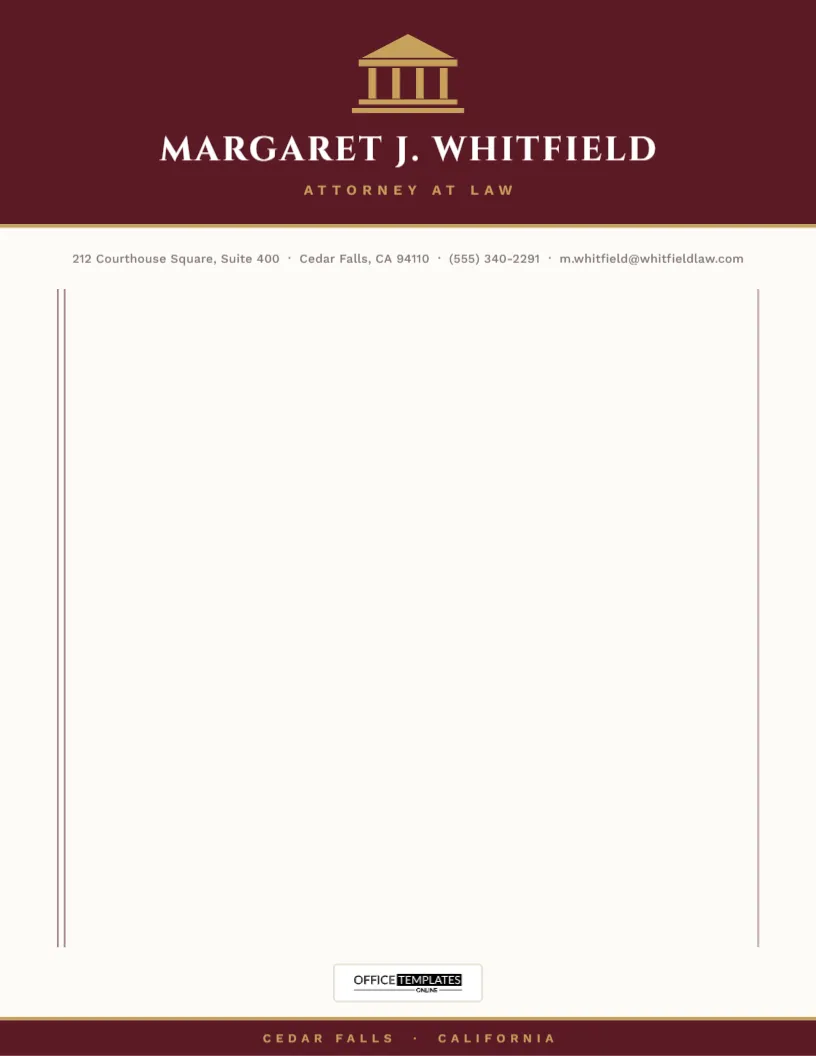
Anyone who has filed with a court will recognize the vertical lines that frame this page. Traditional pleading paper carries a double rule down the left margin and a single rule down the right, and this letterhead borrows that framing: two fine wine-colored rules on the left, one on the right, running from just under the header to just above the footer. They are not line numbers, and they do not turn the page into a court form, but they give the sheet a quietly legal character and keep your text inside a disciplined column.
The header takes its cue from the courthouse itself. A small gold emblem of classical columns under a triangular pediment sits at the top of a deep wine-red band, a mark that suggests the law without resorting to scales or gavels.
Anatomy of the Header and Footer
The emblem
The courthouse mark is built from simple gold shapes: a pediment, a lintel, four columns, and a two-step base. Because it is made of separate shapes, you can delete it and put your firm’s logo in the same place.
The name
Your name is set in Cinzel, a typeface based on classical Roman inscriptions, in widely spaced capitals, white against the wine band. Below it, Attorney at Law appears in small gold capitals.
The contact line
A thin gold edge closes the band. Beneath it, a single centered line carries your office address, telephone number, and email in a quiet gray, so that it is complete but does not compete with your name.
The foot
A slim wine band with a gold top edge finishes the page, with the city and state in small gold capitals. The Office Templates Online logo sits on a white plate just above it.
Correspondence It Is Suited To
Because the body is empty, the template adapts to the full range of a practice’s paperwork. It is well suited to engagement letters and fee agreements, where a client’s first impression of the relationship is formed; to status updates on a matter; to demand letters, where an established look supports firm content; to letters to opposing counsel and to agencies; and to closing letters confirming that a representation has ended. It also works as a cover sheet for enclosures and as a formal notice page.
For the administration of the practice itself, it makes a consistent base for fee schedules, conflict-waiver requests, and office policy letters.
Setting the Letterhead Up for Your Practice
- Open the template in the editor and click the name to replace Margaret J.Whitfield with your own name or the firm’s name.
- Edit the gold line if Attorney at Law does not fit; many lawyers prefer to name their practice area, such as Estate Planning or Family Law.
- Replace the contact line with your office address, direct line, and email.
- Change Cedar Falls · California in the footer to your own city and state.
- If you have a firm logo, select the column shapes, delete them, and add your logo from the toolbar.
- Download the finished letterhead as a PDF for printing, or as a PNG or JPG if you need an image version.
Professional Standards to Keep in Mind
Letterhead is a form of communication about your services, so many jurisdictions have rules about what it may say. Before you finalize the page, it is worth checking your state bar’s guidance. In general:
- Use your name as it appears on your admission, and add Esq. or a bar number only where that is customary or required in your state.
- Be careful with specialty claims. Words such as specialist or certified are regulated in many states; a plain practice-area description is usually the safer choice.
- If you practice in more than one jurisdiction, consider listing where you are admitted, for example on the contact line.
- If you add a confidentiality notice to letters sent by email, place it at the end of the letter text rather than in the header, so that it sits with the content it protects.
This template does not provide legal or ethics advice; it simply leaves room for whatever your jurisdiction requires.
Paper, Printing and Filing
The page is US Letter (8.5 x 11 in) in portrait orientation. Print the PDF at 100% scale so the margin rules stay parallel to the paper edges. A cotton-content or laid bond paper in bright white or natural ivory gives printed letters weight, and the wine and gold read well on both. For electronic correspondence, save each finished letter as a PDF: the format preserves the layout, attaches easily to a file, and prints consistently at the recipient’s end.
Points Frequently Raised by Practitioners
Can the margin rules be removed?
Yes. Each rule is a separate thin line. Click and delete them, or recolor them in a lighter shade if you want them fainter.
Is the courthouse emblem necessary?
No. It is decorative and can be deleted or replaced with a logo. The header still holds together with the name alone.
Can two partners share the letterhead?
Yes. Replace the name with the firm name and add a second contact line, or list the partners in the footer band.
Which typefaces are used?
Cinzel for the name and Work Sans for the smaller lines. Both are Google Fonts and can be changed from the toolbar.
Will the colors print accurately on an office laser printer?
The deep wine prints well on most color laser printers. If yours renders it too dark, choose a slightly lighter red in the editor before downloading.
Correspondence that reflects the care of your practice begins with the page it is written on. Enter your details and download your attorney letterhead.