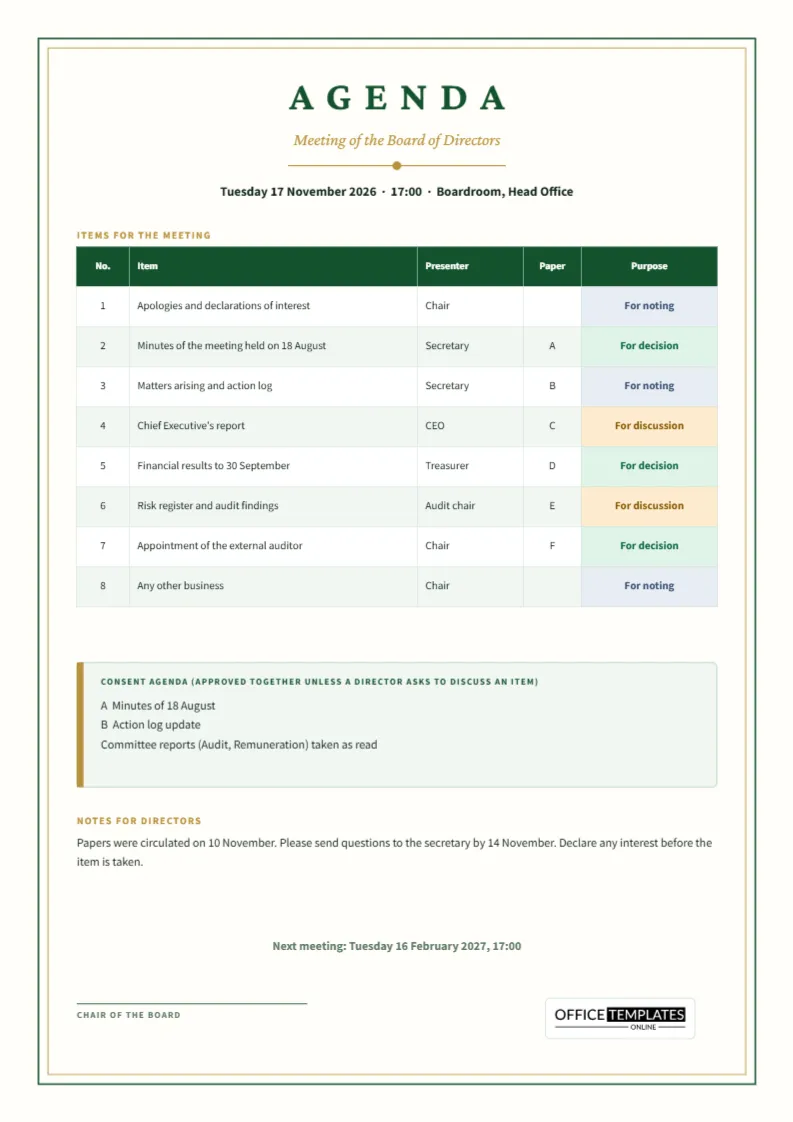
A board agenda is a promise about order. It tells directors what will be taken, who will present, which paper to read, and what is expected of them for each item. It also sets the tone: a board that sends out a tidy, formal agenda is a board that expects its meetings to be orderly. This page presents the agenda in a framed, centred layout with a green and gold border, and tags every item as for decision, for discussion, or for noting.
A Double Frame in Green and Gold
The page has a heavy green outer border with a finer gold line inside it, giving the look of formal stationery. The word AGENDA appears in wide-spaced capitals in Crimson Pro, with the line Meeting of the Board of Directors in gold italics below it, and a small gold rule with a dot at its centre. The date, time and place are centred underneath in bold. Source Sans Pro supports the details.
Why Every Item Is Tagged
The last column of the table carries a coloured label: green for For decision, amber for For discussion and grey-blue for For noting. These three tags are common in board papers. They tell directors what the chair will ask of them, so they can prepare. A director who knows that item five is for decision reads the paper more carefully than one who thinks it is just an update.
What Each Tag Asks of a Director
| Tag | The chair will ask for | How to prepare |
|---|---|---|
| For decision | A vote or agreement | Read the paper and form a view |
| For discussion | Views and challenge | Bring questions |
| For noting | Acknowledgement only | Skim, ask only if something concerns you |
Presenter and Paper Columns
Beside each item, the page names the presenter and a paper reference letter. The sample has eight items, from apologies and declarations of interest to any other business. Paper letters A to F match the supporting documents that were circulated, and items with no paper show a blank cell. A clear link between item and paper saves directors from hunting through the board pack.
The Consent Agenda Box
A green-tinted panel with a gold left edge explains the consent agenda: items approved together unless a director asks to discuss one. The sample lists the minutes of the last meeting and an action log update, with committee reports taken as read. Consent agendas save time on routine matters. Any director may ask to remove an item for discussion, and the chair should invite this before the vote.
Declarations of Interest as Item One
The first item in the sample is apologies and declarations of interest. Placing it first means that conflicts are named before the board discusses anything affecting them. The notes below the table remind directors to declare any interest before the item is taken, and the secretary then records it in the minutes.
Notes for Directors
A short paragraph tells directors when papers were circulated and when to send questions to the secretary. Asking for questions beforehand means the chair can pass them to the right executive, and the answers can be ready on the night. It also reduces the number of surprises.
Setting the Order of Items Deliberately
The order of items shapes the meeting. Put decisions early, while attention is fresh, and routine reports toward the end. Place a long discussion item after a short break if the meeting is long. Any other business should come last, with a limit, so that it does not swallow the evening.
The Chair’s Signature and the Next Date
The foot of the page carries the date of the next meeting, centred, and a line for the chair’s signature, with a small plate holding the brand mark at the right. A signed agenda is not required in every organisation, but it adds formality and can be filed with the minutes.
Circulating the Agenda With the Board Pack
Send the agenda together with the papers, as one PDF or one email, and keep the same order. Directors should be able to follow the agenda from page one. Many boards use a secure portal, and a PDF of this page can be the cover sheet.
Changing Items, Presenters and Purpose Tags
Retype items, presenters, and paper letters in the table. Add rows through Edit Table Data and the Add Row button. The tags are coloured cells, so change both the words and the fill when an item moves from noting to decision.
Time and Quorum Notes on the Agenda
Some boards add the expected duration of each item, or a note that a quorum is needed for the decision items. If you do, put it in the notes block beneath the table, for example, that items two, five and seven require a quorum of five directors. A clear note prevents the embarrassment of reaching a vote with too few members present, and it reminds directors to arrive on time.
Confidential Items and Closed Sessions
Boards sometimes need to discuss matters in private, such as pay or a legal risk. List the item on the agenda with a note such as in closed session, so the meeting is transparent about the fact that a private discussion will take place. Keep the substance out of the circulated pages, and record only that the item was taken and any resolution that must be made public.
Learning From Past Agendas
Review your last four agendas and ask which items took longer than planned, which were routine, and which could have been handled by email. A board that trims its routine items often finds time for the strategic ones. The consent agenda is a practical way to start.
Printing the Framed Agenda Page
A4 portrait. The frame sits about a centimetre inside the page edge, so most printers handle it without clipping. Heavier paper gives a formal feel.
Board Agenda Questions
Do all boards use a consent agenda?
No. It suits boards with many routine items. Remove the box if you do not use one.
Can I use it for a committee?
Yes. Change the title line to the committee’s name.