A tender evaluation is one of the few meetings where the minutes may be read by someone who lost. An unsuccessful bidder can ask how the decision was reached, and a clear, consistent record is the best answer. This template is built around that fact. It records the criteria, the weights, each bidder’s scores and the arithmetic, then states the recommendation and carries a signed declaration from every panel member that they scored fairly.
Why the Scoring Matrix Is the Heart of the Record
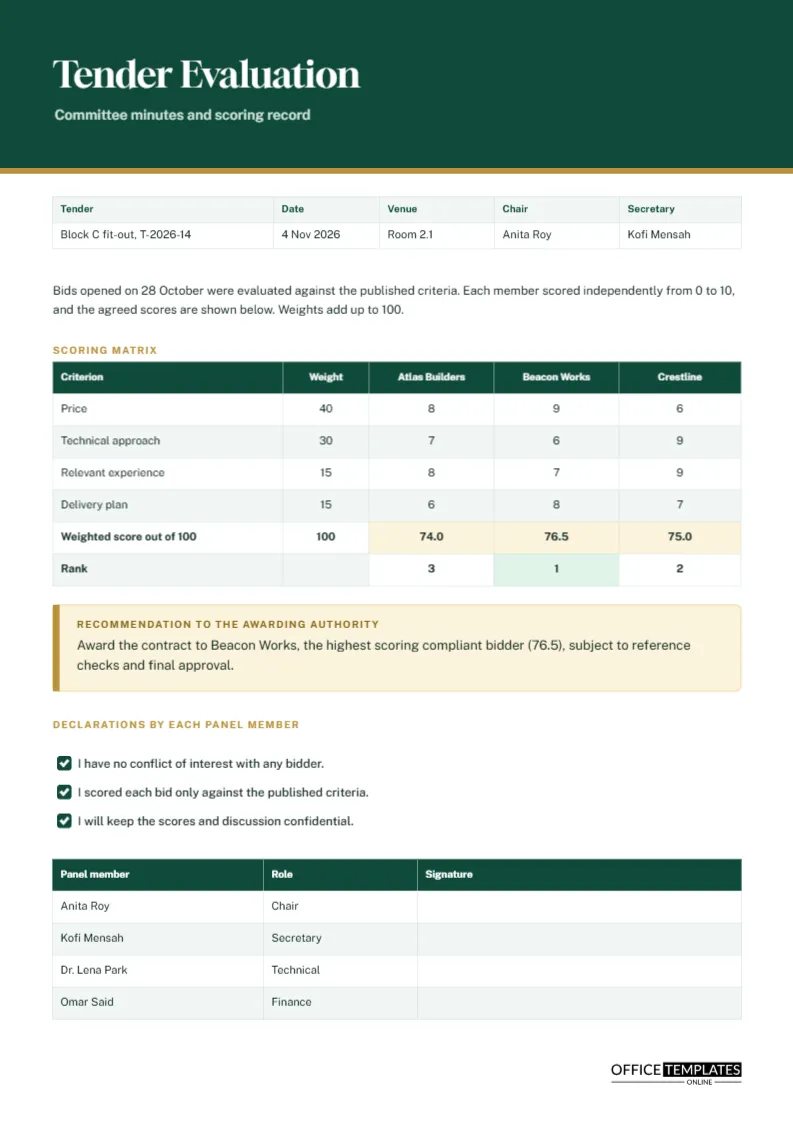
The centre of the page is a table with criteria down the side, weights beside them, and a column for each bidder. Scores run from zero to ten, and the weights add up to one hundred. In the sample, price carries 40, technical approach 30, relevant experience 15, and delivery plan 15. Publishing the weights before bids arrive and recording them in the minutes shows that the rules did not change halfway through.
The Arithmetic Worked Through
The weighted score is the sum of each weight multiplied by the score, divided by ten, which gives a figure out of one hundred.
| Bidder | Calculation | Weighted score |
|---|---|---|
| Atlas Builders | 40 x 8 + 30 x 7 + 15 x 8 + 15 x 6 = 740 | 74.0 |
| Beacon Works | 40 x 9 + 30 x 6 + 15 x 7 + 15 x 8 = 765 | 76.5 |
| Crestline | 40 x 6 + 30 x 9 + 15 x 9 + 15 x 7 = 750 | 75.0 |
The sample page shows the same three totals and ranks Beacon Works first, Crestline second, and Atlas Builders third. Because table cells hold typed text, recalculate by hand whenever you change a score.
A Deep Green Header and Gold Rule
The top of the page is a solid deep green block with a thin gold line beneath it. The title Tender Evaluation appears in Gloock, a high-contrast serif with a formal, public-sector feel, and the subtitle reads Committee minutes and scoring record. Public Sans carries the working text, a face designed for government forms, which suits the subject.
Stating the Evaluation Method Before the Numbers
A short paragraph under the details strip says when the bids were opened and how they were evaluated: independently, against the published criteria, with agreed scores shown. Every tender record should include a sentence like this. It tells a reader what process was followed before they look at the numbers.
Recommendation to the Awarding Authority
A pale gold panel with a gold edge carries the recommendation. The sample recommends awarding the contract to the highest scoring compliant bidder, subject to reference checks and final approval. The word compliant matters. A bidder who scores highest but fails a mandatory requirement cannot win, and the minutes should say so where it applies.
Declarations Each Panel Member Signs
Three ticked boxes read that the member has no conflict of interest, scored only against the published criteria, and will keep the scores confidential. Below them, a signature table lists four panel members with their roles and a blank signature column. Declarations signed at the meeting, not afterwards, are the strongest evidence that the process was fair.
What to Do With a Conflict of Interest
If a member has a conflict, they should declare it before scoring and leave the panel for that tender. Record the name, the nature of the conflict, and the replacement. Do not simply untick the box and carry on, because a quiet change looks worse than an open one.
Keeping Score Sheets Alongside the Minutes
The matrix shows agreed scores. Individual score sheets, with each member’s notes, should be kept with the file. A short sentence in the minutes can say that they are attached. If a bidder asks for feedback, you can explain how the agreed score arose.
Dealing With Ties
When two bidders tie, many procedures fall back on a single criterion, often price or technical score. Agree the rule before opening bids and write it in the notes. The Rank row of the matrix then shows the result without argument.
Editing the Matrix for Your Own Tender
Retype the criteria, weights, and bidder names. To add a fourth bidder, use Edit Table Data and increase the number of columns from the Table panel. Check that the weights still add to one hundred. Every table on the page is a real Table object.
Moderating Scores When Panel Members Differ
Panel members often score the same bid differently. A good chair invites each member to explain any score that is far from the others, and the group agrees on a final figure by discussion, not by averaging. Record in a short note that moderation took place and which scores changed. The matrix then shows agreed scores, and the notes show that they came from a fair conversation.
Giving Feedback to Unsuccessful Bidders
After the award, unsuccessful bidders often ask for feedback. The matrix makes it straightforward: you can show their own scores against each criterion and the weights that applied, without revealing other bidders’ commercial details. Keep your explanation consistent with the minutes, and avoid adding reasons that the record does not support. A fair, documented process rarely leads to a challenge, and when one does arrive, the file is ready.
Storing Tender Records for the Required Period
Many organisations must keep tender records for several years, and public bodies sometimes for longer. File the minutes with the invitation, the bids, the score sheets and the award letter, and note the retention date on the folder. A tidy bundle protects the organisation if the award is questioned long after the people involved have moved on.
Signing the Matrix and Collecting the Evidence
A4 portrait. Print it, collect the four signatures with a pen, and scan the result for the tender file. Procurement rules in many organisations require original signatures for the record.
Procurement Questions Answered
Is this suitable for a public sector tender?
It is a layout. Public procurement rules differ widely, so check your own regulations.
Can I use it for a smaller quote comparison?
Yes. Reduce the criteria and bidders to match.