When you buy from a supplier, the contract describes the promise and the meeting tests it. Most supplier reviews happen once a quarter, in a room with a coffee, and end with friendly nods. Two months later, a delivery fails, and nobody can say what the vendor agreed to do. These minutes are designed to turn a polite chat into a record: a scorecard for the vendor’s performance, a table of commitments from both sides, and a short note of terms discussed.
A Scorecard With Five Stars Per Measure
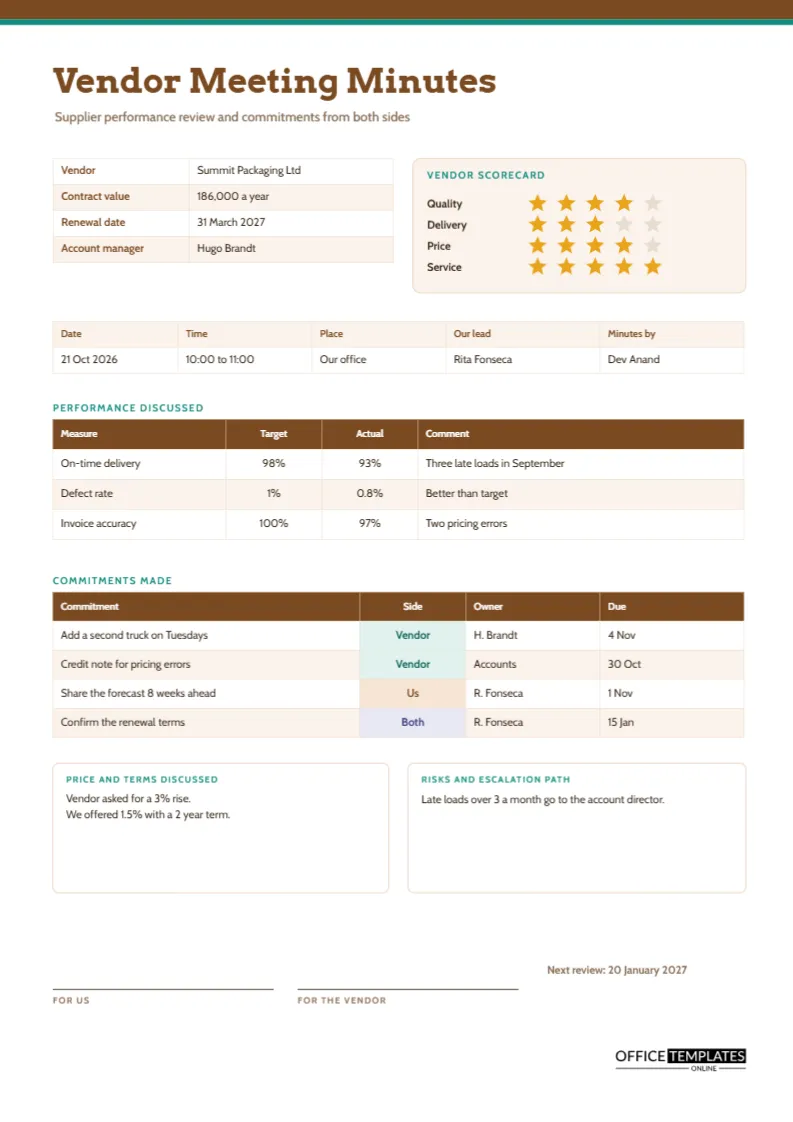
In a tinted panel at the top right sit four rows, each with a label and five small stars. Quality has four filled stars, delivery three, price four, and service five. The stars are gold when earned and pale beige when empty. A simple scale like this makes comparison across vendors easy, and it gives the meeting a shared vocabulary. If you score every supplier the same way each quarter, you will see trends that are hard to notice in a single conversation.
Contract Facts Beside the Scorecard
A small table on the left lists vendor name, contract value, renewal date, and account manager. The sample is a packaging supplier with an annual value of 186,000 and a renewal on 31 March 2027. Keeping the renewal date on the page prompts the team to plan negotiations well ahead, instead of discovering the date a month before.
Brown, Teal and Arvo Slab Type
A thin brown rule and a teal line cross the top of the page. The title Vendor Meeting Minutes is set in sturdy Arvo, a slab serif that suggests contracts and ledgers, and Cabin carries the body text. The restrained palette of brown, teal and cream gives the page a trading-house feel, which suits a document about commercial relationships.
Performance Against Agreed Targets
| Measure | Target | Actual | Meaning in the sample |
|---|---|---|---|
| On-time delivery | 98% | 93% | Three late loads in September |
| Defect rate | 1% | 0.8% | Better than target |
| Invoice accuracy | 100% | 97% | Two pricing errors |
The page uses the same three columns plus a comment. Put the numbers from the vendor’s own report or your own receiving records, and note which source you used.
Commitments Made, With a Side Marked on Each
The commitments table has four columns: commitment, side, owner, and due date. The side column carries a small coloured label reading Vendor, Us or Both. The sample records that the vendor will add a second truck on Tuesdays and issue a credit note, while your side promises to share a forecast eight weeks ahead. Including your own promises keeps the review fair, and it is often the easiest way to get a vendor to match them.
Price and Terms Without Locking Anything In
A box on the lower left records the pricing conversation in a line or two. In the sample, the vendor asks for a three percent rise, and the buyer offers one and a half percent with a two-year term. Note that this is a discussion, not an agreement, and say so, because informal remarks can be mistaken for commitments.
Risks and the Escalation Path
The box beside it states the escalation path, for example, that more than three late loads in a month go to the account director. Agreeing the path in advance saves time when the first problem appears, because everyone knows who to call.
Signatures for Both Parties
Two lines at the foot read For the vendor and for us. Many suppliers will happily sign meeting minutes, and a countersigned page is far more persuasive than a one-sided one. A line gives the date of the next review, which in the sample is January.
Preparing a Vendor Review Like a Professional
- Collect delivery, quality, and invoice data for the period.
- Score each measure on the stars before the meeting.
- Share the numbers with the vendor in advance.
- List the two or three commitments you want from them.
- Decide what you can offer in return.
Handling a Vendor That Disagrees With Your Scores
Disagreement is useful. Ask the vendor to show their data and compare the sources. If the difference persists, record both figures in the comment cell and agree on how to reconcile them. A documented difference is bigger than a silent one.
Editing the Scorecard Stars
Each star is a small polygon. To change a score, select the star and change its fill from gold to beige or the reverse. To add a measure, copy a row of five stars and its label and move them down. The two tables are real Table objects with Edit Table Data and Add Row.
Printing and Filing Supplier Minutes
A4 portrait. File each signed page with the contract, so that anyone reviewing the relationship can see the whole history in one place.
Why Vendors Should See the Minutes Before They Are Final
Share a draft with the vendor within two days and invite corrections. This small courtesy catches misunderstandings early, and it makes the final page a document both sides own. Vendors are more likely to honour commitments they have read and approved than ones they discover later in an email from your procurement team.
Keeping the Relationship Constructive
A review is not a trial. The best supplier meetings acknowledge what is going well before turning to problems, and they treat the vendor as a partner in solving them. The star scorecard helps because it shows strengths as well as weaknesses. In the sample, service scores five stars, and the minutes should say so. Vendors who feel fairly assessed are more likely to invest effort in improving the measures that fall short.
When to Move From Review to Renegotiation or Replacement
If scores stay low across several meetings and commitments are repeatedly missed, the page becomes the evidence for a harder conversation. A series of dated minutes showing the same failures and the same promised fixes supports a request for service credits, a revised contract, or a move to another supplier. Keep each page factual and calm, and the file will speak for itself.
Supplier Review Questions
How often should I meet a major vendor?
Quarterly is common for strategic suppliers, with monthly check-ins for critical ones.
Is the scorecard fair for small suppliers?
Yes, if the measures match what is reasonable for their size.