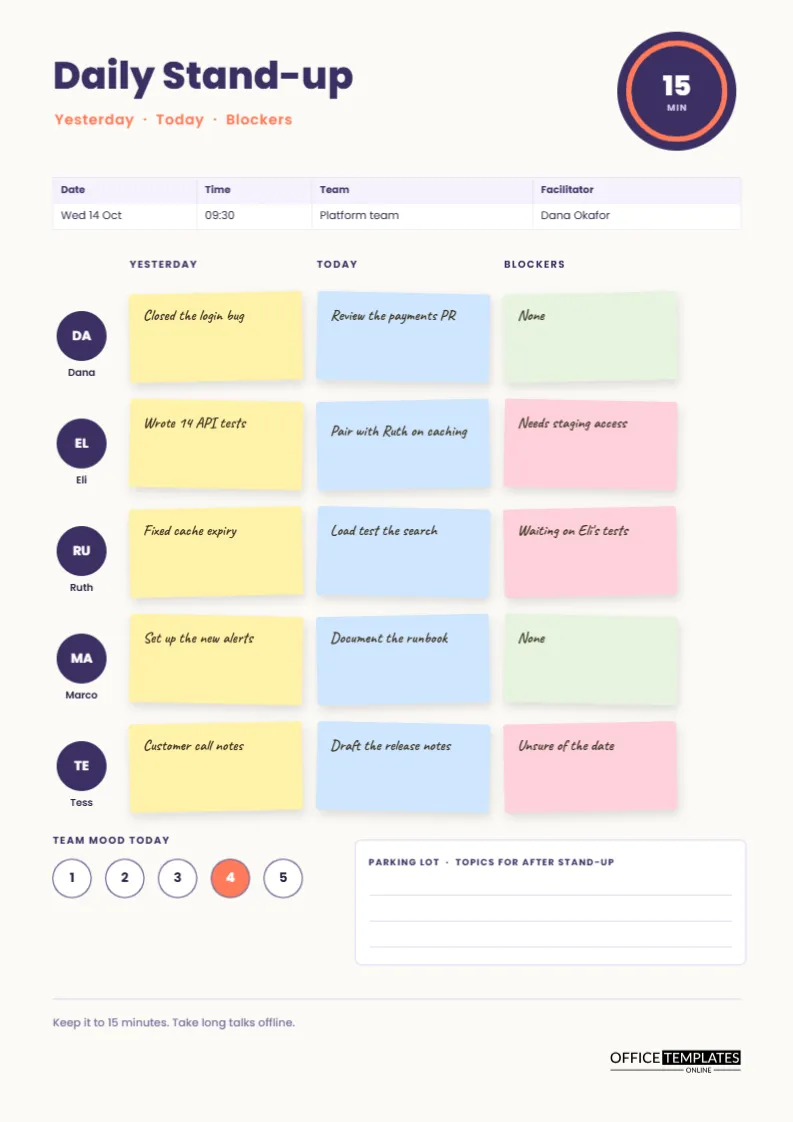
A daily stand-up is supposed to last fifteen minutes and to leave everybody knowing what everybody else is doing. In practice, it drifts into status speeches and side discussions. The notes you keep from it should be as light as the meeting. This page treats each team member as a row of three small sticky notes, and it tucks a timer ring into the corner to remind the group how little time it has.
The Three Questions as Three Colours
Each row follows the classic questions. A yellow note answers what you did yesterday, a blue note says what you will do today, and a pink or green note names blockers. Pink means a real blocker; green means none. The colours let the facilitator scan down the page and see at once which people need help, without reading a word.
A Fifteen Minute Ring in the Corner
At the top right, a deep violet circle holds a coral ring and the number 15 with the small word MIN beneath it. It is not a working timer, only a visual promise. Some teams set a real timer to match it, and some simply glance at the ring when a story begins to wander. The title, Daily Stand-up, is set in heavy Poppins, with the three questions in coral beneath it.
Handwritten Type for the Note Content
The text on the sticky notes uses Caveat, a handwriting-style Google Font, so the notes feel like real ones. Each note is rotated a degree or so in alternating directions and carries a soft shadow, which gives the page a lived-in feel without making it messy. Because the notes are ordinary shapes and text boxes, you can retype them, move them, or change their colours.
A Sample Week for a Platform Team
| Person | Yesterday | Today | Blocker |
|---|---|---|---|
| Dana | Closed the login bug | Review the payments PR | None |
| Eli | Wrote 14 API tests | Pair with Ruth on caching | Needs staging access |
| Ruth | Fixed cache expiry | Load test the search | Waiting on Eli’s tests |
Notice how Ruth’s blocker and Eli’s work connect. A page that puts rows side by side makes dependencies like that visible within seconds.
Avatars With Initials
Down the left edge, each person has a round avatar with initials and a first name under it. For a team of five, the page is full. For a smaller team, delete the extra rows and move the lower sections up. If you have more than five people, consider splitting the team, because a stand-up over eight people rarely stays within fifteen minutes.
The Team Mood Row
Under the notes sits a row of five circles numbered one to five. The fourth is filled coral in the sample. Ask each person to hold up a number, or ask the team for an average, and mark it. A mood number takes seconds and shows trends over weeks that a status update never would.
The Parking Lot for Longer Talks
A white box with three ruled lines is headed Parking lot: topics for after stand-up. When a discussion grows, write its topic here and hand it to the two or three people who care. This is the habit that keeps the meeting to fifteen minutes.
Facilitating Without Becoming a Bottleneck
The facilitator named in the strip at the top does not have to be the team lead. Rotating the role weekly spreads ownership and stops the stand-up from becoming a report to a boss. The facilitator’s tasks are small: start on time, keep the order, park long talks, and end on time.
Remote and Hybrid Stand-ups
The same page works for a video call. Share your screen, or fill it in afterwards from the chat. If people post their three answers in a thread before the call, the call itself can focus on blockers, and the page becomes a record of the thread.
Keeping Notes Without Keeping Them Forever
Stand-up notes rarely need long storage. Keep the pages for a sprint, then archive or discard them, unless a blocker turned into a decision worth remembering. Anything important should move to the sprint retrospective or the decision log.
Turning Blockers Into Actions the Same Day
A blocker written on a pink note is only a complaint until somebody takes it. The facilitator should ask one question for each pink note: who will remove this, and by when? If the answer is nobody, the blocker moves to the parking lot with a name beside it. Teams that apply this simple habit find that blockers rarely survive more than a day or two, and the stand-up develops a reputation for getting things moving rather than for taking time.
What Good Sticky Note Wording Looks Like
A sticky note has room for a short line, so the wording has to carry the point. Good entries start with a verb and name the thing: closed the login bug, review the payments PR, load test the search. Weak entries are vague, such as worked on stuff or more of the same. If you see a vague note, ask the writer for the name of the task, because the specific name is what other team members need to hear. Short, concrete notes keep the whole stand-up under fifteen minutes.
Printing the Sticky Note Page
The page is A4 portrait on a warm off-white background. The coloured notes print best in colour; in grayscale, the notes become three shades of grey, still easy to tell apart by position.
Starting Stand-ups on Time, Every Day
The habit that makes a stand-up work is starting at the same minute whether or not everyone has arrived. Print this page for the first week and leave it on a board or a table. The visible notes, the ring, and the mood row create a small ritual that people begin to expect. Within a fortnight, most teams no longer need the facilitator to call the meeting, because the page and the time do it for them.
Stand-up Questions
Can I replace the question headings?
Yes. Retype the three column labels, for example, to Done, Doing, and Stuck.
Do the notes have to be handwritten?
No. They are typed text in a handwriting font, so they are easy to read.