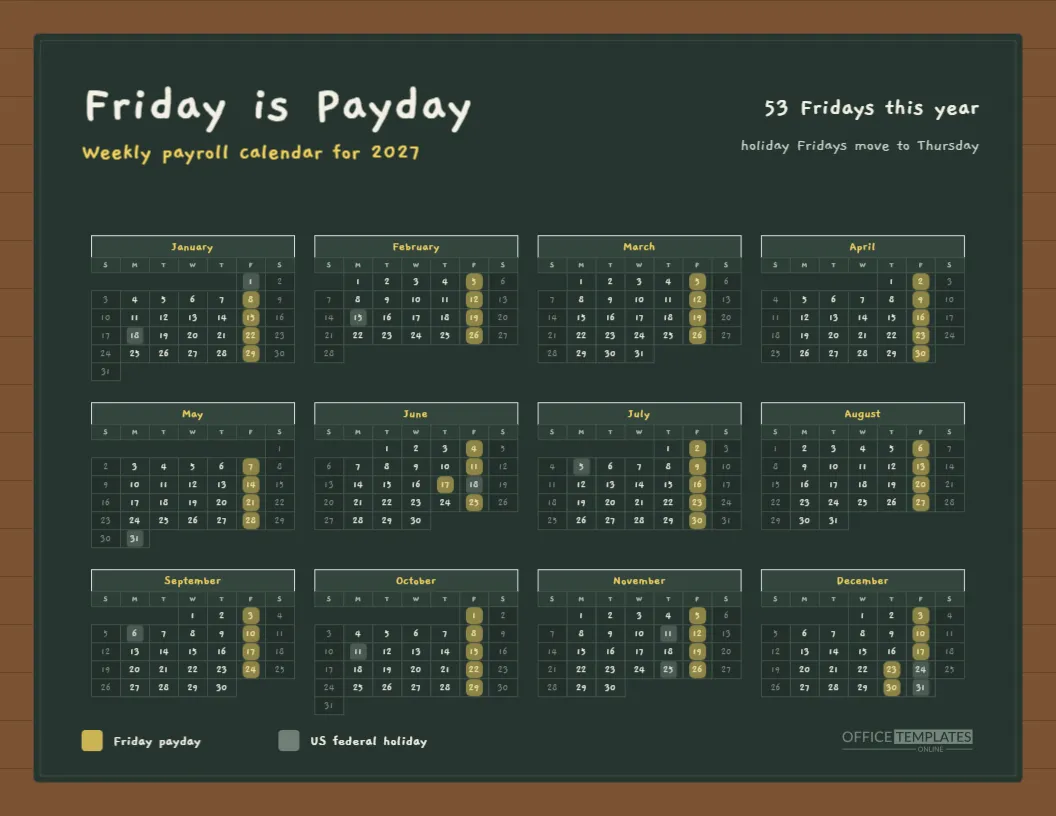
Walk into a cafe, a bakery, or a workshop, and you will often see a chalkboard by the till. This payroll calendar for 2027 brings the same board to the back office. A slate green panel sits in a wood frame, a chalk-style headline reads Friday is Payday, and a four-column year shows every Friday payday as a square of yellow chalk. It is made for weekly paid teams who like a hands-on look.
The Wood Frame
The page background is a warm walnut brown with thin darker lines that suggest planks. A slate green rounded panel sits inside it, with a fine lighter outline just inside the edge. The simple frame gives the page the feeling of a real board hung on a wall, and it costs nothing in complexity because the shapes are plain rectangles.
Chalk Lettering
The headline Friday is Payday is set in Gaegu, a casual handwritten Google Font, in off-white. Beneath it, Weekly payroll calendar for 2027 appears in a softer yellow. On the right, 53 Fridays this year and holiday Fridays move to Thursday carry the two facts that matter. The lettering feels hand-drawn but remains clear and editable.
The Chalk Calendar
Twelve months sit in four columns and three rows. Month names are yellow on a slightly lighter slate, day letters are pale grey, and numbers are chalk white. Weekends are a darker slate and out-of-month cells are blank. Each cell has a thin border in a dim green, like faint chalk lines from a ruler.
Yellow Squares for Fridays
Every Friday payday carries a soft yellow square with rounded corners, like a block of chalk. There are 52 of them dated in 2027, because the first Friday, January 1, moves back to December 31, 2026. Holidays carry a grey green square. The two read clearly on the slate even from across a room.
The Thursday Squares
Three paydays land on Thursdays: June 17, December 23 and December 30. Each is a yellow square on a Thursday, next to a grey green square on the observed holiday. The headline note explains that holiday Fridays move to Thursday, so staff who read it will understand the odd-looking cells without further help.
Why a Chalkboard for Payroll
Weekly pay is frequent and informal, and many weekly employers run places where chalkboards already hang. The metaphor fits: a board you glance at daily, with the key information written large. People relax around a chalkboard, and a relaxed reader is a reader who actually checks the date.
Friday Counts by Month
January has four paydays in the grid, February four, March four, April five, May four, June four, July five, August four, September four, October five, November four, and December five. Months with five Fridays carry an extra pay run, and the chalk squares make those months easy to spot.
Editing the Lettering
All the chalk text is editable. Change the headline to your business name or a catchphrase, and rewrite the two notes on the right. Keep the same font so the board stays coherent, and keep the lines short so they fit the space. A bolder weight reads better at a distance.
Editing the Calendar
The year grid is the editor’s Full Year Calendar object with Gaegu as its font. Calendar Options let you change the year, the week start, and the colours. The yellow and grey-green squares are separate grouped shapes laid over the grid, so move them after any change.
Colour Alternatives
A classic black board with white and pastel chalk works, as does a green board with pink and blue chalk. Change the board fill, the cell fills and the square colours together. Keep the chalk colours light and the board dark so text stays readable, and test the result on screen before printing.
Printing the Board
Print landscape on Letter at actual size, with background graphics on. The dark panel uses a good deal of ink, so a laser printer or print shop works best. For a more economical copy, print the page in greyscale, where the yellow squares appear as light tiles on a dark ground.
Hanging It for Real
Mount the printout on a sheet of foam board and hang it in the staff room. Add a real piece of chalk on a string for a joke, or a small magnet strip so staff can pin their own notes beside it. A tactile display makes a payroll reminder part of the room.
Ideas for Chalk Day Notes
Use a paint marker or a chalk pen on a laminated copy to circle the next payday and write short reminders like hours due Monday. Wipe off and change weekly. A laminated page turns into a reusable board, so you print once for the year and keep the dates fresh by hand.
Pairing With the Weekly Tables
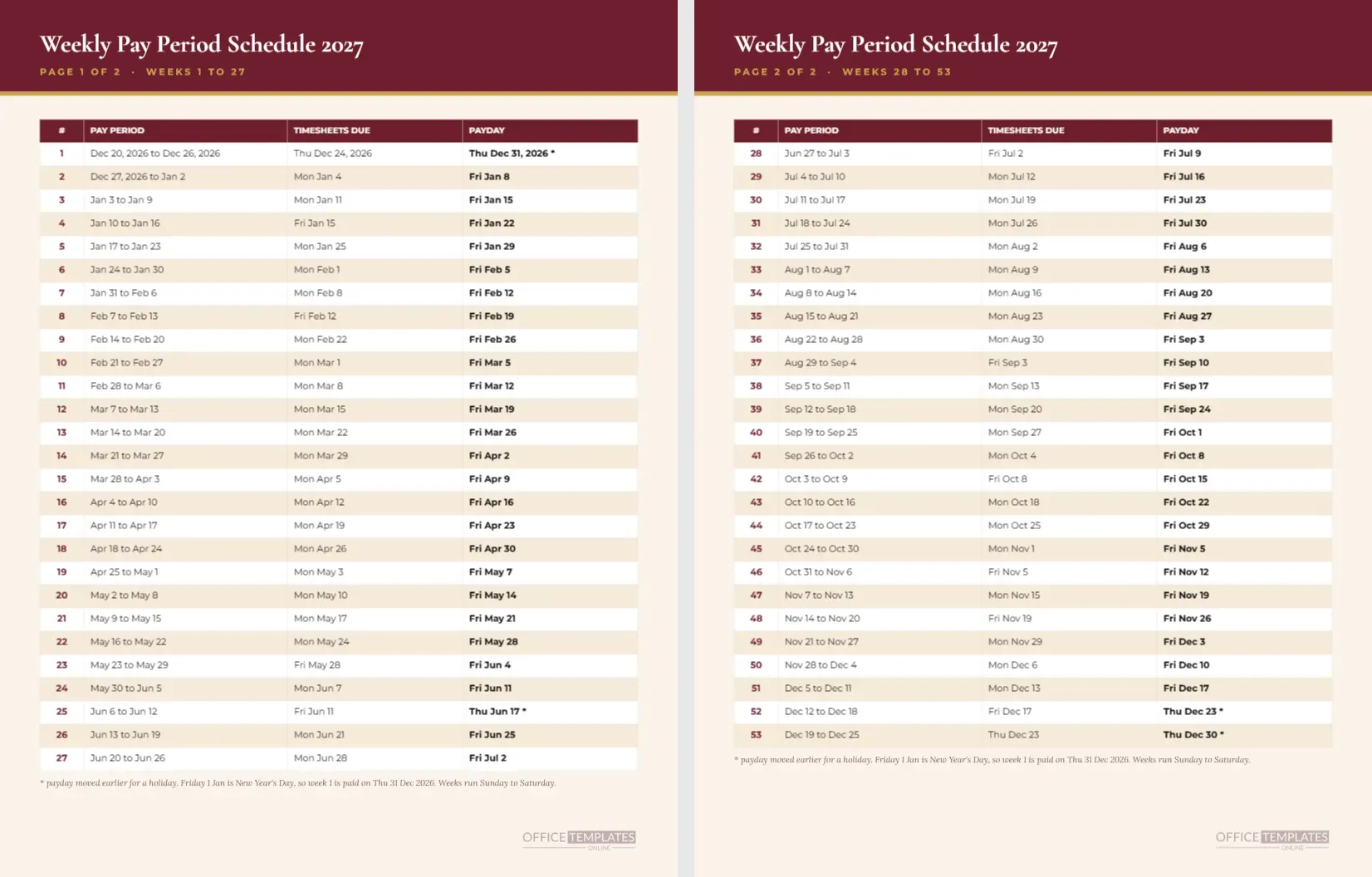
For the exact timesheet and period dates, see the weekly pay period schedule in this collection. It lists all 53 weeks across two pages. The chalkboard page is the friendly summary, and the tables are for those who run the numbers.
Who Will Enjoy It
Cafes, restaurants, bakeries, garden centres, workshops, farm shops and craft studios, where chalkboards are already part of the furniture. It also suits school offices and community groups that like a handmade feeling. A strict corporate setting may prefer one of the navy or minimal pages.
Cautions About the Dates
The squares follow one rule: pay on the previous business day, and a US federal holiday list. Your payroll provider may differ, and local holidays are not included. Confirm any date before you promise it to staff, and change the grey-green squares to your own holiday list.
The Chalkboard Page in Brief
Slate board in a wood frame. Chalk lettering. Fifty-two Friday paydays dated 2027, three Thursdays. Four-column year. Letter landscape. All text, shapes, and the calendar editable.
Keeping Chalk Dust Out of the Office
If you do want to write on a real board, a printed copy mounted on a sheet of slate coloured card can be marked with chalk pens that wipe away. Test a corner first, since some printers leave ink that smears. A matte laminate sheet over the printout protects it and gives you a surface for dry-erase markers instead.