Every first-year law student learns the objective memorandum. It is the workhorse document of legal practice: an associate researches a question for a supervising attorney and reports what the law is, how it applies, and how a court would likely rule. Legal writing courses grade memos rigorously, and the format matters. This cover takes the memo heading and the two opening sections that matter most, the Question Presented and the Brief Answer, and sets them on a yellow legal pad, the paper every lawyer knows.
Yellow Legal Pad, Red Margin, Scales of Justice
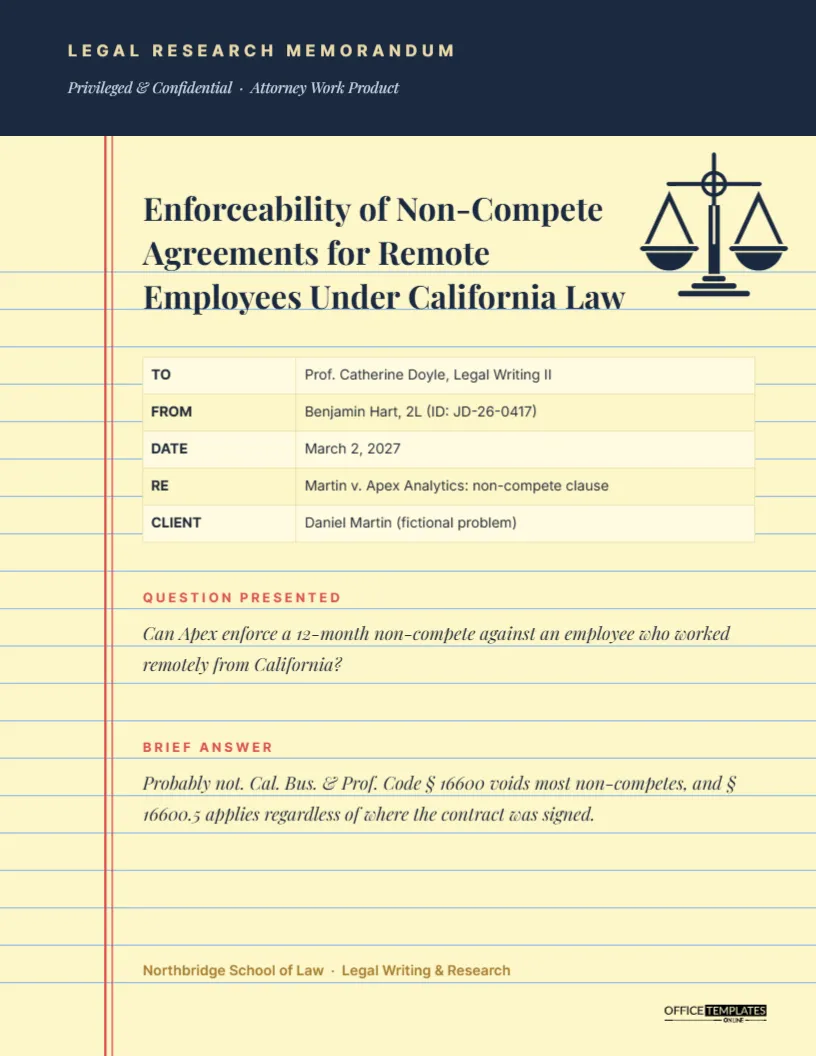
The page is pale legal-pad yellow, ruled with thin blue lines and crossed near the left edge by a double red margin line. A navy band across the top holds Legal Research Memorandum in spaced gold-tinted capitals and, beneath it in italic, Privileged & Confidential · Attorney Work Product. On the right, a navy scales of justice sits just under the band. The title, Enforceability of Non-Compete Agreements for Remote Employees Under California Law, is set in navy Playfair Display. A memo heading table follows, then Question Presented and Brief Answer in red capitals, each with an italic paragraph. A gold line at the bottom names the law school and course, beside the logo.
The Memo Heading as a Table
Memo headings follow a fixed pattern, so the template uses a real table. Select it and choose Edit Table Data to fill in your own rows:
| Heading | Sample entry | Notes |
|---|---|---|
| TO | Prof. Catherine Doyle, Legal Writing II | In practice, the supervising attorney |
| FROM | Benjamin Hart, 2L (ID: JD-26-0417) | Your name; add an exam number for anonymous grading |
| DATE | March 2, 2027 | The date you deliver the memo |
| RE | Martin v. | |
| Apex Analytics: non-compete clause | Client or matter name and the issue | |
| CLIENT | Daniel Martin (fictional problem) | Remove for anonymous grading if required |
Many legal writing programs use anonymous grading with exam numbers. If yours does, replace your name with your number throughout and delete anything that identifies you.
Drafting the Question Presented
A good Question Presented combines the applicable law, the legal question, and the key facts in one sentence. A common formula is Under [law], does/can [legal question] when [key facts]? The sample is short for the cover: Can Apex enforce a 12-month non-compete against an employee who worked remotely from California? In your full memo, you would likely expand it: Under California Business and Professions Code § 16600, can an Illinois employer enforce a 12-month non-compete agreement against a former employee who signed the agreement in Illinois but worked remotely from California for three years?
Drafting the Brief Answer
The Brief Answer responds directly, usually starting with Yes, No, Probably yes, or Probably not, followed by one to three sentences giving the reason. The sample: Probably not. Cal. Bus. & Prof. Code § 16600 voids most non-competes, and § 16600.5 applies regardless of where the contract was signed. Avoid hedging at length. Your supervising attorney wants the bottom line first; the Discussion section is where you work through counterarguments and uncertainty.
Objective Memo Versus Persuasive Brief
A memo is objective. It predicts how a court will rule and gives both sides fairly, because the reader needs to make good decisions for the client. A brief is persuasive: it argues for one side to a court. Students sometimes slip into advocacy in a memo, using words like clearly or ignoring bad cases. Graders notice. Use neutral verbs (the court would likely find) and address the strongest opposing authority directly. The cover’s Privileged & Confidential line reminds you that the memo is internal advice, not a court filing.
Citation Reminders for the Memo Body
Most U.S. legal writing courses use The Bluebook or the ALWD Guide to Legal Citation. In a memo, use the practitioners’ format: case names italicised or underlined, reporters abbreviated, pin cites to specific pages, and short forms (Id., supra) after the first full citation. Statutes include the code, section, and year where required. Check your course’s chosen guide, as rules on short forms and signals differ slightly.
Customizing the Legal Pad
The ruled lines are a single group, and the red margin is two thin shapes; you can recolour or remove them. For a more formal firm-style memo, change the background from yellow to white, remove the ruled lines, and keep the navy band. The scales of justice are an editable vector, so you can change its colour from its swatches or replace it with a gavel from the editor library. Gold and navy suit most law schools; change them to your school’s colours if you like.
Beyond First-Year Legal Writing
The same cover works for seminar papers in law school, moot court research memos, clinic memos (with real client details removed or anonymised), paralegal coursework and pre-law undergraduate assignments. For a seminar paper, change the label to Seminar Paper and use the Question Presented space for your thesis. For a moot court memo, add the competition name in the RE row.
Confidentiality in Clinic and Externship Work
If you write memos in a law clinic or externship, real client information is involved. Never use a public template service to store confidential client details unless your supervisor approves it. For practice and class assignments with fictional facts, as in the sample, there is no issue. When in doubt, use initials or placeholders and add details in your firm’s secure system.
Printing on Legal Pad Yellow
The page is US Letter, 8.5 x 11 inches, the standard for U.S. legal memos. Note that legal size paper is 8.5 x 14 inches; this template is not legal size. The yellow background prints as a pale tint on white paper. Download as a PDF for submission through your course portal.
Law Memo Cover FAQ
Does a legal memo normally have a cover page?
In practice, the heading is at the top of the first page. Courses and firms sometimes want a cover for longer memos; ask your professor.
Can the Question Presented be more than one sentence?
Traditionally, it is one sentence. If you have several issues, number them.
Should I include the Statement of Facts on the cover?
No. It follows the Brief Answer inside the memo.