A Letter From a Kid, Delivered by a Kid
Imagine a seven year old writing her first Christmas card to her grandparents. She has chosen the paper, practised the spelling of Grandma three times and drawn a reindeer that is mostly legs. The envelope should look as excited as she is. This gingerbread house design does exactly that, with minty paper, white icing around the edges, sweets scattered everywhere and a roomy, rounded label where she can write the address in her biggest, best handwriting.
Everything That Is on the Page
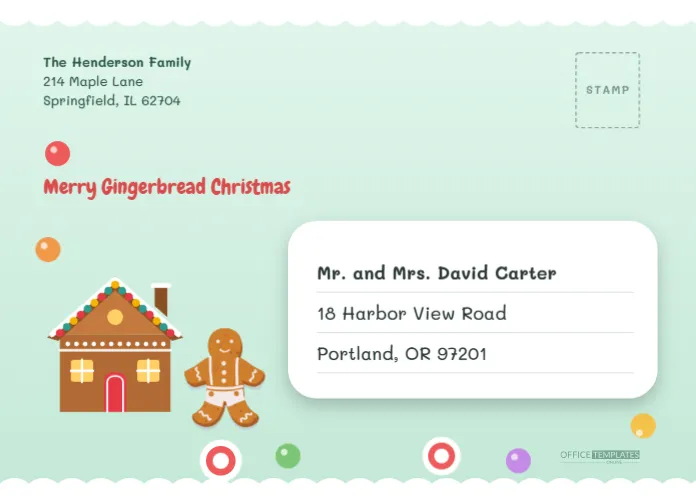
The envelope is an A7, 7.25 by 5.25 inches, landscape. The background is a soft mint green gradient. Along the top and bottom edges, a row of white circles forms a scalloped line of icing. Scattered around are gumdrops in red, orange, yellow, green and purple, each with a small white highlight, and two swirled peppermints in red and white. A gingerbread house with a white icing roofline, bright candy dots, a red door and a little chimney stands in the lower left, and a gingerbread man in white icing shorts waves beside it.
The greeting, Merry Gingerbread Christmas, is set in Chewy, a bouncy, hand cut looking font, in a warm red. The return address in the top left uses Mali, a friendly hand written style font, in deep green. On the right, a large white rounded label holds the recipient lines in Mali at 13.5 points, each on a pale green rule.
Bold Design Choices for Little Hands
| Choice | Reason |
|---|---|
| A large white address label | Gives a big, clean space for hand writing |
| Rounded corners everywhere | Feels soft and friendly, with no sharp edges |
| Hand written style fonts | Match the look of a child’s own writing |
| Sweets in many colours | Fills the page with cheerful detail without crowding the label |
| Mint green background | A fresh colour that makes the candy colours pop |
Using It as a Classroom Craft
- Print one envelope per child on plain paper.
- Ask each child to write a name and address on the label, using a pencil first, then going over it with a marker.
- Let the children add stickers of sweets where there is space, away from the label.
- Fold or place each card in an envelope blank, or use the printed page as the envelope itself.
- Check addresses before posting, since children’s handwriting can be hard for sorting machines.
Changing the Gingerbread Greeting and Sweets
Click the greeting to change it. Try Merry Christmas from Grace, or a family name. Select a gumdrop to move or recolour it, or copy it to add more. The gingerbread house and man are editable vector artwork, so you can ungroup them. To make the label larger or smaller, drag its handles and move the lines with it. The return address uses the same font family as the greeting, so the envelope looks consistent.
Safety, Postage and Sweets
Real sweets in an envelope are a hazard. They can melt, stick to the card or fall out and confuse a postal machine, and some countries restrict food in the mail. Use printed sweets instead, and tuck a sticker sheet or a hand drawn picture inside for a surprise. The design gives a full feeling of a sugary Christmas without a single crumb.
Printing the Mint and Candy Colours
Print on bright white paper at high quality, since the mint green and the small details look best with a strong white base. Use a printer with accurate colour if possible, as the gumdrops should be vivid. Check that the label stays pure white and that the text is dark enough to read.
Gingerbread Envelope Queries From Parents
Can children colour in the design?
The design is already in colour. For colouring, delete the fills and keep the outlines, or print the label only.
Can I change the gingerbread house to a snowman?
Yes. Delete the house and insert another vector from the library.
Is the font easy to read for young children?
Mali is a clear, rounded hand style font, and it is suitable for most readers.
Planning a Cookie Swap Invitation Mailing
A neighbourhood cookie swap is the perfect event for this envelope. Send each neighbour a small card with the date, the time and the rule: bring a dozen cookies and a recipe card. The gingerbread house on the front tells everyone what to expect, and the mint colour stands out in a stack of ordinary mail. Keep a list of replies so that you know how many cookies to expect.
Handwriting Practice Before the Real Thing
Children often write addresses for the first time at Christmas. Give them a practice sheet with the same three line layout, let them try their own name and an easy address, then check it together. Praise their effort, and fix any digit that could be misread, such as a seven that looks like a one.
Gumdrop Colours and Accessibility
The sweets use red, orange, yellow, green and purple, which are easy to tell apart for most children. If a child has trouble with certain colours, add a small white highlight or a dot pattern to each sweet so they are distinguishable by shape and not only by hue. The address label stays white for strong contrast.
Wrapping Up a Class Set Without a Single Crumb of Mess
A teacher can print the whole class set in one go, trim them on a guillotine and give the pile a light press under a book. Pre write the return address for each child, since many will not know their postcode, and leave the label for them to fill. A box of coloured pencils at each table finishes the job.
Designing a Matching Card With Cut Paper Shapes
Fold a sheet of cream paper in half and glue a small paper gingerbread house on the front. Use icing coloured dots from a gel pen, and write the greeting inside in your best handwriting. The simplicity of the card lets the envelope’s sweets and colours take centre stage.
Using the Envelope for a Kids Holiday Pen Pal Exchange
Schools and clubs often pair children as pen pals at Christmas. Print an envelope for each child, add the name of the partner on the label, and give a short list of ideas for the letter: favourite food, a funny moment, a drawing. Children who receive a reply feel part of a bigger world, and the colourful envelope makes the exchange memorable.