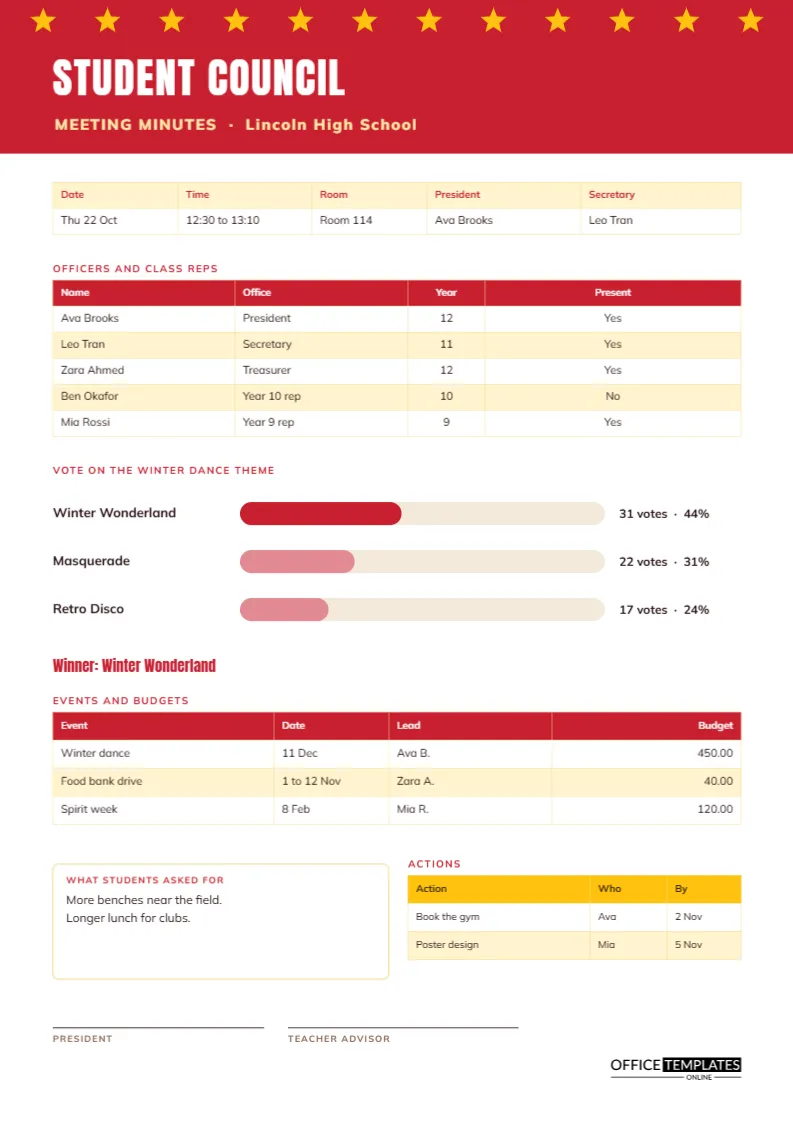
A student council is often a young person’s first experience of running a meeting, and it is a good place to learn why minutes matter. Votes are taken, money is spent on dances and drives, and everybody wants to know afterward who decided what. This template is made for that setting. It has the energy of a school banner, a clear list of officers and a vote section that shows results as bars, so that a decision can be checked by anyone who looks.
A Red Banner With a Row of Gold Stars
The page opens with a bold red header and a row of twelve small gold stars across the top. The title STUDENT COUNCIL appears in Anton, a tall condensed face often used for sports and school banners, and a line beneath reads MEETING MINUTES with the school name. The red and gold palette is classic school colours, and it gives the page a sense of occasion without being hard to read.
Officers and Class Reps Present
A roll table lists name, office, year, and whether each member was present. The sample shows a president, secretary, treasurer, and representatives for years ten and nine. Recording absences teaches an important habit: decisions are made by the members who were there. If the council has a quorum rule, write the number needed in the notes.
Vote Bars That Match the Counts
The centre of the page holds a vote on the theme of the winter dance. Three bars show Winter Wonderland with 31 votes, Masquerade with 22, and Retro Disco with 17, a total of 70. Each bar’s length is drawn in proportion to its share, and the percentage appears beside it: 44, 31, and 24 percent. The winner is named in red display type beneath the bars. Because the numbers and bars match, readers can trust the result.
Counting a Vote Properly
- Decide how voting will work before it starts: show of hands, ballot slips, or an online poll.
- Appoint two counters who are not on the ballot.
- Count twice and write down the totals.
- Add the votes to check the total against the number of voters.
- Announce the result and record it in the minutes.
Events and Budgets in One Table
A table lists the winter dance, a food bank drive, and spirit week, with dates, lead student, and budget. The sample budgets are 450, 40, and 120. Putting a name against each event gives students ownership. Seeing a budget beside each event also teaches them to plan with limits, which is one of the most valuable lessons a council can offer.
What Students Asked For
A white box records requests that students passed on to the council, such as more benches near the field and longer lunch for clubs. This is the council’s reason for existing: to carry the voice of the student body to the adults who run the school. Recording requests shows that the council listens, and it gives next month’s meeting a list of questions to follow up.
Actions With a Yellow Header
A small table with a gold header lists two actions, book the gym and design the poster, each with a student’s name and a date. Keep actions small, so they can be done between meetings alongside schoolwork.
The Teacher Advisor’s Signature
Two lines at the foot are for the president and the teacher advisor. A teacher’s signature confirms that the record is accurate and gives the school a copy for its files. It also models how formal organisations work.
A Sample Agenda for a Lunchtime Meeting
| Minute | Item | Who leads |
|---|---|---|
| 0 to 5 | Welcome, roll call, and minutes | Secretary |
| 5 to 15 | Treasurer’s report and event budgets | Treasurer |
| 15 to 30 | Vote on the dance theme | President |
| 30 to 40 | Student requests and actions | Class reps |
Teaching Students to Write Neutral Minutes
Young secretaries often write what they felt, not what happened. Help them by coaching three habits: write decisions in the past tense, leave out opinions about people, and always record the vote count. The page gives them a structure that supports these habits, and a teacher advisor can review each set quickly.
Editing the Vote Section
To change a vote, retype the option names, and select each bar to adjust its width in proportion to the votes. If you have four options, copy a bar row and move the lines below it. Both tables are real Table objects, so cells and rows can be changed from the editor panel.
Fair Voting and Student Trust
A council only keeps the trust of the student body if its votes are fair. Explain how voting works, count openly, and publish the totals. If a result is close, say so. Writing the exact counts in the minutes, as this page does, lets any student check the result and teaches everyone the value of transparency in a democratic process.
Connecting Council Decisions to School Leaders
The council advises, and the school leadership decides many things. Use the requests box to list what the council will take to the principal, and record the response at the next meeting. A visible loop, from request to answer, shows students that the council can achieve change, which keeps participation high.
Learning Minute-Taking as a Skill
Taking minutes teaches listening, summarising and writing under time pressure. Students who practise on this page often carry the skill into university and work. Encourage the secretary to rotate each term so more students try it, and give them feedback on clarity and accuracy.
Printing and Posting for Students
A4 portrait. Post the page on a school notice board so that students see what the council decided. The red header prints boldly, and the page remains readable in black and white.
Keeping Council Minutes Short and Positive
Students read minutes when they are short and show results. List the wins, such as an event approved or a request granted, near the top, and the council gains credibility with the whole school.
Council Questions
Who should take the minutes?
The elected secretary, with a deputy ready to step in.
Can younger students use it?
Yes. Simplify the language and reduce the number of table rows.