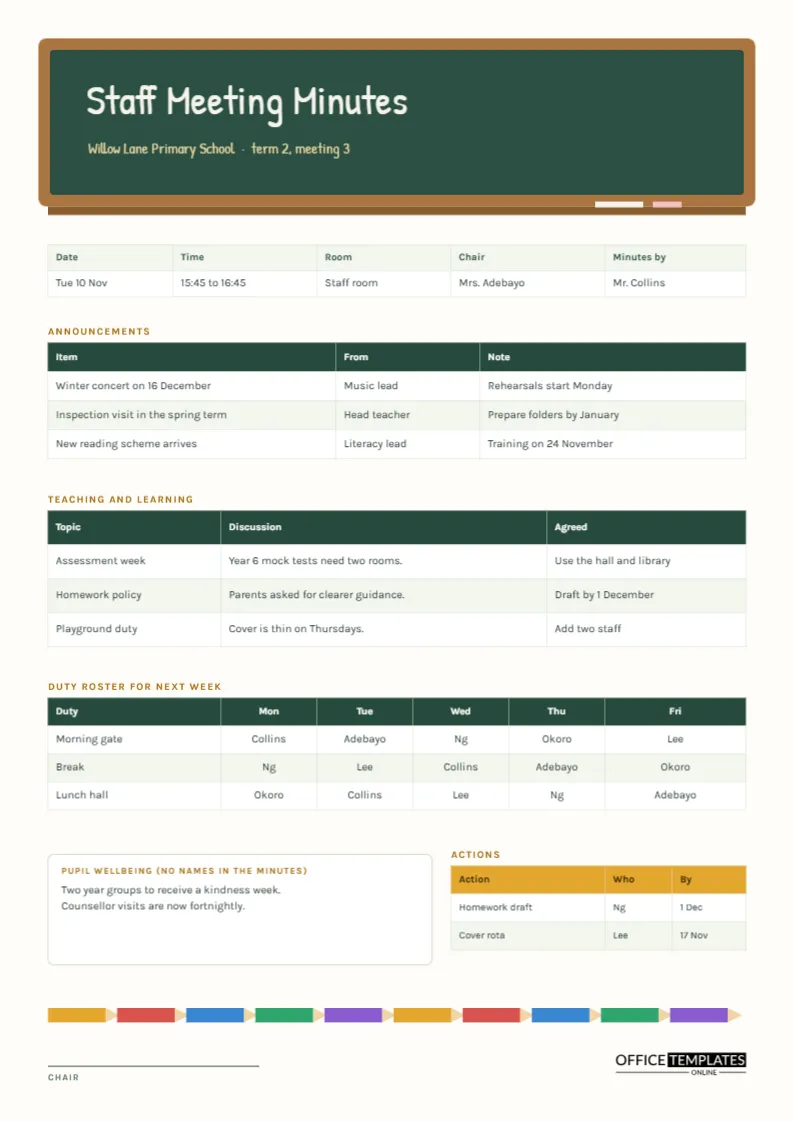
School staff meetings have their own rhythm. They happen after the bell, in a staff room, with tired people and a long list: announcements, assessment dates, a change to duty cover, a concern about a year group. The minutes have to be useful to teachers who were absent and to a head who needs a record. This page recalls the look of a classroom, with a framed chalkboard at the top and a row of coloured pencils at the foot, and holds a tidy set of tables for the real business.
The Framed Green Board at the Top of the Page
The header is a deep green board with a tan wooden frame and a darker shelf beneath it holding two pieces of chalk, one white and one pink. The title, Staff Meeting Minutes, is set in Patrick Hand, a casual handwriting-style font, in chalk white. Below it, a line in soft yellow names the sample school and the term. The effect is friendly without being childish, which suits a document that teachers will read on a busy afternoon.
A Row of Pencils at the Bottom
Near the foot of the page, ten coloured pencils lie end to end, their sharpened tips pointing right. The row echoes the board at the top, so the page feels like one design. The pencils are grouped, so you can move or delete them as one object.
Announcements by Source
The first table lists items, who they come from, and a short note. In the sample, the music lead announces a winter concert and rehearsals begin on Monday. The head teacher announces an inspection visit in the spring, and the literacy lead says that a new reading scheme arrives with training on 24 November. Listing the source tells absent teachers whom to ask.
Teaching and Learning Decisions
The second table has columns for topic, discussion, and what was agreed. The sample covers assessment week, homework policy, and playground duty. Entries are short: Year 6 mock tests need two rooms, with the agreement to use the hall and library. Keep discussion to one sentence, and make the agreement concrete.
Common Items on a School Staff Agenda
| Area | Typical item | Where it goes on the page |
|---|---|---|
| Calendar | Concerts, trips, inspection dates | Announcements table |
| Assessment | Test weeks, moderation, reports | Teaching and learning table |
| Policy | Homework, behaviour, uniform | Teaching and learning table |
| Supervision | Gate, break and lunch duty | Duty roster |
| Pupil wellbeing | Programmes and support | Wellbeing box |
The Weekly Duty Roster
A six-column table lists duties down the left and the five weekdays across the top, with a staff member’s surname in each cell. The sample covers morning gate, break, and lunch hall. A roster inside the minutes means everybody sees it on the same day, and it becomes the reference if a duty is missed.
Pupil Wellbeing Without Naming Pupils
A white box at the lower left is headed Pupil wellbeing, with the reminder that no names appear in the minutes. This is a sensible rule. The minutes may be seen by many staff and, in some places, by inspectors or parents requesting records. Record programmes, themes and actions, such as a kindness week or a change to counsellor visits, and keep individual matters in confidential files.
Actions With a Gold Header
A small table with an amber header lists actions with a person and a date. The sample has a homework policy draft for 1 December and a cover rota update for 17 November. Add rows if your meeting generates more.
Signing and Sharing the Minutes
The chair signs at the foot, and the page goes to staff by email or onto the staff room board the next morning. Part-time staff and teaching assistants who were not at the meeting depend on the page, so send it to them too.
Editing the Chalkboard
The board, frame, and chalk are simple shapes you can recolour. Retype the school name and term in the subtitle. The three tables are real Table objects. Use Edit Table Data to retype cells and Add Row to include more duties or announcements. Fonts can be changed from the text panel, though the chalk look depends on the handwriting-style face.
Why Part-Time Staff Need the Written Page
Many schools rely on part-time teachers, teaching assistants and visiting specialists who do not attend every staff meeting. For them, the minutes are the main channel of information. Send the page to the whole staff list, and consider printing a copy for the staff room table. A clear, regular record keeps everyone informed, and it reduces the number of questions that begin with I did not know about that.
Handling Inspections and Policy Evidence
Schools are inspected, and inspectors like to see that decisions about teaching and policy were discussed and recorded. Staff minutes are good evidence. If the page records that a homework policy was reviewed, the reasons and the date of the decision, it shows a school that manages itself thoughtfully. Keep the pages for the period your authority requires, and store them in date order.
Recording Cover, Trips and Safeguarding Reminders
Short operational reminders belong in the announcements table. A trip notice, a change to cover arrangements or a reminder about safeguarding procedures can each be a row with the source and one useful note. Do not record details of individual pupils. If a safeguarding matter needs action, follow your school’s own procedure and keep the record in the proper confidential place.
Printing the School Staff Page
A4 portrait on a warm off-white. The board prints dark, so for draft copies you might lighten its fill. In black and white, the page stays clear because the tables carry the structure.
Keeping Staff Minutes Friendly and Brief
Teachers have little spare time, so the page should be quick to read. Use short sentences, plain words, and one line per decision. A friendly tone helps staff feel the meeting is a shared effort and not a list of instructions from above.
School Meeting Questions
Can I use it for a secondary school?
Yes. Change the duty names and add departments to the teaching and learning table.
How long should staff minutes be?
One page is ideal. If you run past it, ask whether some items belong in a separate memo.