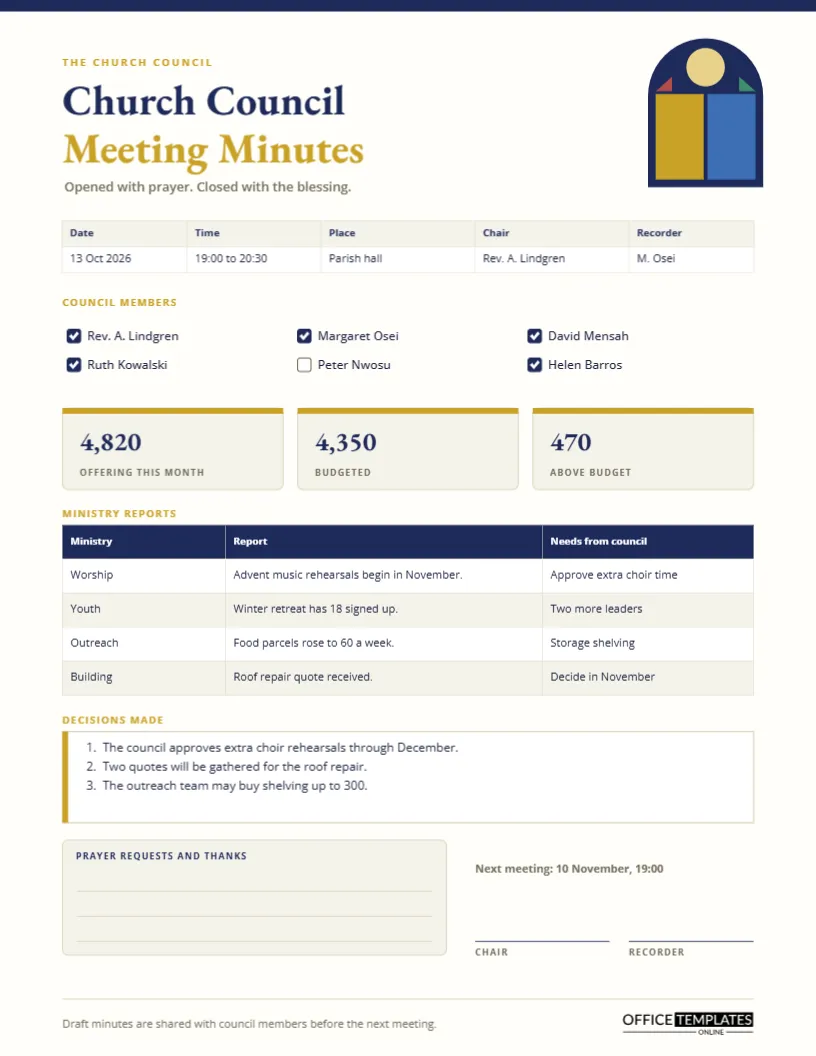
A church council meets to look after the practical life of a congregation: the building, the finances, the ministries and the people who serve. Its minutes are part of the congregation’s memory. They should be accurate and calm, and they should leave room for the spiritual side of the work as well as the budget. This page is arranged to do both, with a quiet navy and gold design that suits a parish hall or a vestry table.
An Arched Window Beside the Title
In the top right corner, a navy arch holds a small stained-glass style window of gold and blue panes, with a pale gold circle set above them and two small coloured corner pieces in red and green. It uses simple geometric shapes only, with no figures or symbols, so the page suits any tradition. Along the left, the title Church Council appears in navy EB Garamond, and the words Meeting Minutes follow in gold. A short line beneath reads Opened with prayer. Closed with the blessing, which you can change to match your own custom.
Opening and Closing Words in the Record
Many councils record that the meeting began and ended with prayer, and the subtitle makes space for that without taking up a row of the page. If your tradition includes a reading or a reflection, note its subject in the prayer requests box at the bottom, in a few words. This is a courtesy to members who were not present and a gentle way to keep worship at the centre of what is otherwise administrative work.
The Council Roll
Six names appear in two rows of check boxes, five ticked and one empty. The first is the minister, whose title you can retype. A tick means present, and an empty box means absent. If your council also includes ex officio members, such as the churchwardens or elders, add them below the grid or in the notes.
Offering and Budget Tiles
Three tiles with gold tops hold the monthly offering, the budgeted figure, and the difference. The sample shows 4,820 received against a budget of 4,350, which leaves 470 above budget. Councils do not need to publish detailed accounts in the minutes, but a simple monthly comparison keeps the leadership informed and invites questions early, long before the annual report.
Prompts for Each Ministry Report
The ministry reports table lists each area with a short report and what it needs from the council. To make reports short and useful, ask each leader to answer the same three questions.
| Question to the ministry leader | Sample answer from the page | Column it fills |
|---|---|---|
| What has happened since last time? | Winter retreat has 18 signed up | Report |
| What is planned next? | Advent music rehearsals begin in November | Report |
| What do you need from the council? | Two more leaders | Needs from council |
Writing Decisions in Neutral Language
The decisions box has a gold edge and three numbered statements. The sample records that the council approves extra choir rehearsals, will obtain two quotes for the roof, and allows the outreach team to buy shelving up to a set amount. Notice that each decision names the thing agreed and a limit or a next step. Avoid language that attributes motives, and avoid recording the strength of feeling on either side.
Pastoral and Personal Matters
Councils sometimes discuss the circumstances of members, such as illness, bereavement or financial need. These matters call for discretion. Record that a pastoral matter was discussed and what action was agreed, such as a visit or a card, but keep names and details out of the general minutes. If a more detailed note is required, keep it in a separate confidential file held by the minister.
Prayer Requests and Thanks
A soft-tinted box at the bottom left has three lines for prayer requests and thanks. It also gives a place to record gratitude to volunteers, which is something church work often forgets to do in writing. Beside it, the next meeting date appears together with lines for the chair and the recorder.
Editing the Page for Your Tradition
Every label on the page is an editable text box. Rename Council members to Elders, Vestry, Session, or Church committee, and change the ministry names to suit. The arched window is built from shapes that can be recoloured, and the tables are real Table objects that accept new rows through Edit Table Data and the Add Row button.
Building and Property Matters in the Minutes
Councils make many practical decisions about property: repairs, insurance, hall bookings and contracts. Record the decision, the amount and who is responsible, and refer to quotes or reports by name and date. When a roof repair spans several meetings, as in the sample, a short running note such as quotes received, decide in November lets a reader follow the story across pages. Careful records protect the congregation if a contractor or insurer later asks what was agreed.
Sharing the Draft With the Council
The footer line suggests sharing draft minutes before the next meeting, which is a good habit. Members can send corrections in advance, and the approval at the start of the next meeting becomes a quick formality instead of a long discussion.
Keeping the Record Over the Years
Congregations often outlast their leaders, so the minutes may be read by people not yet born. File each signed page in date order and keep an index of major decisions at the front of the volume. If your church has a safe or a locked cabinet, keep the originals there and hold a scanned copy on a shared drive with restricted access.
Printing the Council Page
US Letter portrait, printed at actual size. The ivory paper tone is a background, so choose a print setting that includes background colours if you want it. The arch prints best in colour, though a grayscale copy is clear and dignified.
Questions From Church Secretaries
Can a congregation of thirty use this?
Yes. Reduce the number of ministries and the council roll and keep the finance tiles.
Can I replace the window with our own logo?
Yes. Delete the window shapes and place your logo in the same corner, on a light background so it remains clear.