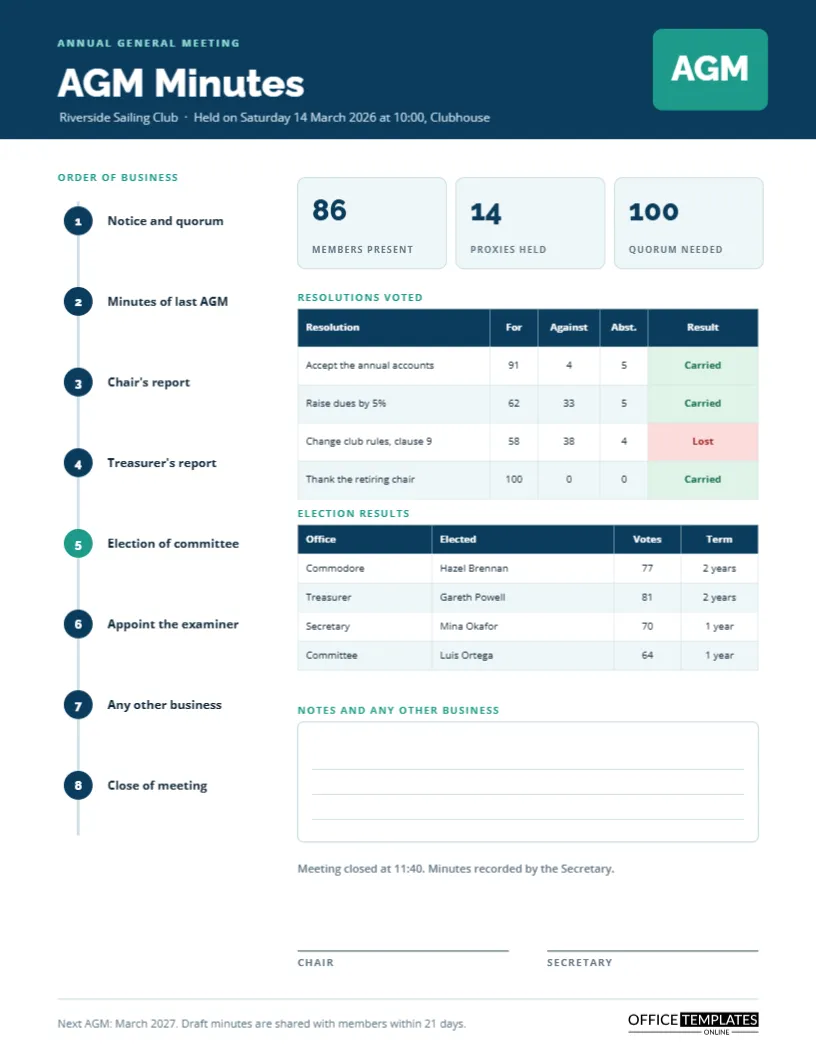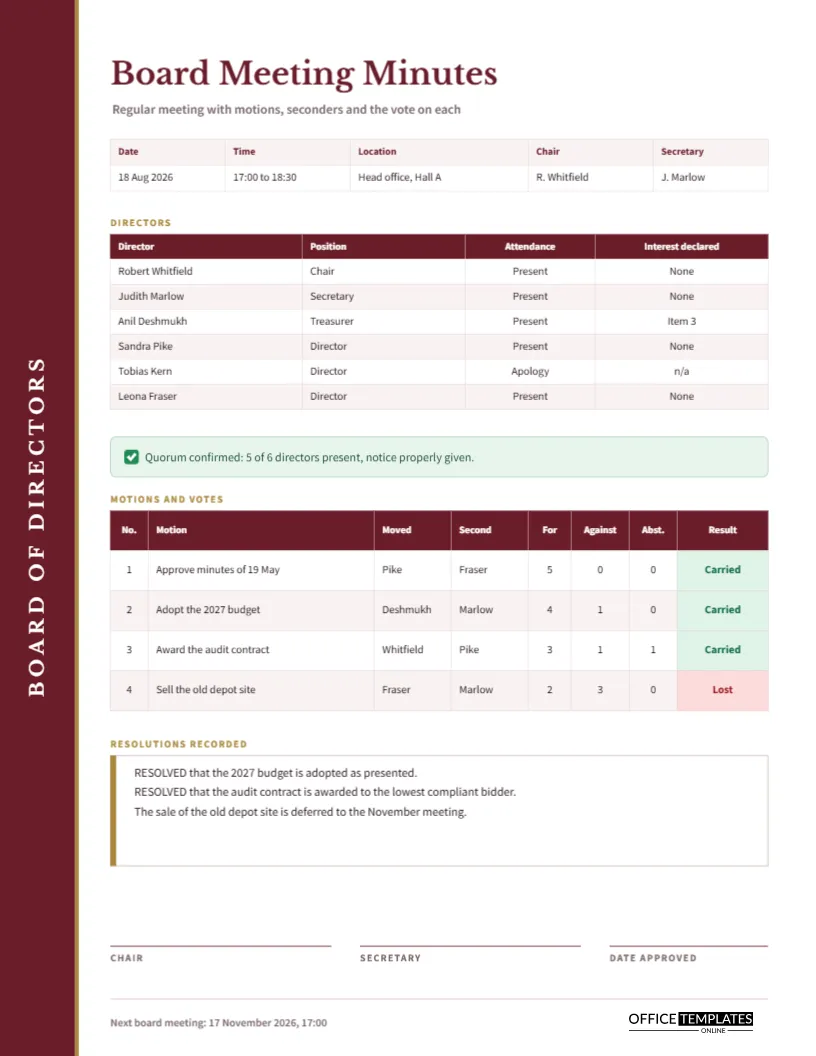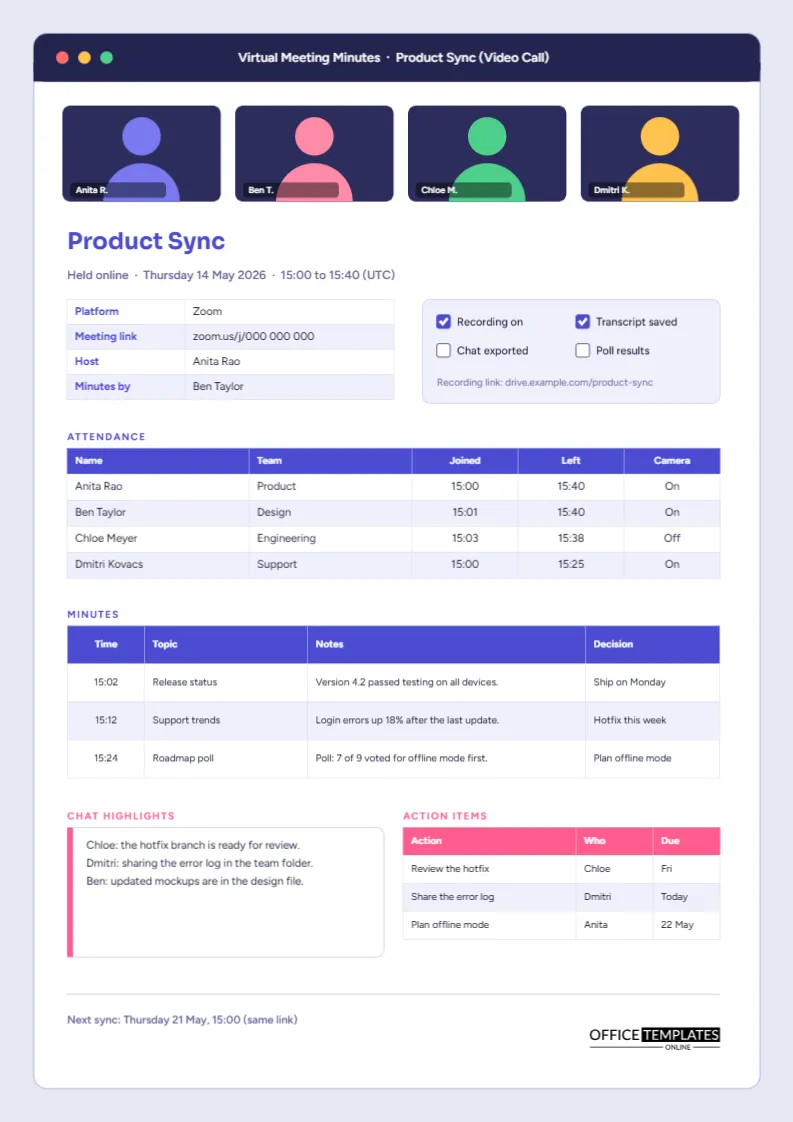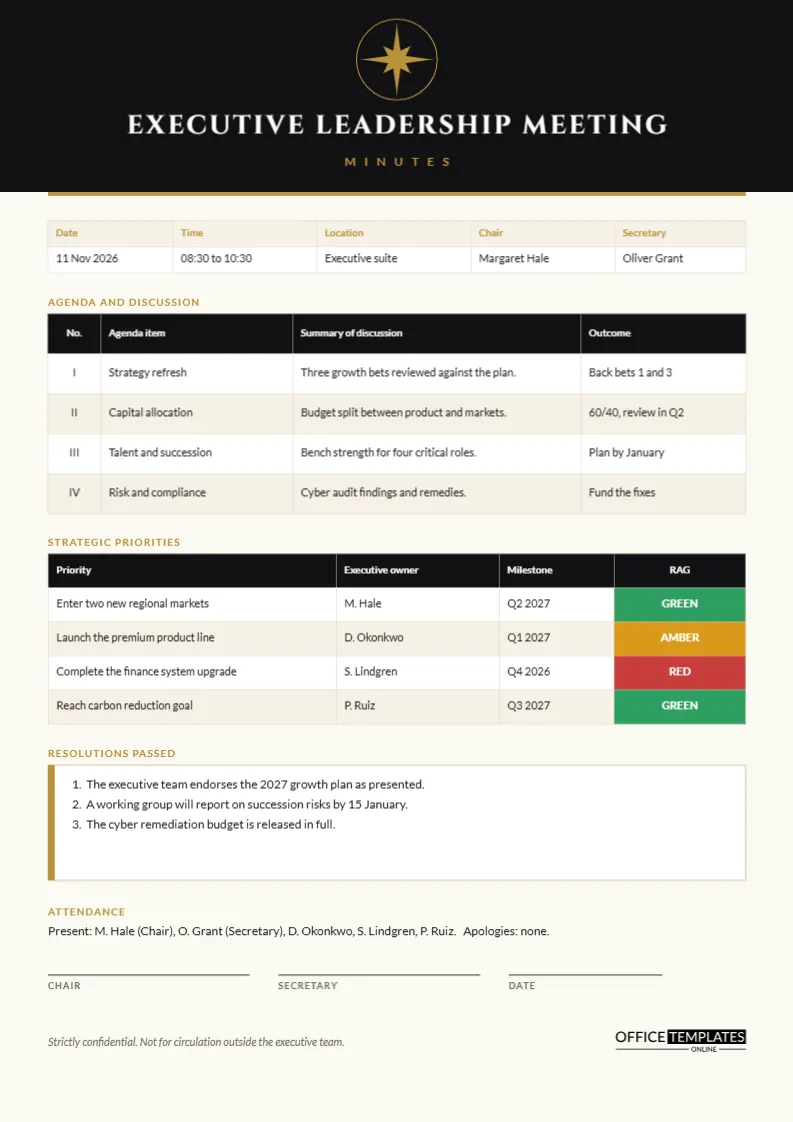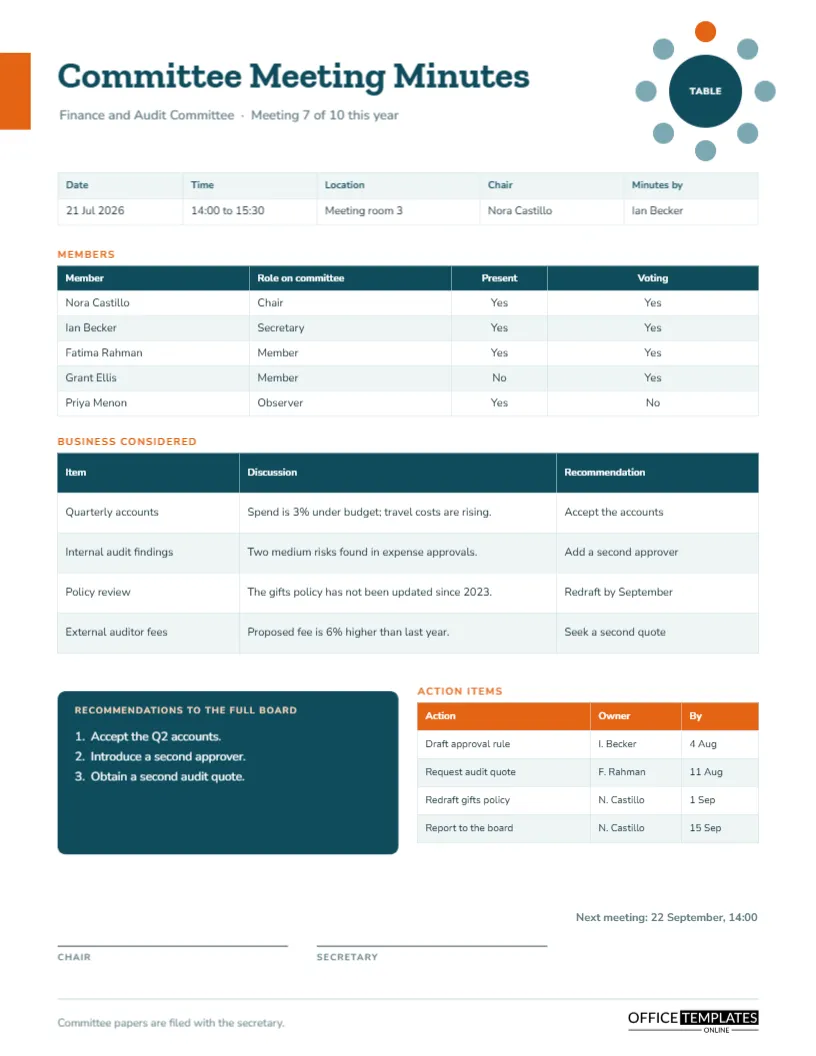
A committee does not usually make final decisions. It studies a matter, debates it in more detail than the full board has time for, and then recommends what the larger body should do. Good committee minutes therefore have one job above all: to make the recommendation clear. This template puts a dark teal box labelled Recommendations to the full board at the centre of the lower page, and builds the rest around it.
From Committee Room to Board Table
It helps to picture the path a topic takes.
- The board creates a committee for finance, audit, governance or another area.
- The committee meets, reviews papers and questions, and meets with staff.
- Members agree what to recommend, and the secretary records it.
- The chair carries the recommendations to the board.
- The board accepts, amends, or rejects each one, and the board minutes record the outcome.
Because step three is the product of the meeting, the page puts it where the eye lands.
A Round Table in the Corner
In the top right corner, a dark teal circle labelled Table is ringed by eight smaller circles, seven pale blue and one orange. It is a plan view of a round table, with the orange seat marking the chair. A copper-orange tab on the left edge echoes that colour beside the title, and the title itself is set in Zilla Slab bold. The mood is practical and slightly warm, suited to a working group more than a formal board.
The Member Roll
A table lists members, their role on the committee, whether they were present, and whether they have voting rights. The last two columns matter because committees often include non-voting observers or advisers. The sample shows five people, one absent member and one observer. Record voting status accurately, since a recommendation passed by a committee with an uncounted observer could be challenged.
What the Committee Considered
The business table has three columns: item, discussion, and recommendation. Each row pairs the topic with the committee’s view. The sample covers quarterly accounts, internal audit findings, a policy review, and external auditor fees. Notice that every row ends in a recommendation, such as accept the accounts or seek a second quote. A committee that cannot offer a recommendation should say so and explain what it needs.
Wording Recommendations That the Board Can Act On
| Vague wording | Clear wording | What the board can do with it |
|---|---|---|
| Look at the audit risks | Introduce a second approver for expenses | Approve or amend |
| Review fees | Obtain a second audit quote | Approve the request |
| Update policy | Redraft the gifts policy by September | Accept the deadline |
The Recommendations Box
The dark teal panel on the left of the lower half holds three numbered recommendations in white type. It is the part of the page the board secretary will lift into the board papers. Keep each recommendation to one sentence, and avoid referring to details the board has not seen.
Actions for Committee Members
To the right of the recommendations sits an action table with an orange header: action, owner and date. In the sample, one member drafts an approval rule by 4 August while another requests an audit quote by 11 August. The final action, reporting to the board on 15 September, belongs to the chair. Putting the board report as an action ensures it is not forgotten.
Closing the Committee Page With Signatures and a Date
Two signature lines at the foot, for the chair and the secretary, sit beside a short note giving the date of the next committee meeting. A footer line reminds the secretary that committee papers are filed with the secretary.
Reading Papers Before the Meeting
A committee is only as good as its preparation. Circulate the papers at least several days before the meeting, and ask members to read them. The minutes can then say that the papers were taken as read, and the discussion column can concentrate on questions and concerns instead of summaries. When a paper arrives late, note that in the discussion cell, because a decision made on late material may be revisited.
Handling Items the Committee Cannot Decide
Sometimes a committee needs more information, or the matter belongs to the board. In those cases, the recommendation column should say exactly that: refer to the full board, or defer pending a second quote. An explicit deferral is far better than an empty cell, because it gives the secretary an item to carry forward and tells the board what the committee needs from it.
Adapting the Round Table Page to Your Committee
Retype the committee name and the meeting number in the subtitle. If your committee has more members, add rows to the roll through Edit Table Data and the Add Row button, and shorten the business table to compensate. The round table graphic can be edited too: recolour the seats, delete one, or replace the word Table with your committee’s initials.
Rotating the Pen Between Meetings
In some committees, the secretary takes the minutes every time, and in others members share the duty. If you rotate, agree to use this page as the single format so the record looks the same whoever writes it. A consistent layout also helps the board secretary lift recommendations quickly, whoever drafted the page.
Keeping Committee Minutes Separate From Board Minutes
Do not copy committee minutes into the board minutes. The board minutes should record the board’s decision on each recommendation, with a reference to the committee paper. That keeps each record clean and avoids confusion about who decided what.
Print Notes for This Page
US Letter, portrait. The dark panel prints heavily, so for draft copies you may prefer to change its fill to a light tint. A final copy in colour makes the recommendations stand out for the readers who matter most.
Committee Page Questions
Can a committee vote?
Often yes, among its voting members, though the rules of your organisation decide. Record any vote in the discussion or recommendation cell.
Is this suitable for a sub-committee?
Yes. Change the committee name in the subtitle and use the same layout.