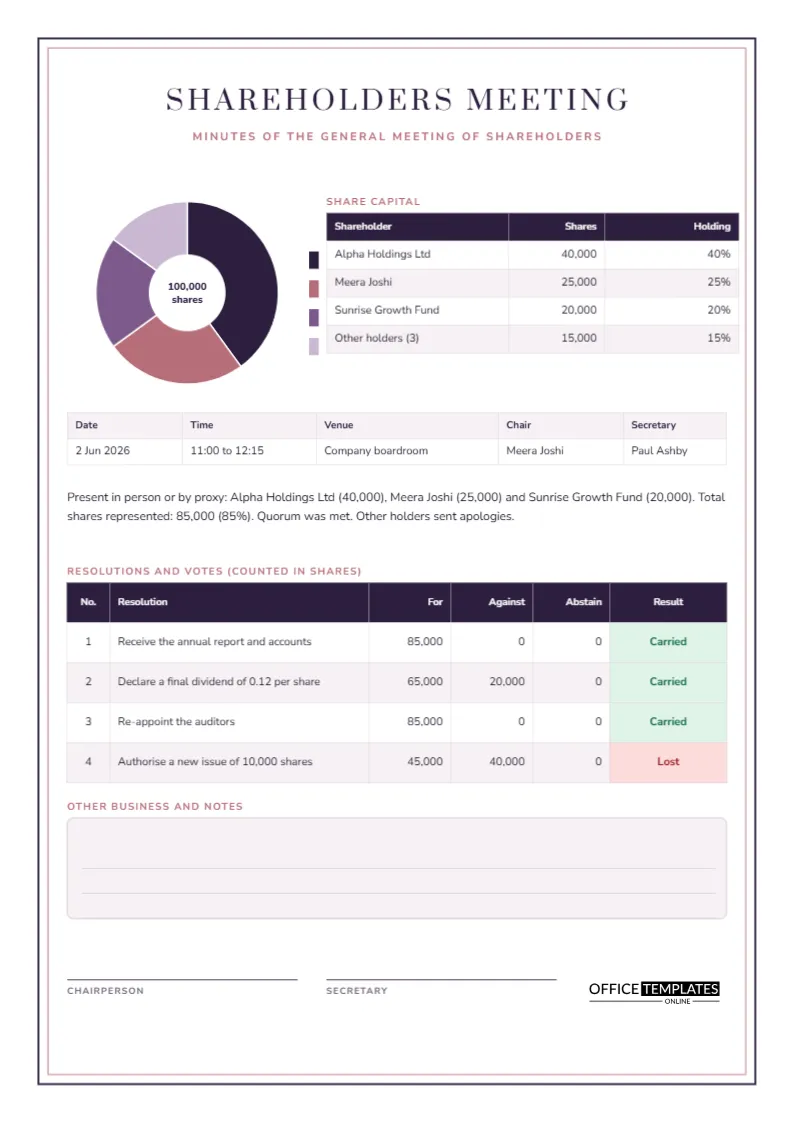
A shareholders’ meeting is different from almost every other meeting, because votes are not counted by heads. A holder of forty thousand shares carries forty times the weight of a holder with a thousand. That single fact is why ordinary minutes forms fall short. They have a vote column, but they do not make it obvious that the numbers represent shares. This page does.
Why Counting Votes in Shares Changes the Minutes
In a club or a committee, one person has one vote. In a company, one share usually carries one vote, so the result of a resolution depends on who holds what. If two large holders disagree, a hundred small ones may not matter. For this reason, the minutes should show how many shares were represented and how many voted each way. The page is built so that those totals sit next to each other, and the holdings chart reminds everyone how the capital is divided.
A Worked Example of Counting Shares
The sample company has 100,000 shares. Three holders attend and hold 85,000 shares between them, which is 85 percent of the capital.
| Resolution | Shares for | Shares against | Percent in favour | Outcome |
|---|---|---|---|---|
| Receive the annual report | 85,000 | 0 | 100% | Carried |
| Declare a final dividend | 65,000 | 20,000 | 76.5% | Carried |
| Re-appoint the auditors | 85,000 | 0 | 100% | Carried |
| Issue 10,000 new shares | 45,000 | 40,000 | 52.9% | Lost |
The last resolution has more votes for than against, yet it is marked Lost in the sample, because new share issues often need a higher threshold than a simple majority. Always check the threshold in your own articles of association.
Plum, Rose Gold and an Engraved Frame
A thin plum line and a finer rose gold line frame the page, giving it the look of a share certificate. The title Shareholders Meeting is set in Prata with generous letter spacing, and a rose gold subtitle states what the document is. The working text is Nunito Sans, which stays friendly and legible at small sizes. Colours come from the same limited family of plum, rose, and lilac throughout.
The Share Capital Chart and Table
At the top left, a doughnut chart shows how 100,000 shares are divided among four holders: 40, 25, 20 and 15 percent. A small square legend in the same four colours sits beside a table that lists each shareholder, their shares and holding percentage. The chart is made of editable shapes, so if your split is different, you can change the slices by adjusting the shapes, or delete the chart and keep the table.
Recording Who Was Present and Represented
Below the details strip, a paragraph states who attended in person or by proxy and totals the shares represented. In the sample, this is 85,000 shares, or 85 percent. Quorum for a company meeting is often defined by shares, not by people, so the total belongs in the record.
A Note on Proxies
A proxy is someone authorised to vote on a holder’s behalf. If proxies voted, list the holder and the proxy together in the attendance paragraph, such as “Sunrise Growth Fund, represented by its nominee”. Keep the signed proxy forms with the minutes.
Reading the Result Colours
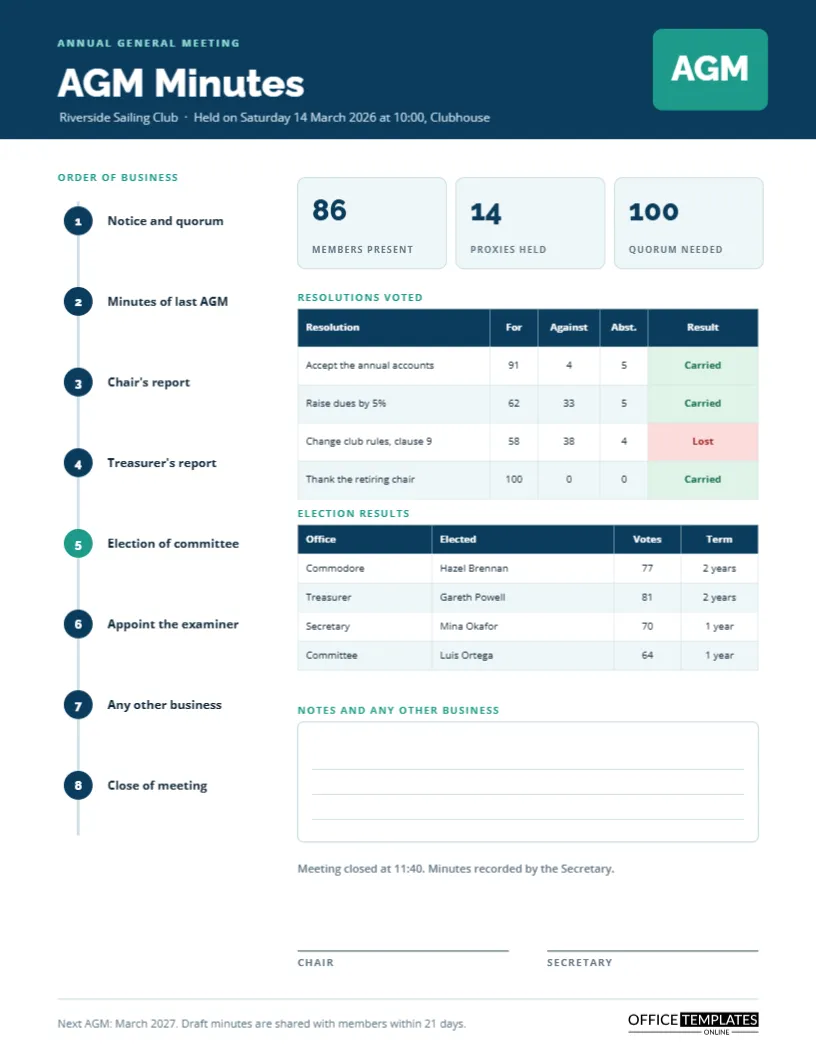
As on the other voting pages, result cells are coloured green for Carried and red for Lost. The numbers in the For, Against and Abstain columns are right-aligned, so large figures line up and are easy to compare. Add a column or a note if your resolutions require a percentage threshold.
Other Business and Notes
A tinted box with writing lines near the bottom records anything outside the formal resolutions, such as a question about future dividends. Below it, two signature lines are labelled Chairperson and Secretary.
Written Resolutions and Meetings Held by Video
Not every shareholder decision happens in a room. Some are passed by written resolution, and many meetings now run on video. If yours did, say so in the details strip by changing the venue cell to the platform name, and record how the identities of the voters were verified. For a written resolution, this page can still hold the result, with the date the last signature arrived replacing the meeting time. The legal rules for both methods vary by country and by company type, so confirm them before relying on a record.
What Auditors and Investors Look for in the Minutes
Outsiders read shareholder minutes to confirm that major actions were properly authorised. Auditors look for dividend approvals and the appointment of the auditors themselves. Investors look for share issues and changes to rights. Banks sometimes ask for a copy to confirm who may sign for the company. A page that lists resolutions in numbered rows, with counts in shares and a clear result, answers all of these quickly, and the signatures at the foot make the copy credible.
Swapping in Your Own Company Details
All text boxes are editable, and the tables accept new rows through Edit Table Data. Replace the sample company details, holders, and resolutions. Table cells hold typed text rather than formulas, so recalculate percentages by hand when you change share numbers.
Keeping the Minutes Book Up to Date
After each meeting, file the signed page with the notice of meeting, any proxy forms, and the reports presented. Add the page to the register of resolutions if your company keeps one. Doing this in the same week as the meeting is far easier than reconstructing the file at year-end, when auditors are waiting.
Printing the Framed Page
The page is A4, with the frame about a centimetre inside the edge, so most printers handle it without clipping. A heavier paper suits the engraved look.
What This Template Does Not Do
It does not replace legal advice. Company law differs between countries, and it sets requirements for notice, voting thresholds, and records. Use the page as a clear way to record what happened, and check your own obligations separately.
Shareholder Meeting Questions
Can I use it for a private company with two owners?
Yes. Delete extra rows from the share table and keep the resolution section.
Does the pie chart update when I change the table?
No. It is drawn from shapes, so adjust it by hand if the holdings change.