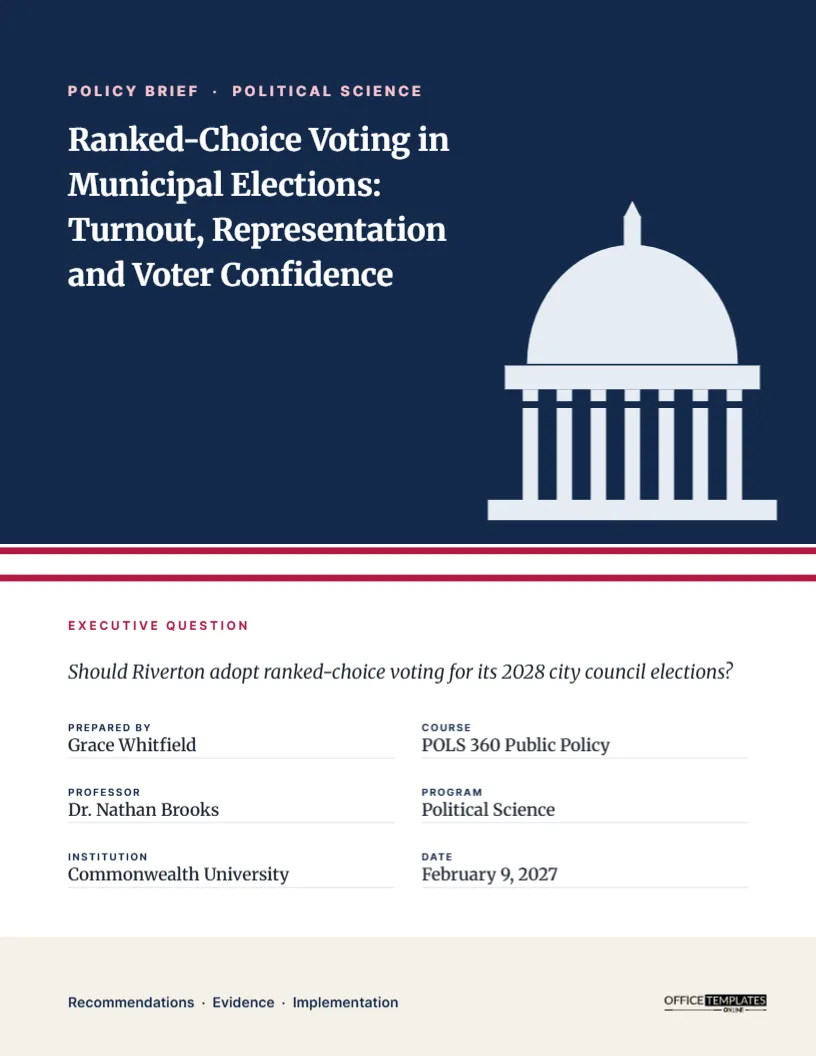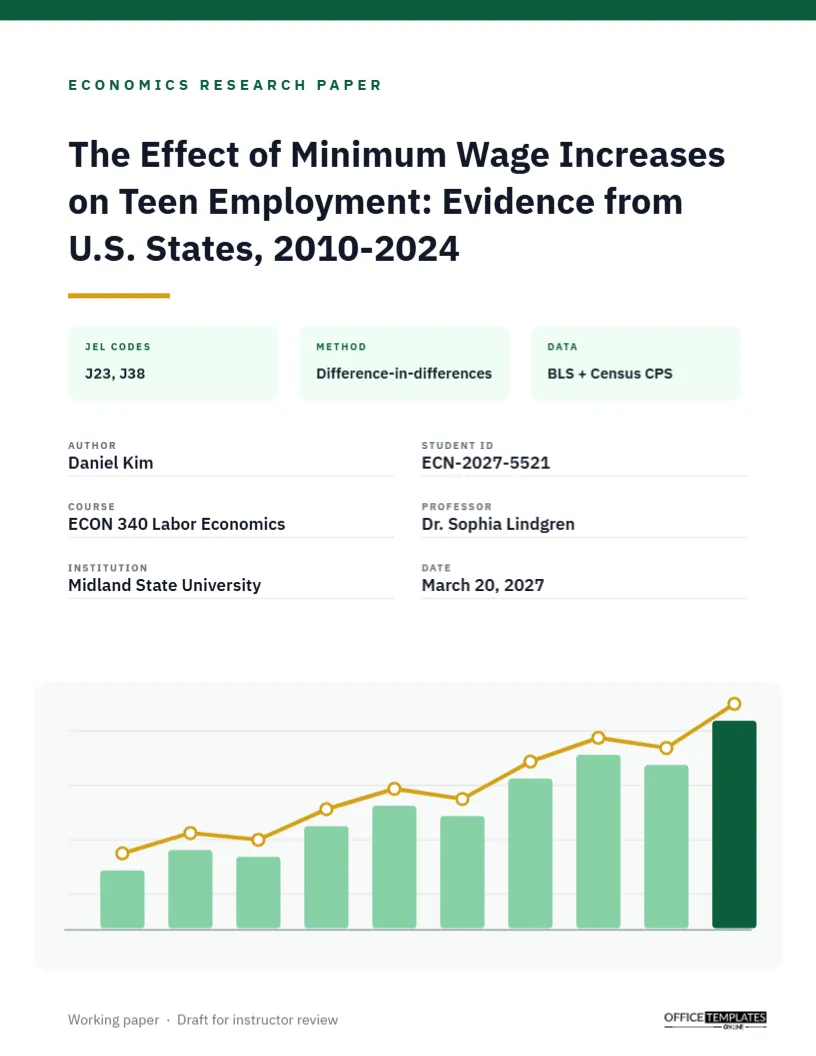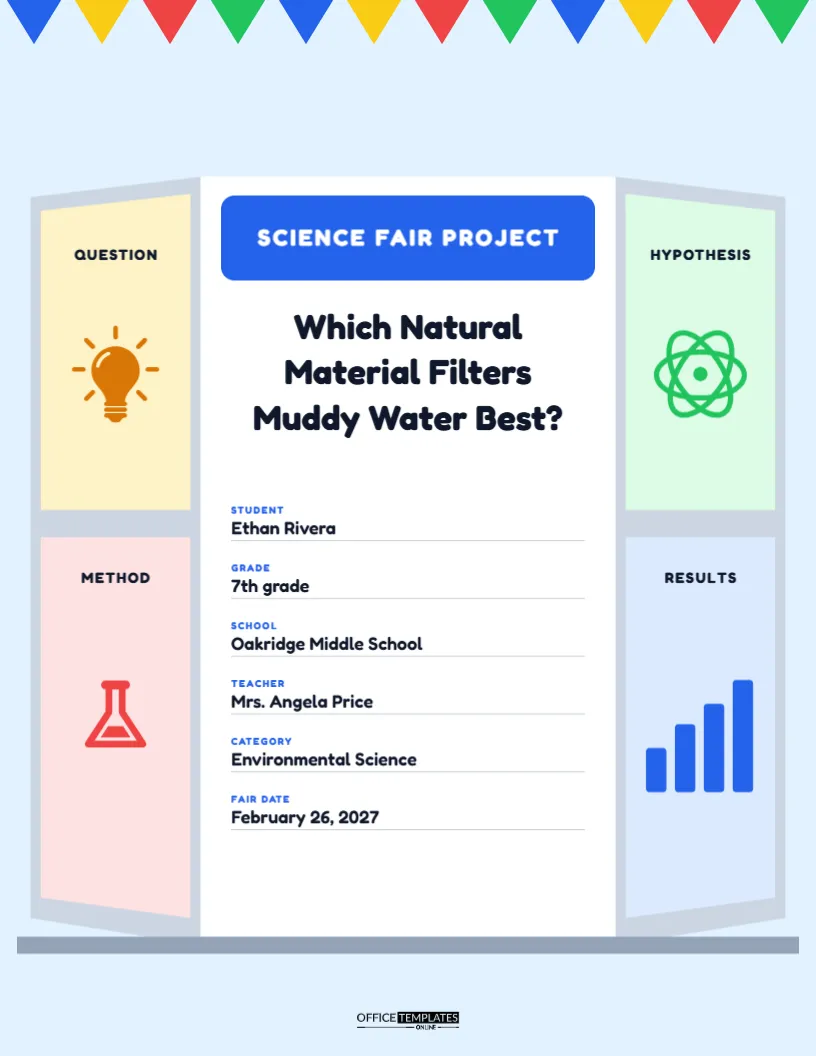
Every science fair has the same scene: rows of tables, and on each one a tri-fold board with a title across the middle and panels for the question, hypothesis, method, and results. This cover recreates that board on paper. It is a cheerful, colourful page for the written report that goes with a science fair project, from elementary school to middle school and early high school. It also teaches the scientific method at a glance, because each side panel is labelled with one of its steps.
Bunting, a Tri-Fold Board and Four Panels
The background is a pale sky blue. A row of triangle bunting in blue, yellow, red and green runs across the top edge like a party banner at the fair. Below it stands a tri-fold display board: two grey side wings angled toward the viewer and a white centre panel, resting on a grey table edge. Each wing is split into two coloured panels. The top left panel is pale yellow with a light bulb and the word Question. The top right is pale green with an atom and Hypothesis. The bottom left is pale pink with a flask and Method. The bottom right is pale blue with a small bar chart and Results. In the centre panel, a blue banner reads Science Fair Project; the title, Which Natural Material Filters Muddy Water Best?, is set in friendly navy Fredoka, and six details sit below. The logo is centred under the board.
The Scientific Method on the Side Panels
The four panels follow the order judges expect to see on a real board:
- Question: what you wanted to find out. The bulb stands for the idea.
- Hypothesis: what you predicted would happen and why. The atom stands for scientific thinking.
- Method: the steps and materials you used. The flask stands for the experiment.
- Results: what happened, shown with data. The bar chart stands for measurements.
Your report will also need a background section, a conclusion, and sources, but these four ideas are the heart of any project. Keeping them on the cover helps young students remember the structure while they write.
Student Details on the Centre Panel
The six details are Student (Ethan Rivera), Grade (7th grade), School (Oakridge Middle School), Teacher (Mrs. Angela Price), Category (Environmental Science), and Fair date (February 26, 2027). Click each value to type your own. Science fairs organise projects into categories, so check your fair’s list. If two students worked together, write both names in the student line.
Turning a Topic Into a Testable Question
Judges reward questions that can be answered with an experiment and measured results. How do water filters work? is a research topic. Which natural material filters muddy water best? is testable: you can compare materials such as sand, gravel, and charcoal and measure how clear the water becomes. Good questions often start with Which, How does… affect…, or What is the effect of…. Make sure you can change one thing, measure another, and keep everything else the same.
Project Ideas by Category
| Category | Testable question | What to measure |
|---|---|---|
| Plant science | Does music affect how fast bean seeds sprout? | Days to sprout, stem height |
| Chemistry | Which household liquid dissolves an eggshell fastest? | Time and mass lost |
| Physics | How does ramp height affect how far a toy car rolls? | Distance in centimetres |
| Environmental science | Which natural material filters muddy water best? | Water clarity score |
| Behavioural science | Do people remember words better with pictures? | Number of words recalled |
| Engineering | Which paper bridge design holds the most coins? | Coins before collapse |
Writing a Fair Title That Gets Noticed
Science fair titles can be playful, but the best ones still say what the project tests. A question title like the sample works well because it invites curiosity. Catchy alternatives are fine if a subtitle explains them: Dirty Water Detectives: Testing Natural Filters. Keep the title short enough for three lines on the centre panel, and use the same title on your report, your board and your registration form.
Recolouring Panels and Icons
The board, wings and panels are one group, so the board stays in shape. Ungroup it to change panel colours, or to make the wings a bright cardboard colour like a real board. The four icons are editable vectors; recolour them from their swatches to match. The bunting is a separate group and can be switched to your school colours. For a more grown-up look in high school, choose deeper colours and keep the layout.
Tips for Parents and Teachers
Science fair projects work best when the student leads, and adults support. Help with safety, shopping for materials, and keeping a timeline, but let the student choose the question and write the report in their own words. A lab notebook, even a simple one with dated entries, makes the report much easier to write and impresses judges. Encourage at least three trials of each test, so the results are more reliable.
Safety Rules Judges Check
Most science fairs have rules about chemicals, heat, animals, people, and mould. Experiments involving human subjects, vertebrate animals, or potentially hazardous materials often need approval forms before the experiment starts. Check your fair’s rulebook early. If your project used safety equipment such as goggles or gloves, mention it in your method; judges like to see careful work.
Printing at Home or School
The page is US Letter, 8.5 x 11 inches, with light colours that print well on any home inkjet. Save the page with Download As PDF and print it without scaling. You can also print an extra copy to tape to your display board as a mini version of your title area.
Science Fair Cover FAQ
Can I use this for an elementary school science project?
Yes. Change Grade to the child’s grade and keep the bright colours.
What if my project is an engineering design, not an experiment?
Rename the panels to Problem, Design, Build and Test, and Results.
Can I add a photo of my experiment?
Add it inside the report. If you want one on the cover, place a small photo in the white centre panel below the details.