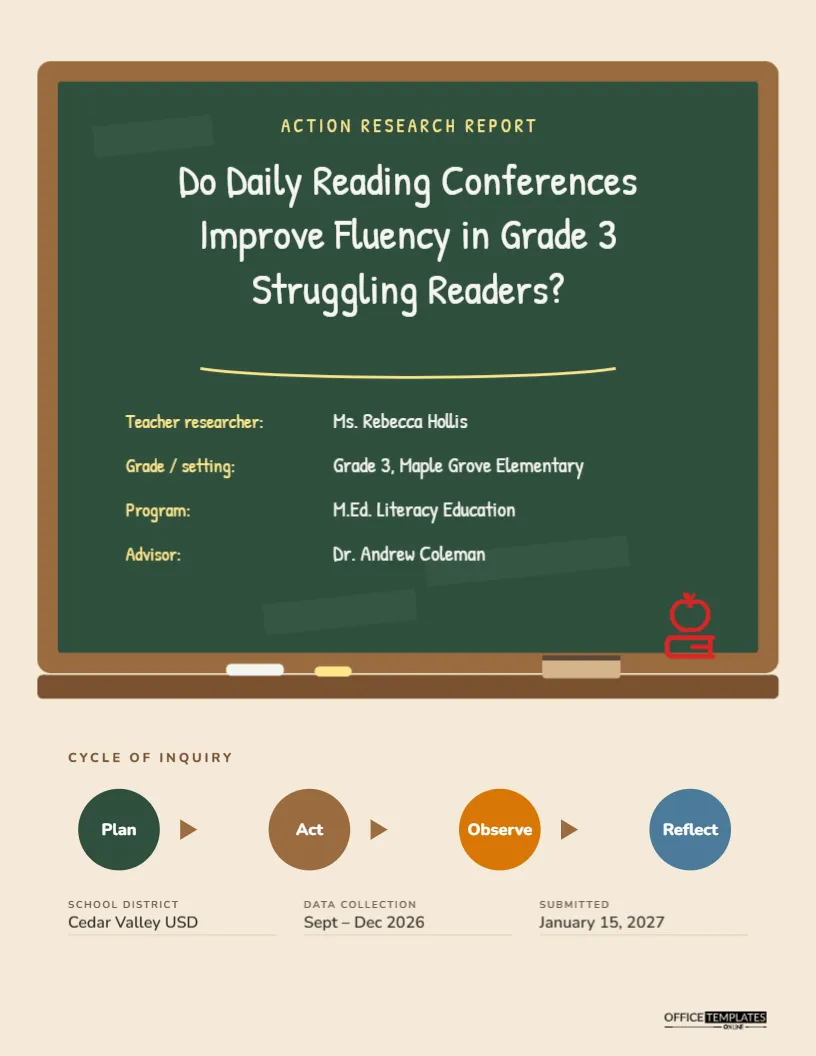
Action research is research by teachers, for teachers. You notice a problem in your own classroom, try a change, collect evidence, reflect, and try again. M.Ed. programs, teacher credential courses, and school professional development schemes all ask for action research reports, and many teachers write one while working full-time. This cover speaks your language: a green chalkboard in a wooden frame, your research question written in chalk, an apple on the chalk tray, and the four-step cycle of inquiry printed underneath.
A Classroom Chalkboard as the Cover
The page is a warm cream. A large chalkboard fills the upper half, its dark green surface surrounded by a honey-brown wooden frame, with faint lighter smudges where chalk has been wiped away. At the top of the board, small yellow chalk letters read Action Research Report, and your question is written in large white Patrick Hand, a handwriting font that looks like neat chalk: Do Daily Reading Conferences Improve Fluency in Grade 3 Struggling Readers?. A yellow chalk swoosh underlines it. Four details follow on the board, labels in yellow chalk and values in white. A darker wooden tray runs along the bottom of the board with sticks of white and yellow chalk and a felt eraser, and a red apple sits at the right end. Below the board, a Cycle of Inquiry row shows four coloured circles, Plan, Act, Observe and Reflect, joined by small arrows. Three more details and the logo complete the page.
Your Research Question Belongs on the Board
Action research reports usually take their title from the research question, and a question looks right in chalk. Good action research questions are specific to your setting, focus on something you can change, and name a measurable outcome. The sample, Do Daily Reading Conferences Improve Fluency in Grade 3 Struggling Readers?, names the intervention (daily reading conferences), the outcome (fluency), and the students (grade 3 struggling readers). Keep yours to about fifteen words so it fits on three lines.
Examples of Classroom Questions
| Grade band | Focus | Example research question |
|---|---|---|
| Kindergarten | Behaviour | How does a visual schedule affect transition times in my kindergarten class? |
| Elementary | Mathematics | Do number talks improve mental math strategies in Grade 4? |
| Middle school | Engagement | How does student choice in reading affect homework completion in Grade 7? |
| High school | Writing | Does peer feedback with a rubric improve argumentative essays in Grade 10? |
| Special education | Independence | How do self-monitoring checklists affect on-task behaviour for students with ADHD? |
| English learners | Vocabulary | Do sentence frames increase academic talk among newcomer ELL students? |
The Cycle of Inquiry Row
Below the chalkboard, four coloured circles show the action research cycle: Plan (green), Act (brown), Observe (amber) and Reflect (blue). It reminds readers, and you, that action research is cyclical; a good report shows at least one full turn of the cycle and often plans the next. The row is one group, so it stays evenly spaced. If your program uses a different model, such as Identify · Plan · Act · Evaluate · Share or the Look · Think · Act model, ungroup it and edit the words or add a circle.
Details on the Board and Below It
On the chalkboard: Teacher researcher (Ms. Rebecca Hollis), Grade/setting (Grade 3, Maple Grove Elementary), Program (M.Ed. Literacy Education), and Advisor (Dr. Andrew Coleman). Below the cycle: School district (Cedar Valley USD), Data collection (Sept – Dec 2026), and Submitted (January 15, 2027). Click any text to edit it. If your report is for school professional development rather than a degree, change Program to PD program or Professional learning community.
Keeping Your Pupils Anonymous
Action research involves your own students, so privacy is essential. Do not name students or include photos of their faces on the cover or in the report. Use pseudonyms or codes such as Student A. Many districts require approval before teachers collect data for a university assignment, and universities often require ethics review. Note the approvals in your methods section. You can also keep the school name general, such as a suburban elementary school, if your district prefers it.
Data Teachers Commonly Collect
Action research rarely needs complicated statistics. Useful evidence includes running records and fluency scores, exit tickets, student work samples scored with a rubric, short surveys, behaviour tallies, observation notes, and your own reflective journal. Mixing two or three sources, a practice called triangulation, makes your conclusions stronger. The data collection dates on the cover tell your advisor how long the intervention ran; four to eight weeks is common for one cycle.
Recolouring the Board and Apple
The chalkboard can become a blackboard by changing its green to charcoal; the white and yellow chalk text works on both. The wooden frame can become light maple or dark walnut. The apple is an editable vector, so you can change it from red to green from its swatches. The chalk sticks and eraser on the tray are grouped with it; ungroup to move or recolour them.
Sharing Your Findings With Colleagues
Action research is meant to improve practice beyond one classroom. Many teachers present their findings at a staff meeting or district showcase. Download the cover as a PNG to open your slide deck, and keep the same title on your handout. Colleagues instantly recognise the chalkboard, and the inquiry cycle gives you a simple structure for a ten-minute talk.
Printing the Chalkboard Cover
The page is US Letter, 8.5 x 11 inches. The dark green board uses a fair amount of ink, so a laser printer is best for printed copies. Download as a PDF to submit to your program’s portal. Chalk-style fonts print clearly at the sizes used here.
Teacher Research Cover FAQ
Can I use this for a lesson study or teaching portfolio?
Yes. Change the label to Lesson Study or Teaching Portfolio.
Is Patrick Hand easy to read for long titles?
Yes, at the size on the board. For very long titles, reduce the size slightly rather than switching fonts.
What if I teach high school or college?
The chalkboard suits any level. Change the grade details and keep the cycle.