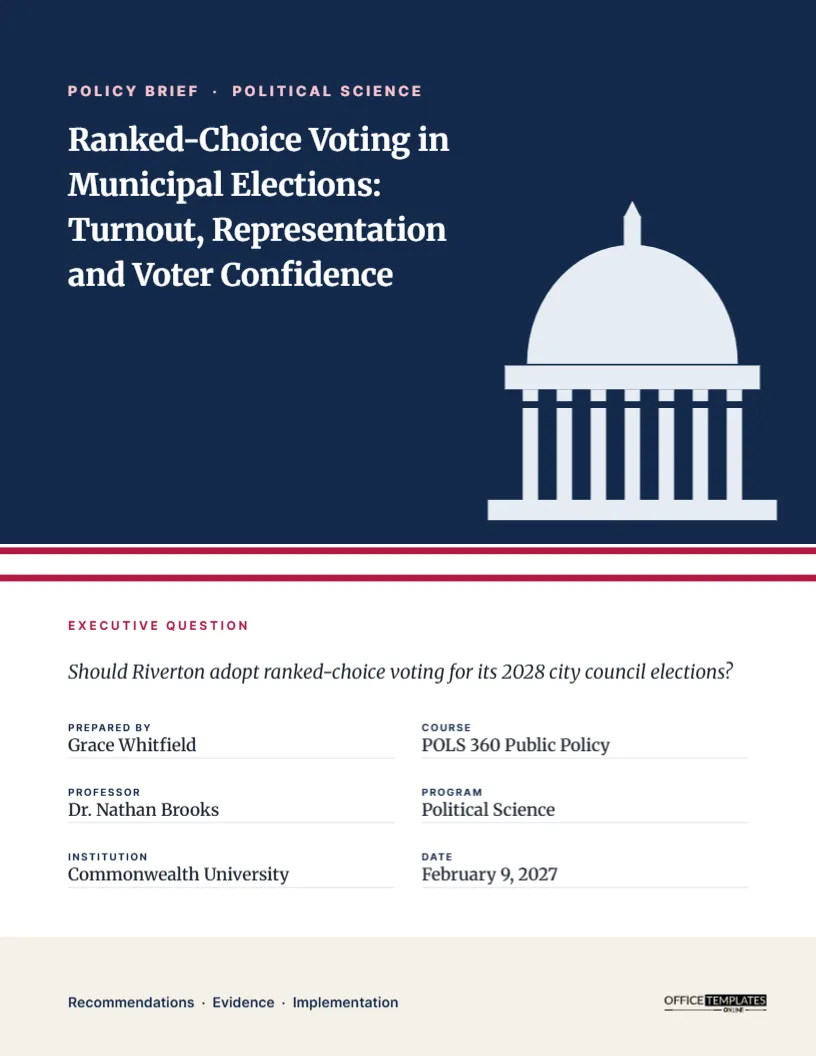
Policy writing is written for decision makers. A city council member, a legislative aide, or an agency director has minutes, not hours, and a policy paper must tell them immediately what decision is at stake. Political science and public policy courses train students to write that way, and this cover is designed to support the habit. The top half is a navy panel with a capitol dome, the symbol of government; a red and white stripe band separates it from the white lower half, where the executive question is stated in one sentence before any details.
Government Blue and a Capitol Dome
The upper half of the page is a deep navy. On the right, a pale capitol building is drawn in simple shapes: a dome with a small spire, a pediment band, a row of seven columns and a wide base. On the left, a soft pink label reads Policy Brief · Political Science, and the title, Ranked-Choice Voting in Municipal Elections: Turnout, Representation and Voter Confidence, runs in white Merriweather, a sturdy serif designed for reading on screens. Below the navy panel, three thin stripes, red, white and red, run across the page like bunting. The white lower half starts with a red label, Executive Question, and the question itself in italics. Six details follow in two columns, and a cream footer band lists the brief’s three parts, Recommendations · Evidence · Implementation, beside the logo.
One Question for a Busy Decision Maker
The executive question is the heart of a policy paper. It should name a decision, a decision maker, and a time frame. The sample reads: Should Riverton adopt ranked-choice voting for its 2028 city council elections? Everything in that sentence is concrete. Compare it with Is ranked-choice voting good?, which is a debate topic, not a policy question. Write yours so that a reader could answer it with yes, no or a clear option.
Policy Questions by Level of Government
| Level | Decision maker | Example executive question |
|---|---|---|
| City | City council | Should the city replace minimum parking requirements with parking maximums downtown? |
| County | Board of supervisors | Should the county fund a mobile crisis response team instead of police for mental health calls? |
| State | State legislature | Should the state adopt automatic voter registration through the DMV by 2028? |
| Federal | Congress or an agency | Should the FTC require age verification for social media platforms? |
| International | Foreign ministry | Should the government join a regional carbon border adjustment scheme? |
Details for Course or Internship Briefs
The six details are Prepared by (Grace Whitfield), Course (POLS 360 Public Policy), Professor (Dr. Nathan Brooks), Program (Political Science), Institution (Commonwealth University) and Date (February 9, 2027). If you are writing the brief during an internship in a legislative office or think tank, rename the fields: Prepared for (the member or director), Office and Supervisor. Click each value to edit.
Structure of a Strong Policy Brief
- Executive summary: the question, your recommendation and the top two reasons, in one paragraph.
- Background: how the issue arose and what current policy does.
- Evidence: data and research on the problem and on the options, including results from places that tried them.
- Options: usually two to four realistic alternatives, including the status quo.
- Criteria: how options are compared, such as cost, effectiveness, equity and political feasibility.
- Recommendation: one option, stated clearly.
- Implementation: steps, timeline, costs and risks.
The cover’s footer line summarises the parts decision makers read first. Edit it if your brief has a different structure.
Writing a Neutral, Informative Title
Policy titles should inform rather than persuade. Ranked-Choice Voting in Municipal Elections: Turnout, Representation and Voter Confidence tells the reader the policy and the outcomes considered, without revealing the recommendation. That neutrality builds trust, especially with readers who may not share your view. Save your recommendation for the executive summary. Opinion pieces and op-eds can use persuasive titles; briefs generally should not.
Editing the Capitol and Stripes
The capitol building is a single group, so you can move or resize it as one. If your paper is about local government, you might prefer a city hall; you can ungroup the capitol and remove the dome to leave a classical building front. For papers about countries other than the United States, change the stripe colours to match a national flag, or use neutral navy and gold stripes. The navy panel can become burgundy, dark green, or charcoal; keep it dark for the white title.
Political Science Papers Beyond Policy
The design also suits other political science assignments: comparative politics papers, international relations essays, constitutional law analyses and campaign strategy memos. Change the label at the top, and use the executive question space for your research question instead. For example: Why did voter turnout among young adults rise in the 2018 and 2020 U.S. elections?
Staying Nonpartisan on the Cover
A policy paper’s credibility depends on fairness. Avoid party logos, campaign slogans and candidate photos on the cover, even when your paper discusses an election. The capitol and stripes represent government in general, not a party, which is why they work for papers across the political spectrum. If you add images inside your report, credit their sources and choose neutral ones.
Print and Screen Versions
The page is US Letter, 8.5 x 11 inches, the standard size for U.S. government documents. Policy briefs are often shared as PDFs by email, so Download As PDF is the main output. If you print it, the navy half prints best on a laser printer. For a presentation to a mock legislature or a class panel, download it as a PNG and use it as your title slide.
Policy Paper Cover FAQ
How long should a policy brief be?
Two to six pages is typical for a brief; longer policy analyses may run to twenty. The cover is the same either way.
Should I include my recommendation on the cover?
Generally no. Keep the cover neutral and put the recommendation in the executive summary.
Can I use this for Model UN position papers?
Yes. Change the label to Position Paper, the question to your committee’s topic, and the details to your country and committee.