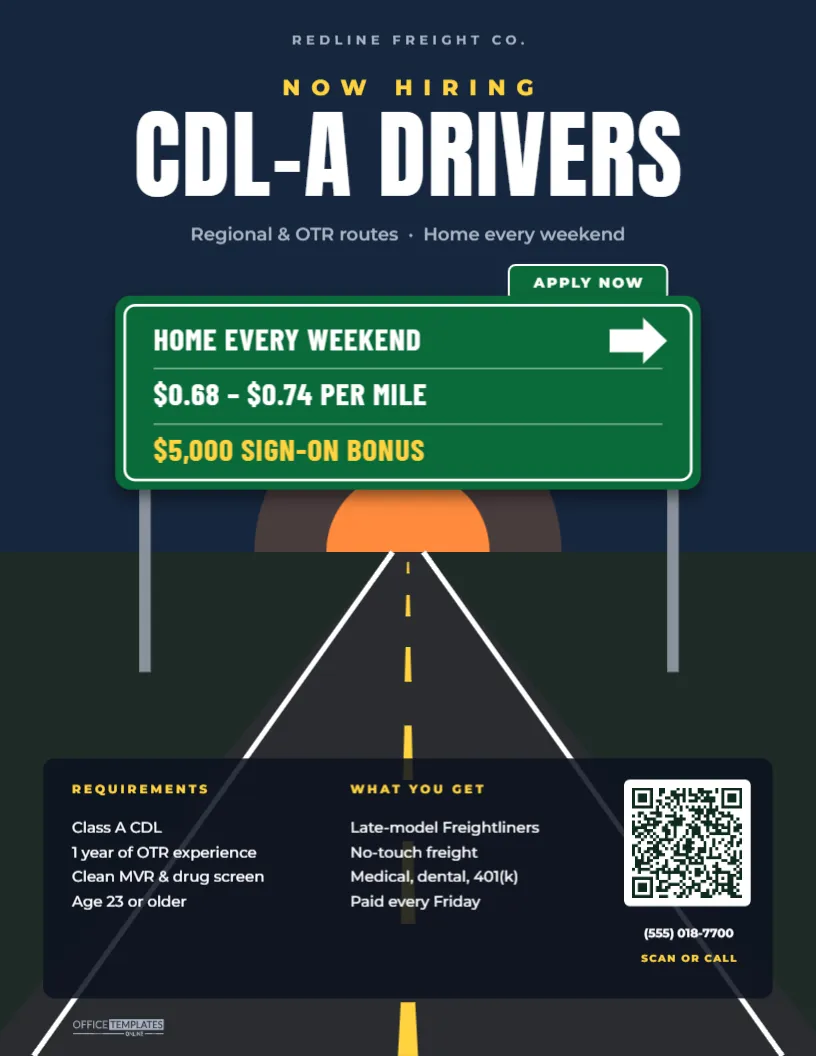
Truck drivers read road signs for a living, so this CDL Driver Hiring Flyer puts the offer on one. A dusk highway stretches toward the horizon under a setting orange sun, the yellow centre-line dashes widening as the road comes toward you, and an overhead green interstate sign spans the page with three lines: HOME EVERY WEEKEND, $0.68 – $0.74 PER MILE, and a $5,000 SIGN-ON BONUS. Above it, CDL-A DRIVERS in tall white capitals; below it, a dark card with requirements, benefits, a phone number and a QR code. It is built for trucking companies, private fleets, owner-operator programmes and freight brokers recruiting regional, OTR and dedicated drivers.
The Road and the Sign, Up Close
- Sky and sun: a deep dusk navy with a soft orange glow and a half-set sun sitting on the horizon between the sign’s posts.
- The highway: dark asphalt in perspective with white edge lines and yellow centre dashes that grow larger toward the bottom of the page, grouped as one object.
- Header: the carrier name, REDLINE FREIGHT CO., in small grey capitals, NOW HIRING in spaced yellow capitals, CDL-A DRIVERS in Anton and Regional & OTR routes · Home every weekend.
- The overhead sign: interstate green with a white border, three lines in a condensed highway-style typeface, a white arrow and thin dividers, with an APPLY NOW tab above its right corner like an exit tab.
- The info card: REQUIREMENTS (Class A CDL, one year of OTR experience, clean MVR and drug screen, age 23 or older), WHAT YOU GET (late-model trucks, no-touch freight, medical, dental, and 401(k), paid every Friday), and a QR code with the recruiting phone number.
It prints on a standard US Letter sheet (8.5 x 11 inches) in portrait orientation, the size most truck-stop boards and driver lounges accept.
Showing Drivers What a Week Is Worth
Cents per mile is the language of trucking pay, but drivers ultimately compare weekly take-home. Printing both is the most honest approach. Here is a simple example to help you decide what to put on the sign and in your recruiting conversations (numbers are illustrative; use your own averages):
| Item | Example | Notes |
|---|---|---|
| Average paid miles per week | 2,500 | Use your fleet’s real average for the lane |
| Rate per mile | $0.70 | Middle of the range on the sign |
| Mileage pay | $1,750 | 2,500 × $0.70 |
| Stop pay and accessorials | $100 | Extra stops, detention, layovers |
| Estimated weekly gross | $1,850 | Say average if you print a figure like this |
If your weekly average is strong, consider replacing one sign line with AVG. $1,800+/WEEK. Drivers respond to realistic figures and are wary of up-to numbers that only a few people ever reach.
Editing the Sign and the Requirements
- Carrier name: double-click REDLINE FREIGHT CO. at the top and type yours.
- Role and routes: change CDL-A DRIVERS to CDL-B, LOCAL DRIVERS or OWNER-OPERATORS, and update the routes line beneath.
- Sign lines: each line on the green sign is a separate text box. Keep them short, in capitals, like a real road sign: HOME DAILY, DEDICATED LANES, $0.72 PER MILE, PAID ORIENTATION.
- Requirements: edit the list to match your insurance and safety policies (experience, age, record). Be exact; drivers who do not qualify will not waste a call.
- Benefits: list what matters on the road: equipment age, freight type, pay schedule, home time, pet or rider policies.
- QR code and phone: select the code and paste your application link in its options panel. The editor can also make a phone-call QR code if you prefer drivers to ring a recruiter.
- Colours: the sign green, sky, and yellow dashes can all be recoloured; keep the sign green for instant recognition.
Home Time: The Line Drivers Read First
Ask experienced drivers what they want most from a new carrier, and home time usually comes before pay. That is why HOME EVERY WEEKEND takes the top line of the sign, next to the arrow. Be precise about what it means: 34 hours at home from Friday evening, a guaranteed reset every weekend, or home every other weekend on longer lanes. Local and dedicated routes can go further with HOME DAILY. If your fleet offers a specific home-time policy, such as home 2 nights a week for regional runs, use those exact words, because drivers compare them directly between recruiters. Drivers with families will often choose predictable home time over a slightly higher rate per mile, and they tend to stay longer when the promise on the sign is kept on the road.
Where Drivers Will Actually See It
A printed flyer works where drivers stop: truck stops and travel centres, driver lounges, fuel islands, CDL training schools, weigh-station noticeboards where allowed, and your own terminal’s drivers’ room for referrals. Online, share the PNG in trucking groups and on job boards that accept images. A clear, road-sign style image stands out in a feed of text-heavy trucking ads.
Keeping Recruiting Claims Accurate
Trucking ads are regulated by the same truth-in-advertising principles as any other job posting, and experienced drivers are quick to spot exaggerated claims. Make sure the sign-on bonus terms (payment schedule, minimum service period) are explained by your recruiters, that home every weekend is true for the lane you are hiring for, and that any pay range reflects what drivers in that position really earn. Honest flyers bring in drivers who stay, which lowers turnover and recruiting costs over time.
Printing a Dark Dusk Design
Print from the PDF download on bright white paper. The design is mostly dark, so a laser printer or a print shop will give smoother results than an inkjet across the sky and asphalt. For truck-stop noticeboards, laminate the flyer so it survives handling and weather. A larger 11 x 17 inch version makes a good poster for a terminal wall or a CDL school hallway.
Driver Recruiter Questions
Can I show several routes on one flyer?
Use the sign for your strongest offer and list the other routes in the requirements card, or make one version per route with Add Page, which makes tracking responses easier.
Can I add a truck photo?
You can add a photo of your equipment from the editor and place it on the road area, above the dark card. Late-model trucks are a real selling point.
Is “Age 23 or older” required?
It is only an example. Use your own insurance requirement; many carriers hire from 21, and some intrastate roles from 18.
Open the template, put your real mileage rate and home time on the sign, point the QR code at your application, and get it up at the next truck stop on your lane.