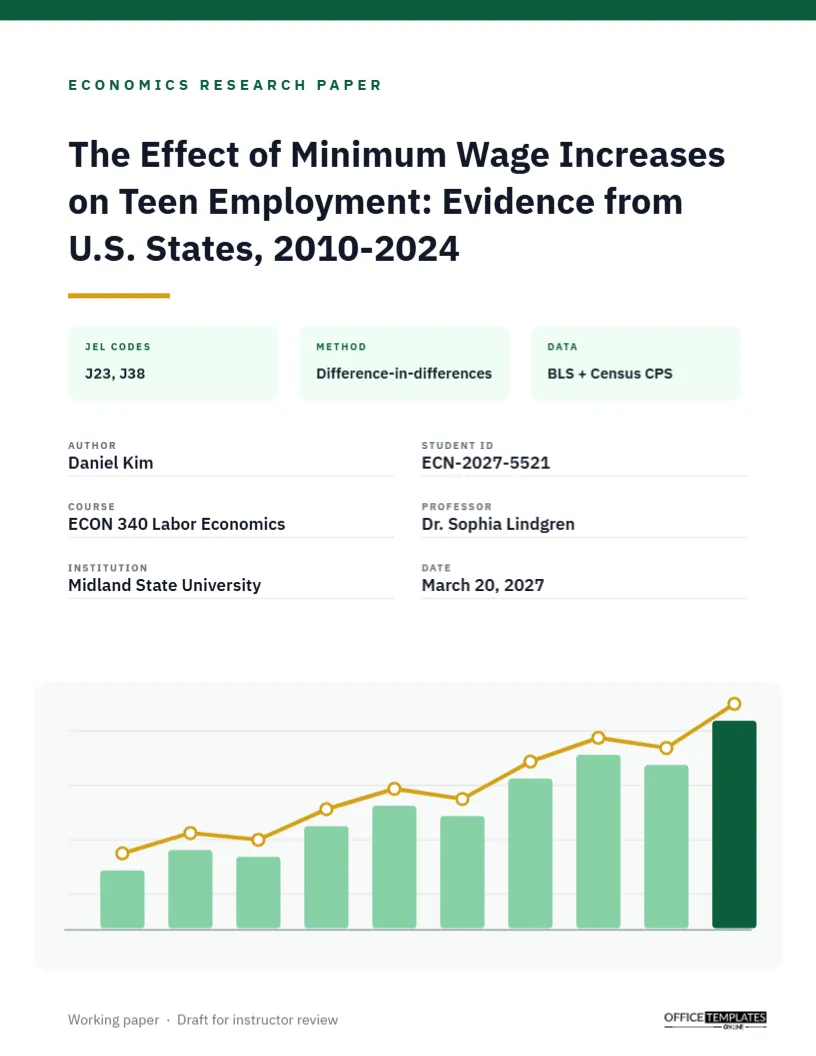
Economists like papers that get to the point. A good economics paper states its question in the title, says how it answers it, and names its data. This cover follows the same habits. Under a precise title, three small chips list the JEL classification codes, the empirical method, and the data sources. The bottom of the page is a rising bar chart with a gold trend line, the most familiar picture in economics. It looks like the first page of a working paper from a research department, which is exactly the impression an economics student wants to make.
The Look of a Working Paper
A dark green bar runs across the top edge of a white page. A green label reads Economics Research Paper, and the title, The Effect of Minimum Wage Increases on Teen Employment: Evidence from U.S.States, 2010-2024, is set in bold IBM Plex Sans, a typeface designed for technical documents. A short gold rule follows. Three pale green chips list JEL codes, method, and data. Six details sit in two columns. The lower third of the page is a soft grey-green panel holding a chart: ten bars rising from light green to a final dark green bar, with a gold line and gold-ringed points tracing the trend. A footer note, Working paper · Draft for instructor review, sits beside the logo.
What JEL Codes Are and How to Pick Them
The Journal of Economic Literature (JEL) classification system assigns codes to fields of economics. Journals and working-paper series ask authors to list two or three. Including them on your cover shows you know the conventions of the field. Codes start with a letter for the broad field and add digits for specific topics. The sample lists J23 (Labor Demand) and J38 (Wage Policy), both in the labor economics group. Look up the full list on the American Economic Association’s website and choose the codes closest to your question.
Common JEL Codes for Student Papers
| Code | Topic | Example paper |
|---|---|---|
| E31 | Price level, inflation | Inflation expectations after the 2021 price surge |
| F14 | Empirical studies of trade | Tariffs and U.S. steel imports |
| I21 | Analysis of education | Class size and test scores |
| J23 | Labor demand | Minimum wages and teen employment |
| Q54 | Climate, natural disasters | Hurricanes and local house prices |
| R31 | Housing supply and markets | Zoning reform and rents |
Naming Your Method and Data
The second chip names the empirical method: Difference-in-differences. Others you might write are OLS regression, Instrumental variables, Regression discontinuity, Panel fixed effects, Event study, or Descriptive analysis. The third chip names the data: BLS + Census CPS. Use short forms that economists recognise, such as BLS (Bureau of Labor Statistics), CPS (Current Population Survey), FRED (Federal Reserve Economic Data), World Bank WDI, or IPUMS. Your full data section will give details; the chip just signals credibility. Mention the sample period and unit of observation in that section too; for example, state-quarter observations, 2010Q1-2024Q4, because readers of economics papers look for them immediately.
Titles That Say Effect, Setting and Period
Economics titles often follow the pattern The Effect of X on Y: Evidence from Z. It is plain but effective: X is the cause, Y the outcome, Z the setting and period. The sample title follows it exactly. If your paper is theoretical, a title such as A Model of Price Discrimination in Two-Sided Platforms fits better. Avoid titles that claim a causal effect if your method only shows correlation; instructors notice.
Author Details in Two Columns
The details are Author (Daniel Kim), Student ID (ECN-2027-5521), Course (ECON 340 Labor Economics), Professor (Dr. Sophia Lindgren), Institution (Midland State University), and Date (March 20, 2027). Click any value to edit. For a senior thesis, rename Course to Thesis advisor and add the advisor’s name.
About the Chart at the Bottom
The bar chart is decorative, not your data. It is a group of shapes, so it is easy to restyle. Ungroup it to change bar heights so they fall, wobble, or rise to suit your story, for example, declining bars for a paper about falling labor force participation. The gold trend line is a single shape; delete it if you prefer bars alone. If you want a chart with your real numbers, add the editor’s own chart object to a later page of your report rather than the cover.
A One-Paragraph Abstract Habit
Economics working papers place a short abstract on the first page. If your instructor allows, you can add one under the details, about 60 to 80 words long: the question, the data and method, the main estimate with its size and the implication. Example: Using state minimum wage changes from 2010 to 2024 and a difference-in-differences design, I find that a 10% increase reduces teen employment by 1.2%, with larger effects in low-wage counties. Reduce the chart panel’s height to make room.
Colours for Other Economic Fields
Green suggests money and growth, which suits most economics topics. For a macroeconomics paper, navy and gold feel like a central bank report. For development economics, terracotta and sand suggest emerging markets. For environmental economics, keep the green and add a leaf icon from the editor library. Change the top bar, label, chips, bars, and labels together so the page stays unified.
Printing the Economics Cover
The page is US Letter, 8.5 x 11 inches, with mostly white space and light fills, so it prints economically on any printer. The fine gold line looks best on a laser printer. Download as a PDF and attach it to the front of your paper or submit it as page one of your PDF.
Economics Cover Questions
Do undergraduate papers need JEL codes?
Rarely required, but they show familiarity with the field. Delete the chip if your instructor finds them unnecessary.
Can I put a key finding on the cover?
Yes, in a short abstract as described above. Keep it factual and give the size of the effect.
Is this suitable for finance papers?
Yes. Change the label to Finance Research Paper and use codes from the G group, such as G12 or G32.