Gratitude is easier to feel than to practise. We know we should notice the good things, but the days blur together. A short daily journal page makes it a habit: a few minutes, a few lines, every evening or every morning through November. This Gratitude Journal Page gives you structure without pressure, with prompts that take five minutes and a little mood tracker to see how the practice changes your days.
The Prompts on the Page
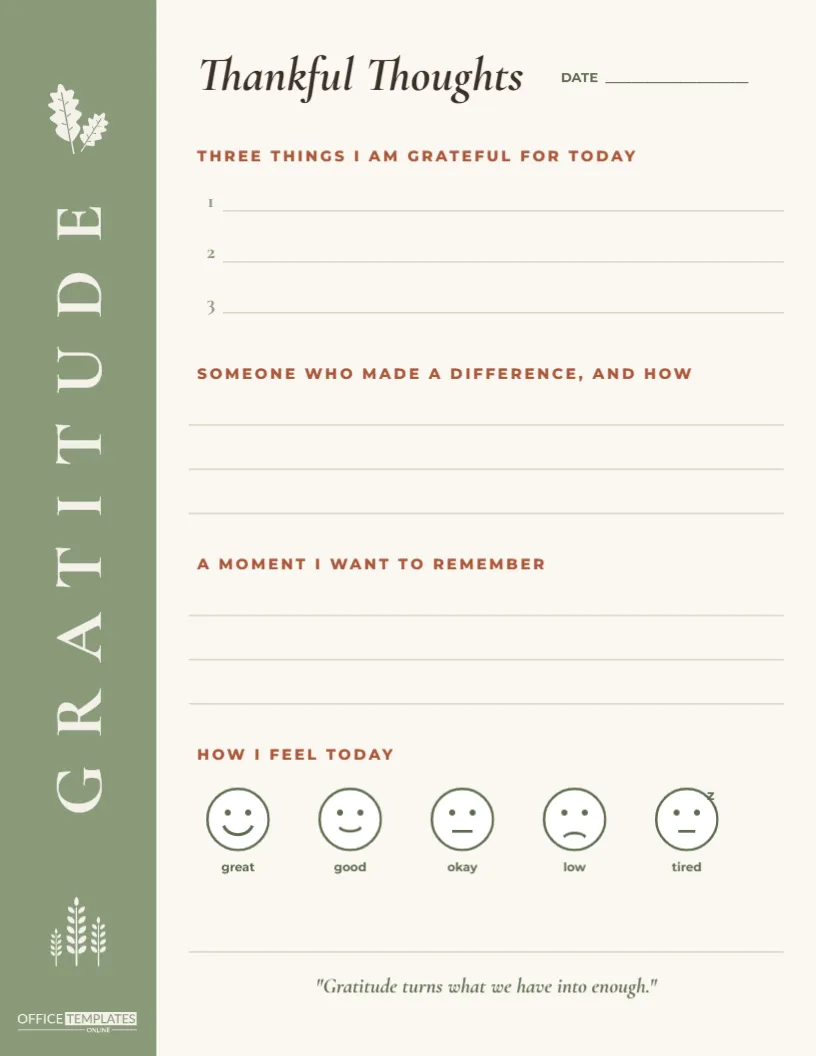
The page is built around four simple sections, each with ruled lines to write on.
Three things I am grateful for today
Three numbered lines. They can be tiny: a good cup of coffee, a call from a friend, the bus being on time. The point is to notice, not to impress.
Someone who made a difference, and how
Three lines to write about one person. Naming the person and what they did makes gratitude specific, and often reminds you to thank them.
A moment I want to remember
Three lines for a small scene from the day: a sunset, a child’s question, a laugh at dinner. Over a month, these become a quiet diary of good moments.
How I feel today
Five little faces drawn in a row, labelled great, good, okay, low, and tired. Circle one. Over time, you can see whether the practice lifts your mood.
A Calm, Sage-Green Design
The journal page is US Letter, 8.5 x 11 inches, portrait. A sage-green sidebar runs down the full left edge, with the word GRATITUDE set vertically in tall, widely spaced cream Cormorant Garamond letters, and a small leafy sprig at the top and a wheat sprig at the bottom, both in cream. The brand mark sits in a pale tint at the foot of the sidebar.
The main area is warm off-white. Thankful Thoughts is written at the top in italic Cormorant Garamond, with a DATE line on the right. Each section heading is in small-spaced terracotta capitals, the writing lines are soft grey, and the numbers for the three gratitude lines are in sage serif. At the bottom, a thin line and a short quote in italic serif close the page: Gratitude turns what we have into enough.
Building a Gratitude Habit Through November
A daily page works best with a little routine. These suggestions come from people who have kept the habit going:
- Pick a time. Many people write in the evening, reflecting on the day; others prefer the morning with coffee.
- Keep the pages together. Print a month’s worth, punch holes, and keep them in a binder or clip them to a board.
- Do not skip the small things. On hard days, the small things are the gratitude.
- Do not aim for perfect. Missing a day is fine. Start again tomorrow.
- Read back once a week. Sunday is a good day to look over the week’s pages.
Thanksgiving is a natural end point. Bring your month of pages to the holiday and share one or two favourite moments at the table if you feel like it.
Thirty Days of Extra Prompts
If you want a different angle each day, write one of these above the three lines. They work well with the page’s structure:
- A meal I enjoyed
- A sound I love
- Something I learned
- A place that feels like home
- A book, song, or film that helped me
- Someone who made me laugh
- A part of my body I am thankful for
- A challenge that taught me something
- A tradition I love
- Something in nature I noticed
Repeat and adapt them through the month, or ask family members to suggest prompts.
Customising the Journal Page
All of the section headings and the quote are editable text boxes. Change the headings to your own prompts, swap the quote for a favourite line, or replace Thankful Thoughts with your name. The sage sidebar is one shape, so changing its colour to dusty rose, slate blue, or warm terracotta takes a click. The two sprigs are editable vector icons that you can recolour from their swatches.
For a children’s version, enlarge the writing lines by removing one section, and replace the mood faces with their own drawings.
Printing the Page for a Month
Download the PDF and print as many copies as you need on regular paper, about thirty for a month. Choose a slightly heavier paper if you write with fountain pens or felt tips, so ink does not show through. Punch holes along the sage sidebar edge for a ring binder; the sidebar gives you a natural margin for the holes.
Choosing a Pen and a Quiet Spot
A favourite pen and a regular spot make the habit stick. Keep the binder by your bed or the coffee maker, with a pen clipped to it, so writing takes no effort to start. Soft pencil and fine felt pens both show nicely on the grey lines.
Using the Page with Others
Gratitude journals are popular in classrooms, therapy groups, workplaces and youth programmes. Print a stack for a group and spend the first five minutes of a meeting writing. Couples and families sometimes fill a page together at dinner, each adding one line to each section.
Turning a Month of Pages into a Keepsake
At the end of November, gather your pages and read them in one sitting. You will notice patterns: the same people showing up again and again, small pleasures you had forgotten, and hard days that still held something good. Bind the pages with a ribbon, add a cover with the year, and keep them with your family photos. It is a gentle way to remember a year from the inside.
Questions About the Thankful Thoughts Page
Do I have to fill every line?
No. Some days one line is all you have, and that is enough.
Can I use the page outside November?
Yes. Nothing on the page is tied to Thanksgiving, so it works all year.
Is the mood tracker scientific?
It is simply a quick way to notice how you feel each day. If your mood is often low, talking to someone you trust or a professional can help.
A few minutes of noticing the good can change the shape of a day. Print your pages, choose your time, and let November become a month of gratitude.